Toyota Prius 3rd Gen XW30 (2010-2015) Maintenance Schedule and Service Intervals

This is the maintenance schedule and associated service intervals for the Toyota Prius 3rd Gen XW30 (2010–2015). It applies to the third-generation Prius liftback introduced for the 2010 model year, built on Toyota’s redesigned hybrid platform using the Hybrid Synergy Drive system and a 1.8-liter Atkinson-cycle four-cylinder engine paired with an electric motor and planetary-type continuously variable transmission.
The hybrid system produces a combined output of 134 horsepower and allows the vehicle to operate using the gasoline engine, electric motor, or both together depending on driving conditions. The larger 1.8-liter engine introduced with this generation improves highway efficiency and allows the engine to run at lower average speeds during cruising, contributing to the Prius’ EPA combined rating of around 50 mpg.
The third-generation Prius also introduced a number of technical updates over the previous model. These include a lighter and more efficient hybrid transaxle, improved regenerative braking control, and an electric water pump and electric power steering system that eliminate accessory drive belts. These design choices reduce mechanical losses and simplify routine maintenance compared with conventional belt-driven systems.
Models that share the same mechanical basis include:
- Toyota Prius Liftback (2010–2015) – standard hybrid model using a nickel-metal hydride traction battery.
- Toyota Prius Plug-in Hybrid (2012–2015) – mechanically similar but equipped with a lithium-ion battery and external charging capability, allowing limited EV-only driving before reverting to hybrid operation.
Both variants use the same Hybrid Synergy Drive architecture and the same 1.8-liter Atkinson-cycle engine.
Across the 2010–2015 production run, the Prius XW30 remained mechanically consistent. Minor updates were introduced during the lifecycle (including trim changes and equipment updates), but the core hybrid powertrain, platform, and service requirements remained largely unchanged. These revisions do not materially affect the factory maintenance schedule.
Other Toyota Prius Model Maintenance Schedules:
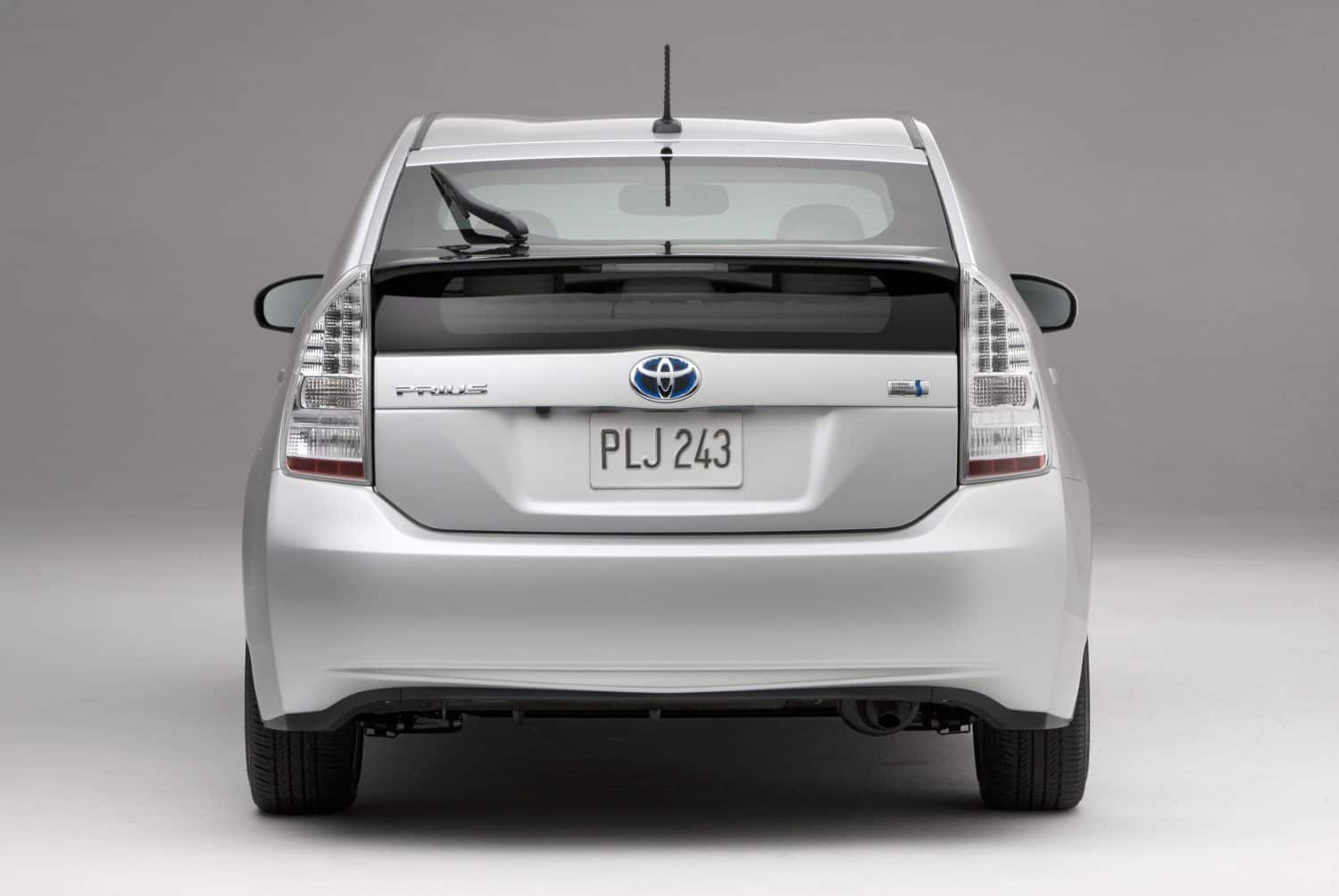
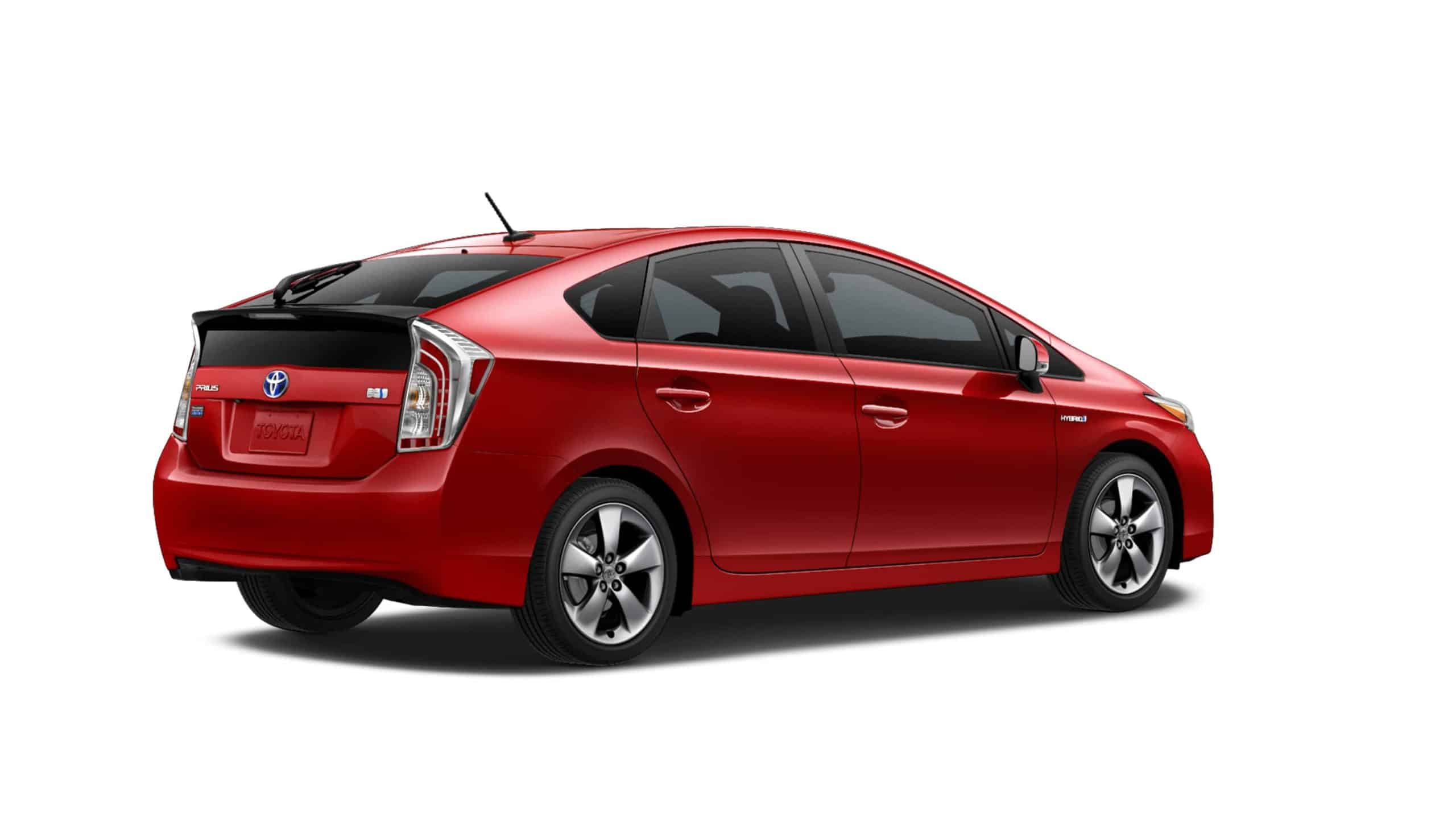
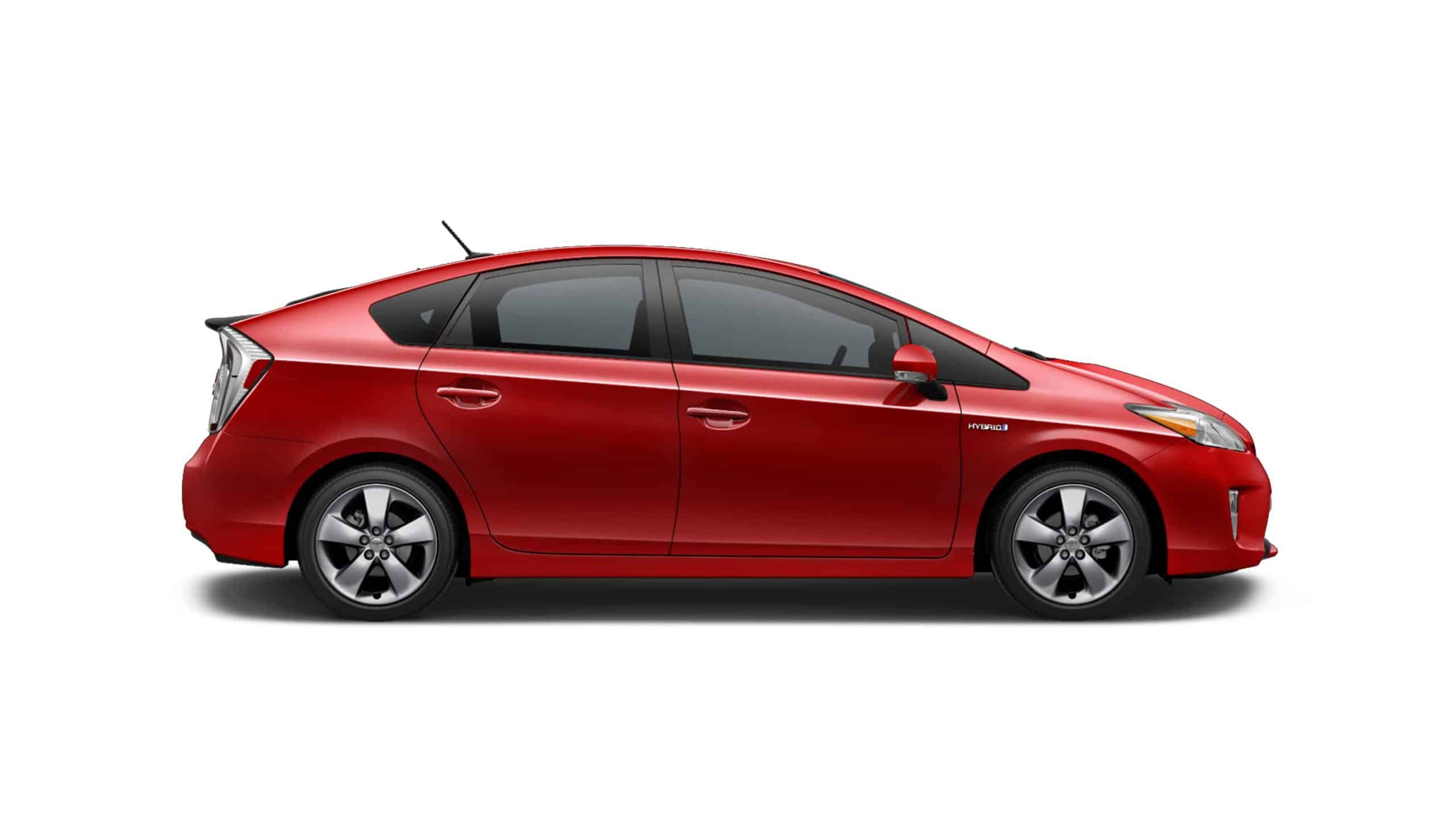

This site has links for things like oil and spark plugs from which we earn a commission (which unfortunately nobody can save, not even us). If you appreciate this work, then please use those links. Thanks!
Toyota Prius 3rd Gen XW30 (2010-2015) Service Intervals
The basic service interval for the Toyota Prius 3rd Gen XW30 (2010–2015) is every 5,000 miles / 8,000 km or 6 months. At each interval, check the schedule to see what items need inspection, adjustment, or replacement.
At the regular service interval:
- Inspect and adjust fluid levels
- Inspect wiper blades
- Rotate tires
- Visually inspect brake pads, discs, and brake components
- Confirm the driver’s floor mat is correctly installed
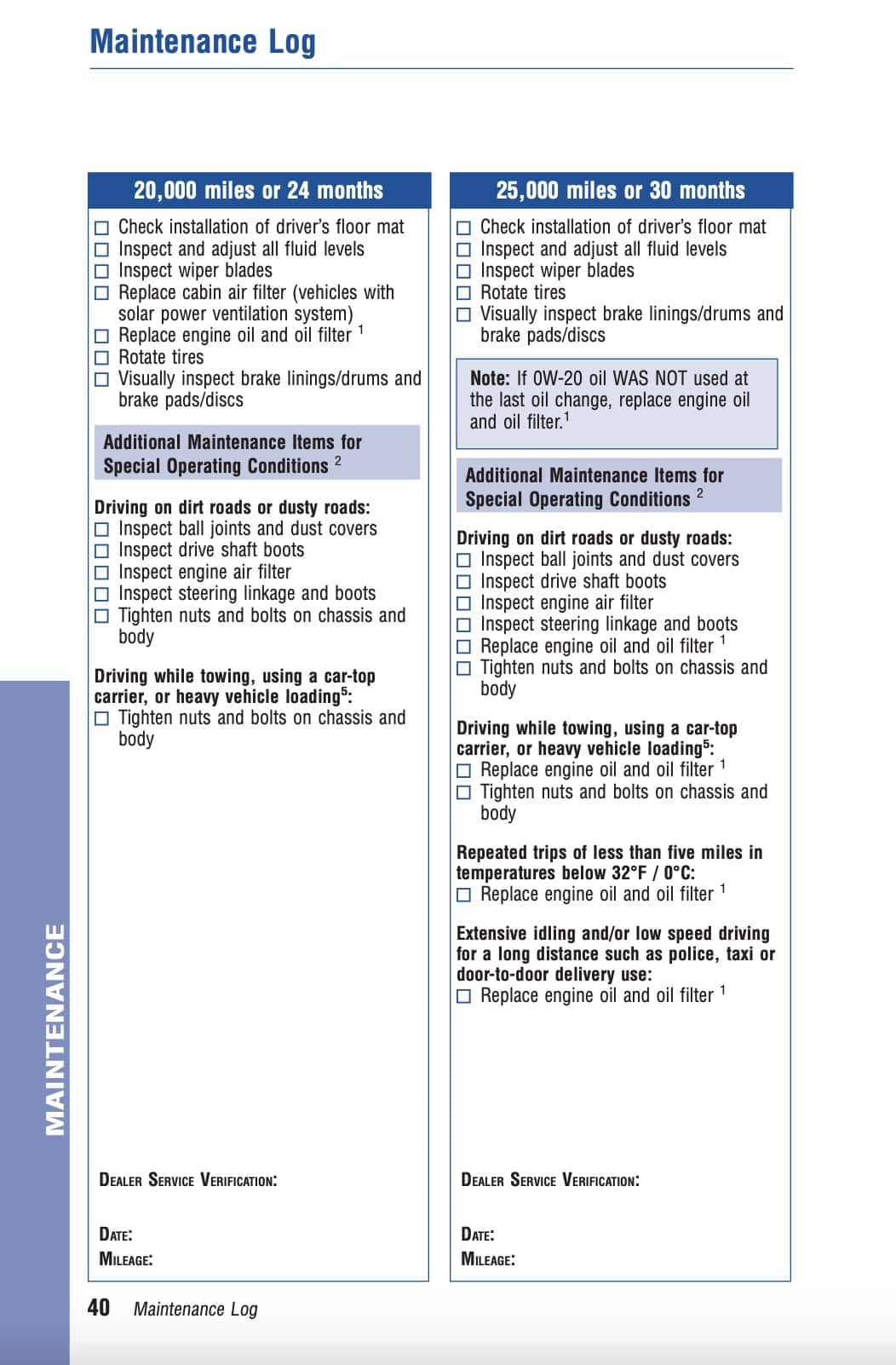
Every 10,000 miles / 16,000 km or 12 months, replace the engine oil and oil filter, and clean or replace the cabin air filter depending on equipment.
Every 30,000 miles / 48,000 km or 36 months, replace the engine air filter and perform a broader inspection of components including brake lines, suspension joints, steering components, cooling system, and drivetrain for leaks or wear.
Longer-term maintenance includes engine and inverter coolant replacement at 100,000 miles / 160,000 km, followed by additional replacements at specified intervals, and spark plug replacement at 120,000 miles / 192,000 km.
The Prius hybrid powertrain uses electric steering and an electric water pump rather than belt-driven accessories, which simplifies routine servicing compared with many conventional engines.
General Notes on Serviceability of the Toyota Prius 3rd Gen XW30 (2010-2015)
- The Toyota Prius 3rd Gen XW30 uses a 1.8 liter Atkinson cycle four cylinder engine paired with Toyota’s Hybrid Synergy Drive system. The gasoline engine and electric motor work together through a hybrid transaxle, so many traditional components such as a conventional starter motor or alternator are not present.
- The engine uses an electric water pump and electric power steering, and the powertrain does not use accessory drive belts. This reduces mechanical complexity and removes a common wear item that normally requires periodic replacement on conventional engines.
- The cooling system includes separate engine and inverter coolant circuits. Engine coolant replacement is scheduled at 100,000 miles / 120 months, and both cooling systems should be monitored for correct level and condition during routine service.
- The hybrid braking system combines conventional hydraulic braking with regenerative braking that recovers energy during deceleration. Because regenerative braking reduces mechanical brake usage, brake pads often wear more slowly than in conventional vehicles.
- Regular service still follows conventional inspection routines. Engine oil and filter changes, tire rotation, brake inspection, and air filter service remain the core maintenance items. Under severe conditions such as dusty roads, heavy idling, or frequent short trips, oil and filter replacement may be required more frequently.
Maintenance schedule for the Toyota Prius 3rd Gen XW30 (2010-2015)
This is the maintenance schedule table for the Toyota Prius 3rd Gen XW30 (2010–2015). It applies to the third generation Prius equipped with the 1.8 liter hybrid powertrain and Hybrid Synergy Drive system used during these model years.
The content comes directly from the official Toyota owner’s manual. The information has been reorganized so it is easier to read and follow. The items themselves are unchanged. The goal is simply to make it clearer which tasks occur at each service interval.
The schedule is divided into three parts:
- Regular maintenance: Every 5,000 miles or 6 months, whichever comes first.
- Periodic maintenance: Maintenance tasks that occur between 10,000 miles – 20,000 miles or 12 months – 24 months, whichever comes first.
- Long-term service intervals: Items that require attention at longer, sporadic intervals.
Where Toyota specifies different requirements based on oil type, driving conditions, or drivetrain configuration, those notes are included so the schedule can be followed accurately without referring back to the manual.
Regular Maintenance
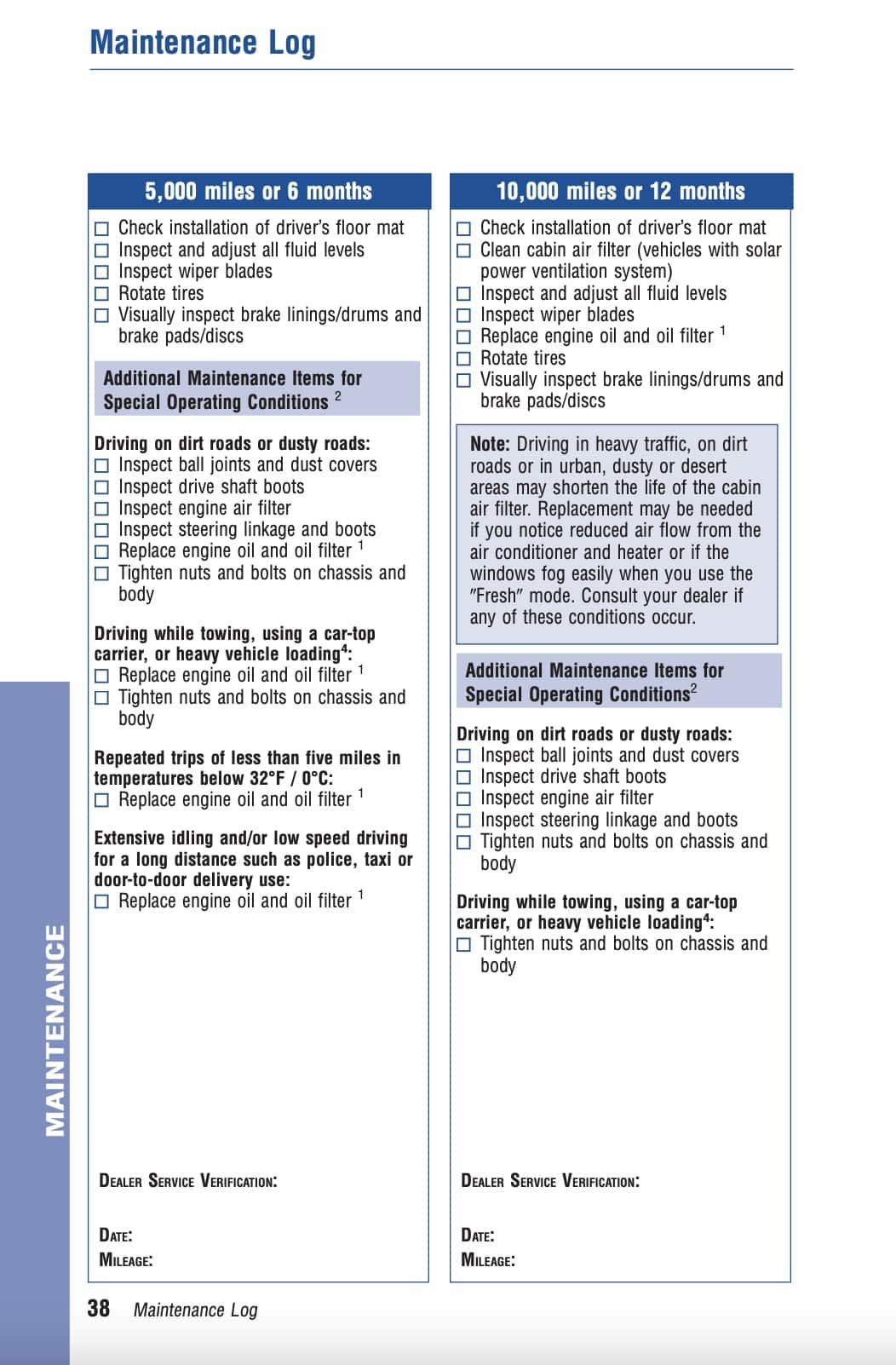
At every 5,000-mile or 6-month service, Toyota specifies a set of standard maintenance items for the Prius 3rd gen XW30. These are primarily inspections and routine checks rather than replacements, and they apply to all vehicles regardless of how they are driven.
| Toyota Prius 3rd Gen XW30 Regular Maintenance Items (Standard) |
|---|
| Check installation of driver’s floor mat |
| Inspect and adjust all fluid levels |
| Inspect wiper blades |
| Rotate tires |
| Visually inspect brake linings/drums and brake pads/discs |
Toyota also lists additional maintenance items for special operating conditions. These only apply if the car is regularly driven under certain conditions, such as frequent short trips, extended idling, heavy loads, or dusty environments. In those cases, some items move from inspection to replacement, most commonly engine oil and the oil filter.
If most of your driving is normal commuting and mixed highway use, the standard table is what you will follow. If your usage matches the special operating conditions Toyota describes, refer to the additional maintenance table and adjust accordingly.
| Maintenance Item | Dirt / dusty roads | Extensive idling / low speed driving | Repeated short trips below 32°F | Towing / heavy load |
|---|---|---|---|---|
| Inspect ball joints and dust covers | ✓ | |||
| Inspect drive shaft boots | ✓ | |||
| Inspect engine air filter | ✓ | |||
| Inspect steering linkage and boots | ✓ | |||
| Replace engine oil and oil filter | ✓ | ✓ | ✓ | ✓ |
| Tighten nuts and bolts on chassis and body | ✓ | ✓ |
Periodic Maintenance
In addition to completing all items listed under Regular Maintenance (5,000 miles / 6 months), also perform the following periodic maintenance tasks for the Toyota Prius 3rd Gen XW30.
Periodic maintenance items occur between 10,000 and 20,000 miles, or 12 to 24 months, whichever comes first. These services introduce the first scheduled replacements rather than inspections, and they build on the regular maintenance rather than replacing it.
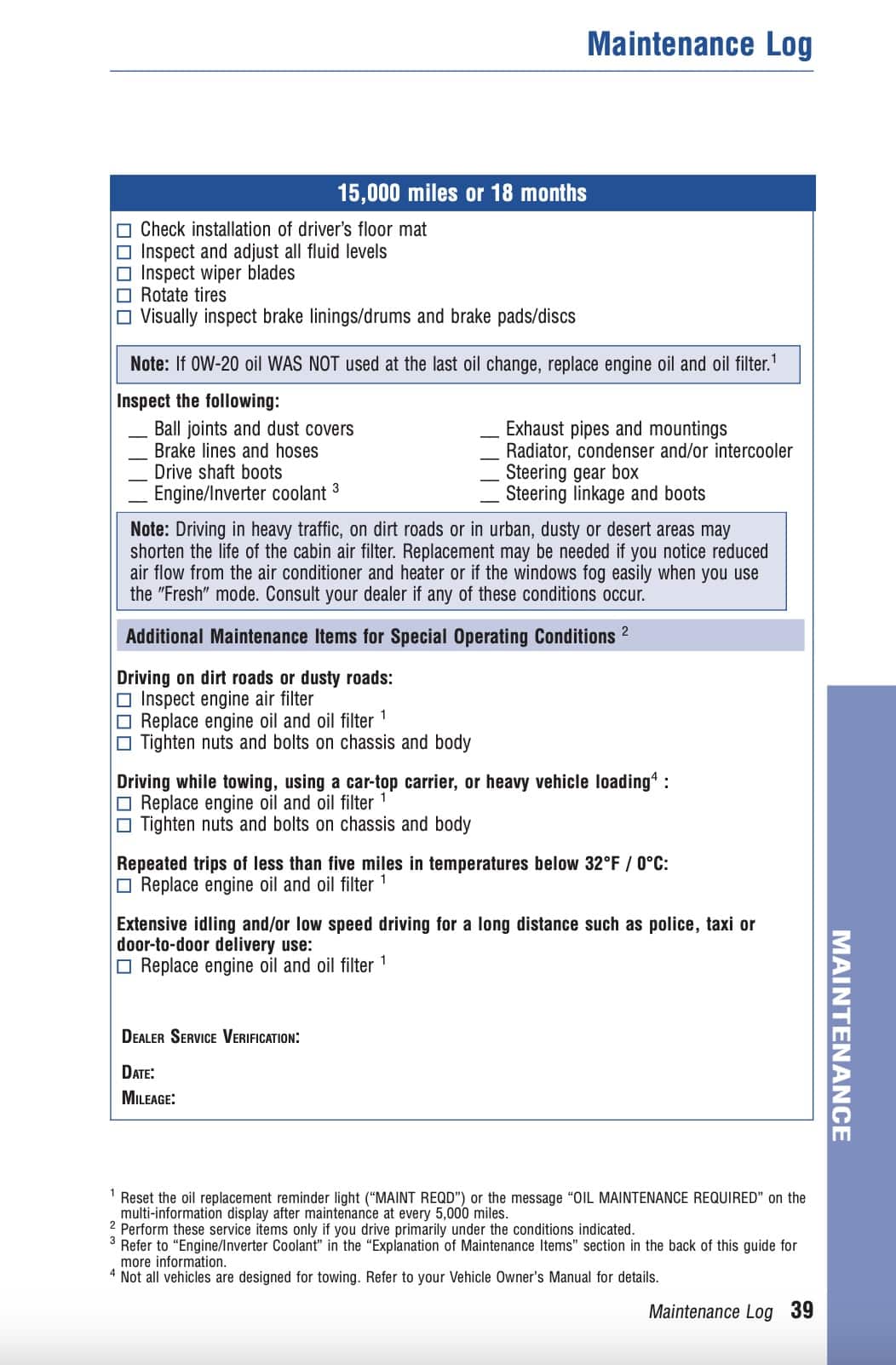
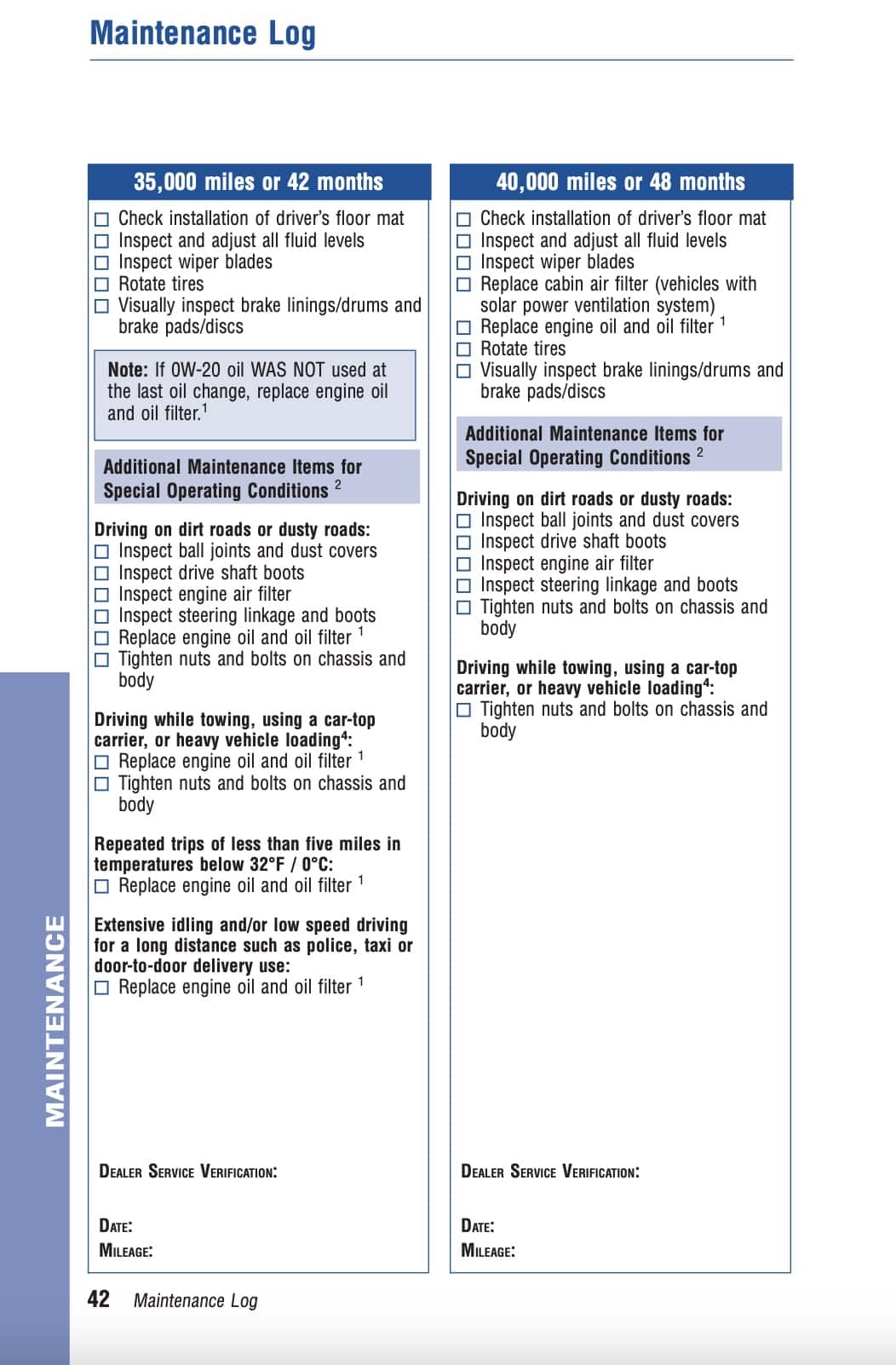
Special note: If 0W-20 oil is used, the engine oil and filter are replaced every 10,000 miles or 12 months. If 0W-20 was not used in the last oil change, Toyota requires an additional oil change at 15,000 miles or 18 months, before returning to the normal 10,000-mile interval once 0W-20 is used again.
| miles x 1000 | 10 | 15 | 20 |
|---|---|---|---|
| time (months) | 12 | 18 | 24 |
| Clean cabin air filter (vehicles with solar power ventilation system) | ✓ | ||
| Inspect ball joints and dust covers | ✓ | ||
| Inspect brake lines and hoses | ✓ | ||
| Inspect cabin air filter | ✓ | ||
| Inspect drive shaft boots | ✓ | ||
| Inspect engine/inverter coolant | ✓ | ||
| Inspect exhaust pipes and mountings | ✓ | ||
| Inspect radiator, condenser and/or intercooler | ✓ | ||
| Inspect steering gear | ✓ | ||
| Inspect steering linkage and boots | ✓ | ||
| Replace cabin air filter (vehicles with solar power ventilation system) | ✓ | ||
| Replace engine oil and oil filter | ✓ | ✓ | |
| Replace engine oil and oil filter If 0W-20 oil was not used at the last oil change | ✓ |
Long-Term Service Intervals
The following tasks are required less frequently, at longer intervals. While they are not part of regular or annual service, they are essential for long-term performance and reliability. Refer to the maintenance schedule table below for the recommended intervals.
| miles x 1000 | 30 | 60 | 90 | 100 | 120 |
|---|---|---|---|---|---|
| time (months) | 36 | 72 | 108 | 120 | 144 |
| Inspect automatic transmission for leakage | ✓ | ✓ | ✓ | ✓ | |
| Inspect brake linings/drums and brake pads/discs | ✓ | ✓ | ✓ | ✓ | |
| Inspect front differential oil | ✓ | ✓ | ✓ | ✓ | |
| Inspect fuel lines and connections | ✓ | ✓ | ✓ | ✓ | |
| Inspect fuel tank cap gasket | ✓ | ✓ | |||
| Replace cabin air filter (vehicles without solar power ventilation system) | ✓ | ✓ | ✓ | ✓ | |
| Replace engine air filter | ✓ | ✓ | ✓ | ✓ | |
| Replace engine/inverter coolant | ✓ | ||||
| Replace spark plugs | ✓ |
Tire sizes and pressures for the Toyota Prius 3rd Gen XW30 (2010-2015)
The following are tire sizes and tire pressures for the Toyota Prius 3rd Gen XW30.
| Type | Wheel/Tire | Size | Pressure (cold) Depending on load/passenger/luggage |
|---|---|---|---|
| A | Front | P195/65R15 89S | 35 psi / 240 kPa |
| A | Rear | P195/65R15 89S | 33 psi / 230 kPa |
| B | Front | P215/45R17 87V | 33 psi / 230 kPa |
| B | Rear | P215/45R17 87V | 32 psi / 220 kPa |
About the Toyota Prius 3rd Gen XW30 (2010-2015)




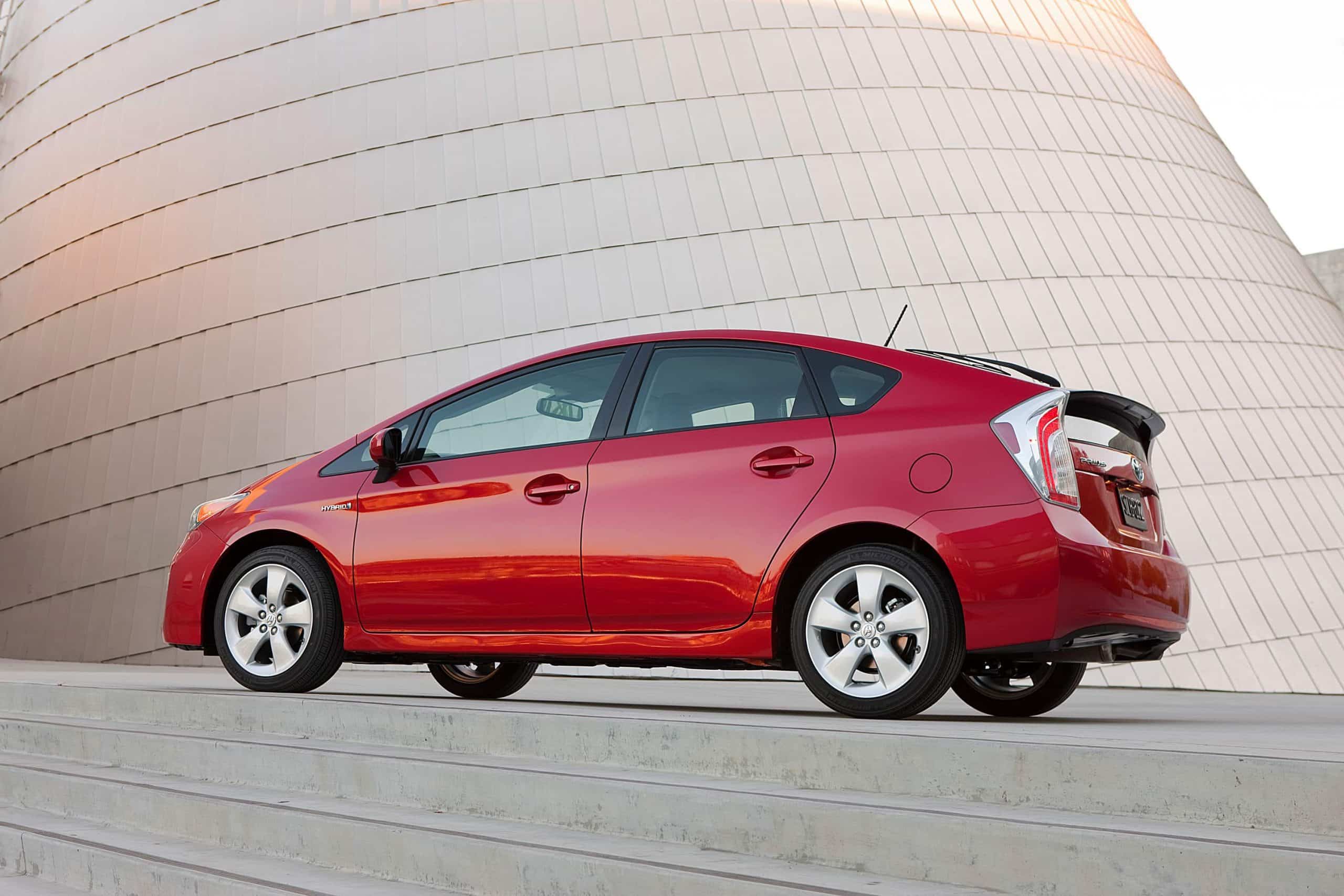




The Toyota Prius 3rd Gen XW30 (2010–2015) is the generation that really cemented the Prius as the benchmark hybrid. Earlier versions proved the concept worked. This one refined it into something genuinely practical, efficient, and surprisingly sophisticated.
Toyota launched the third generation in 2010 with a heavily redesigned version of its Hybrid Synergy Drive system. The big change was a larger 1.8-liter Atkinson-cycle four-cylinder engine (2ZR-FXE) paired with an electric motor and planetary-type continuously variable transmission. The gasoline engine produces 98 horsepower, while the combined hybrid system produces 134 horsepower.
That may not sound like much, but the electric motor delivers 153 lb-ft of torque, which helps the Prius feel stronger off the line than the numbers suggest. Toyota quotes a 0–60 mph time of around 9.8 seconds and a top speed of about 112 mph, which is perfectly respectable for a car designed primarily around efficiency.
More importantly, the system achieves around 50 mpg combined in EPA testing. That was a major improvement over earlier generations and helped make the Prius one of the most efficient gasoline-powered cars on the road.
One interesting engineering detail is that the Prius engine uses an electric water pump and electric power steering, meaning there are no accessory drive belts. That improves efficiency and removes a common maintenance item found in many conventional engines.
The chassis is straightforward but well tuned for comfort and stability:
- Front suspension: MacPherson struts
- Rear suspension: torsion beam
- Brakes: four-wheel discs with regenerative braking integrated into the system
Regenerative braking is a key part of the Prius experience. When slowing down, the electric motor acts as a generator, feeding energy back into the battery rather than wasting it as heat through the brakes. This helps improve efficiency and often means brake pads last longer than on typical cars.
Toyota also added several driving modes. Eco Mode softens throttle response to maximize efficiency, Power Mode sharpens it for more responsiveness, and EV Mode allows short low-speed trips using electric power alone when conditions allow.
Trim levels varied slightly by market, but typical versions included:
- Prius Two – the base model with the core hybrid system and digital instrumentation
- Prius Three – adds navigation and expanded Smart Key functionality
- Prius Persona Series – special edition with appearance upgrades
- Prius Plug-in Hybrid (2012–2015) – adds a lithium-ion battery and external charging capability for short EV driving
The Plug-in version can travel around 11 miles in electric-only mode and then seamlessly revert to normal hybrid operation once the battery is depleted.
Maintenance is straightforward for a hybrid. Oil changes occur roughly every 10,000 miles, while larger items like coolant and spark plugs come up much less frequently. Thanks to the beltless engine layout and regenerative braking, wear items can last longer than on many conventional cars.
In the end, the XW30 Prius is less about performance thrills and more about smart engineering. It is a car that quietly goes about its job with remarkable efficiency, minimal maintenance demands, and technology that was genuinely ahead of its time.
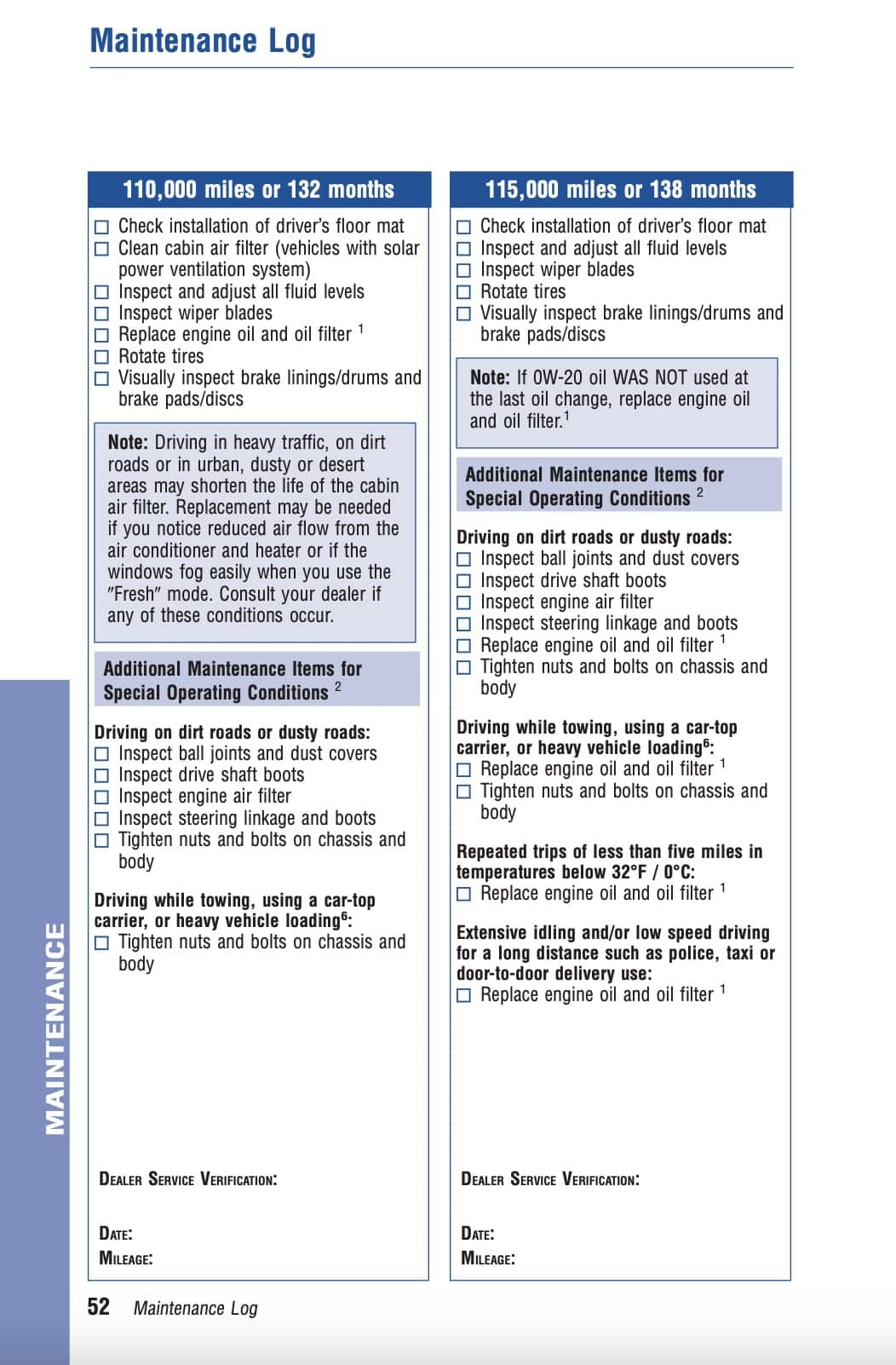
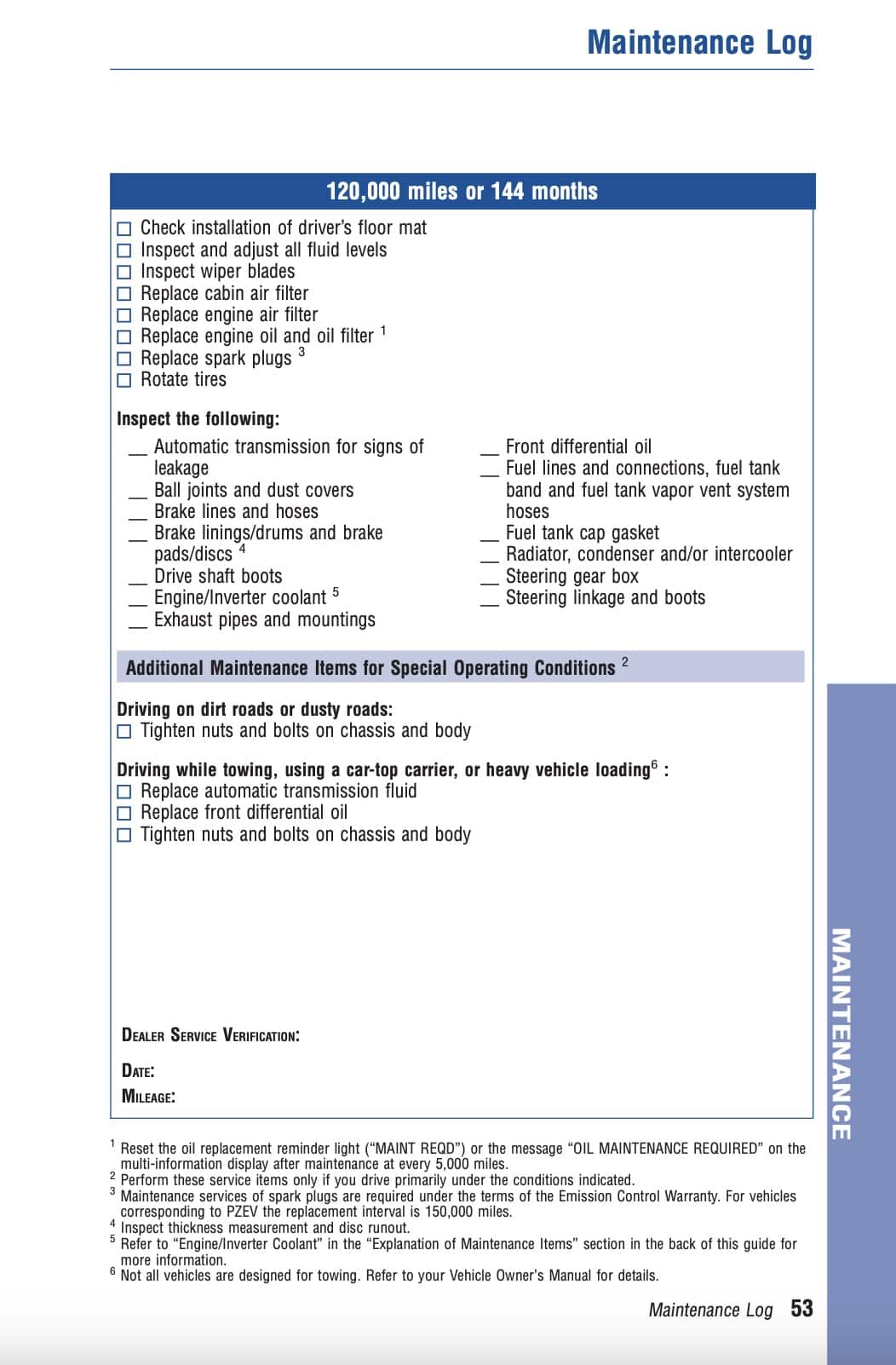
References — Screenshots from the Toyota Prius 3rd Gen XW30 (2010-2015)
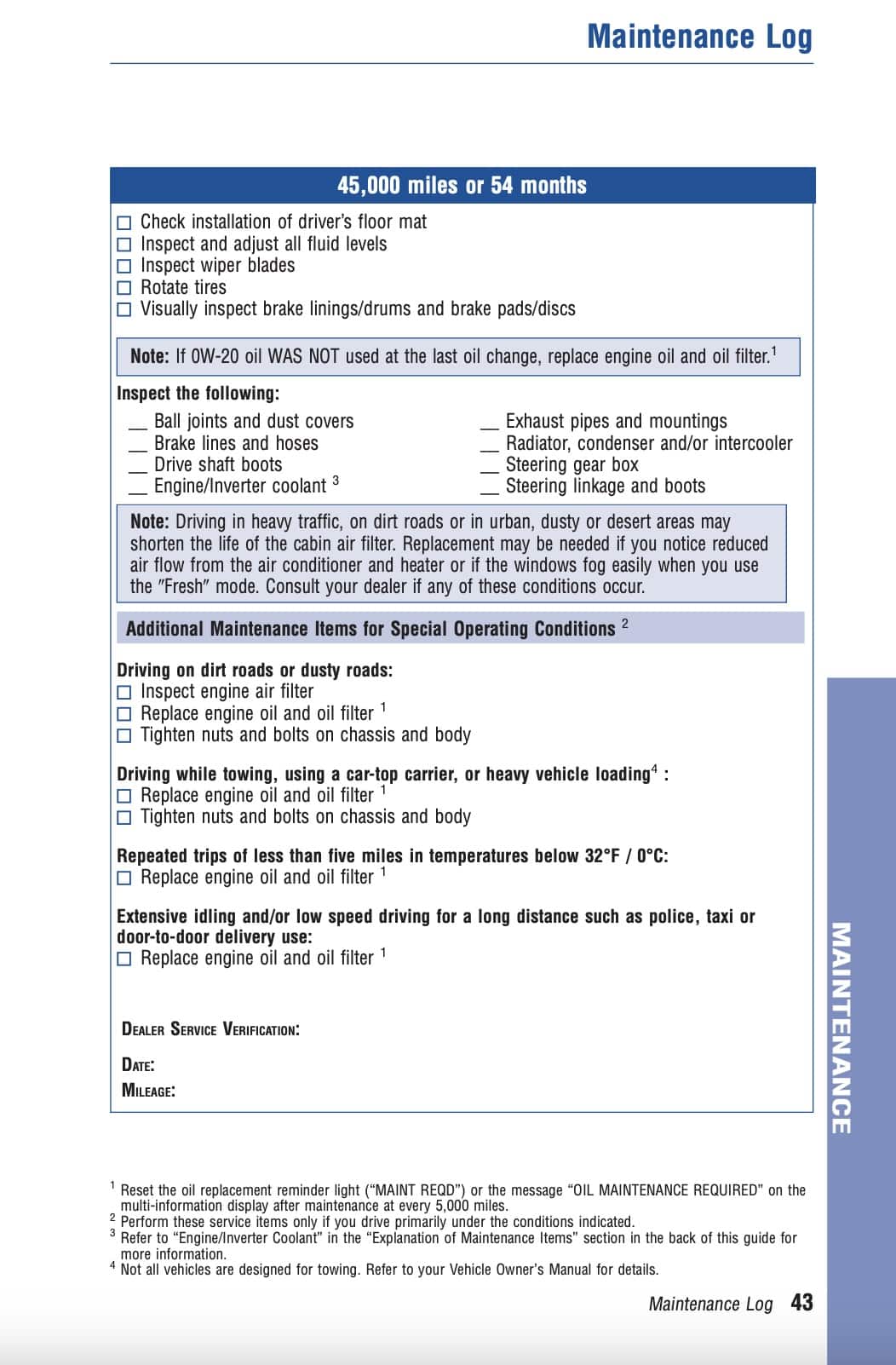
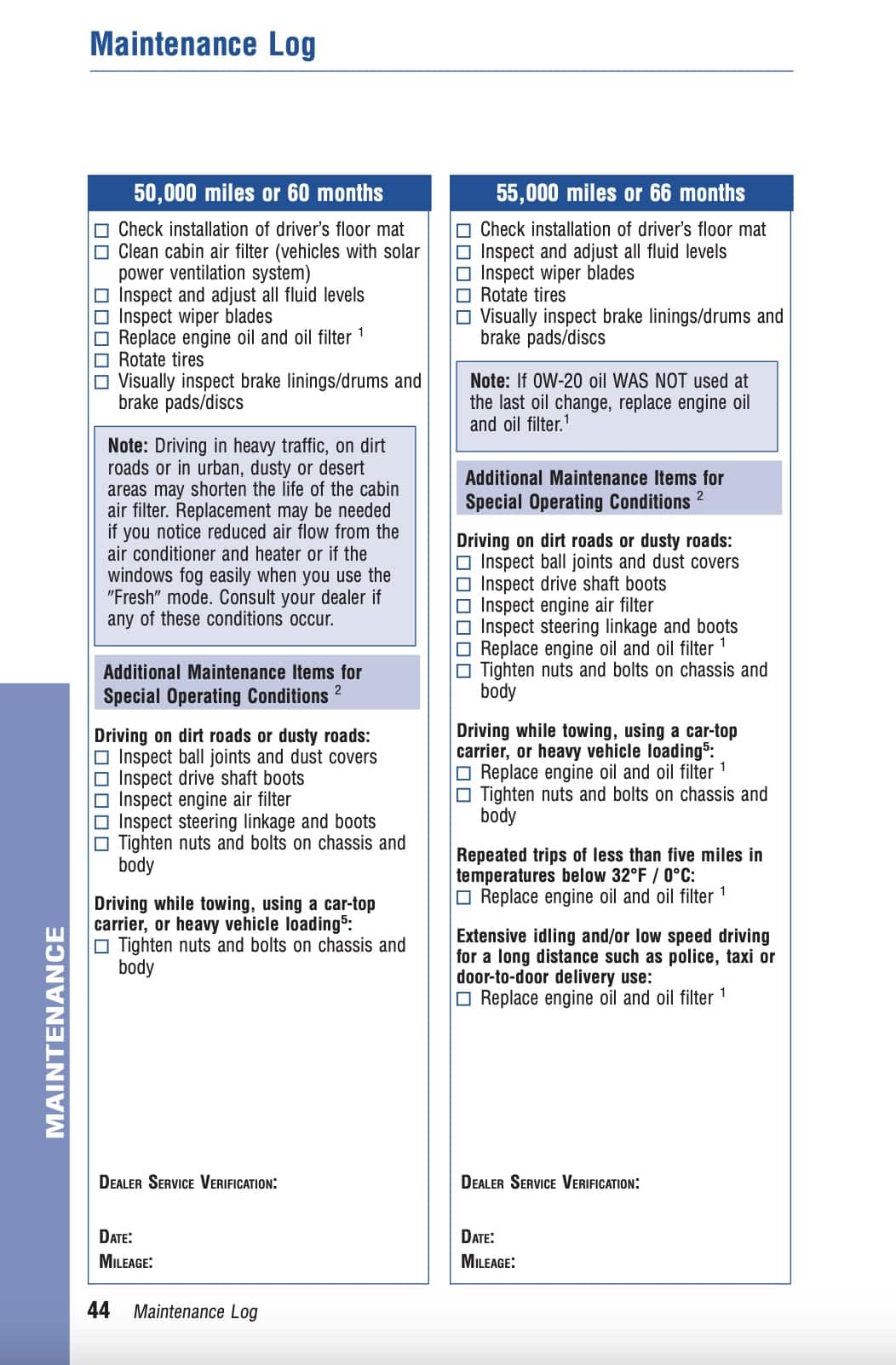
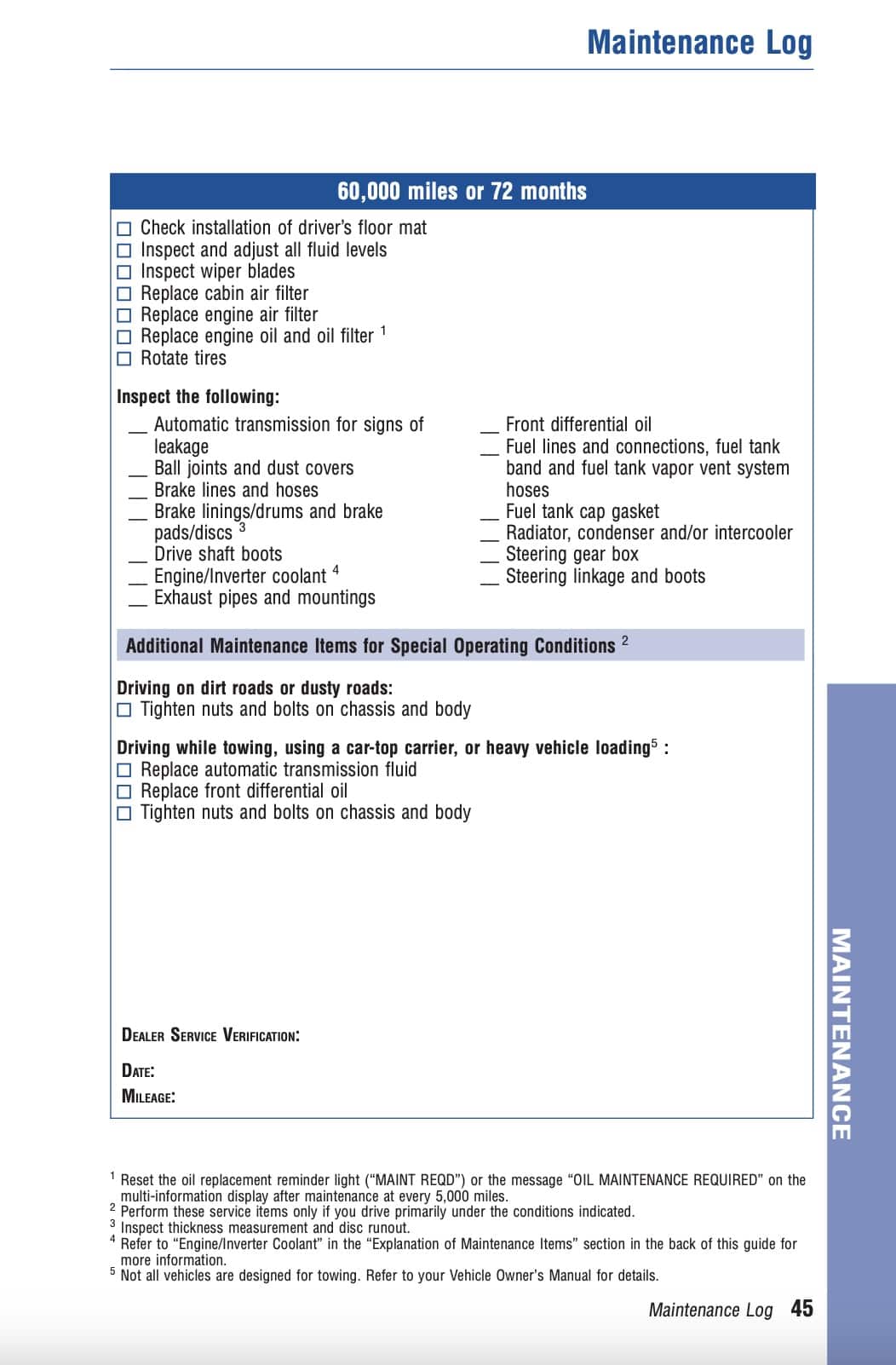
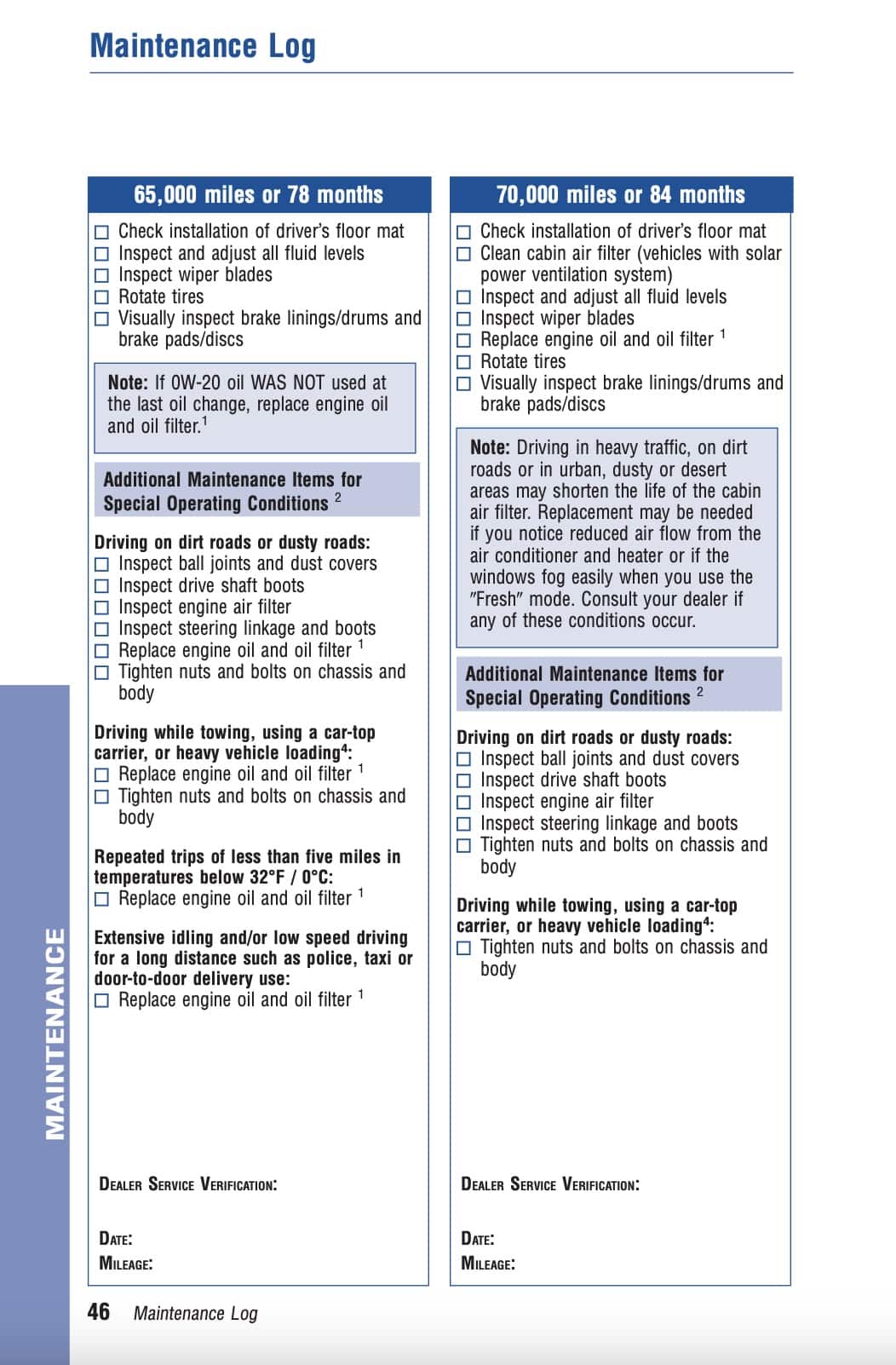
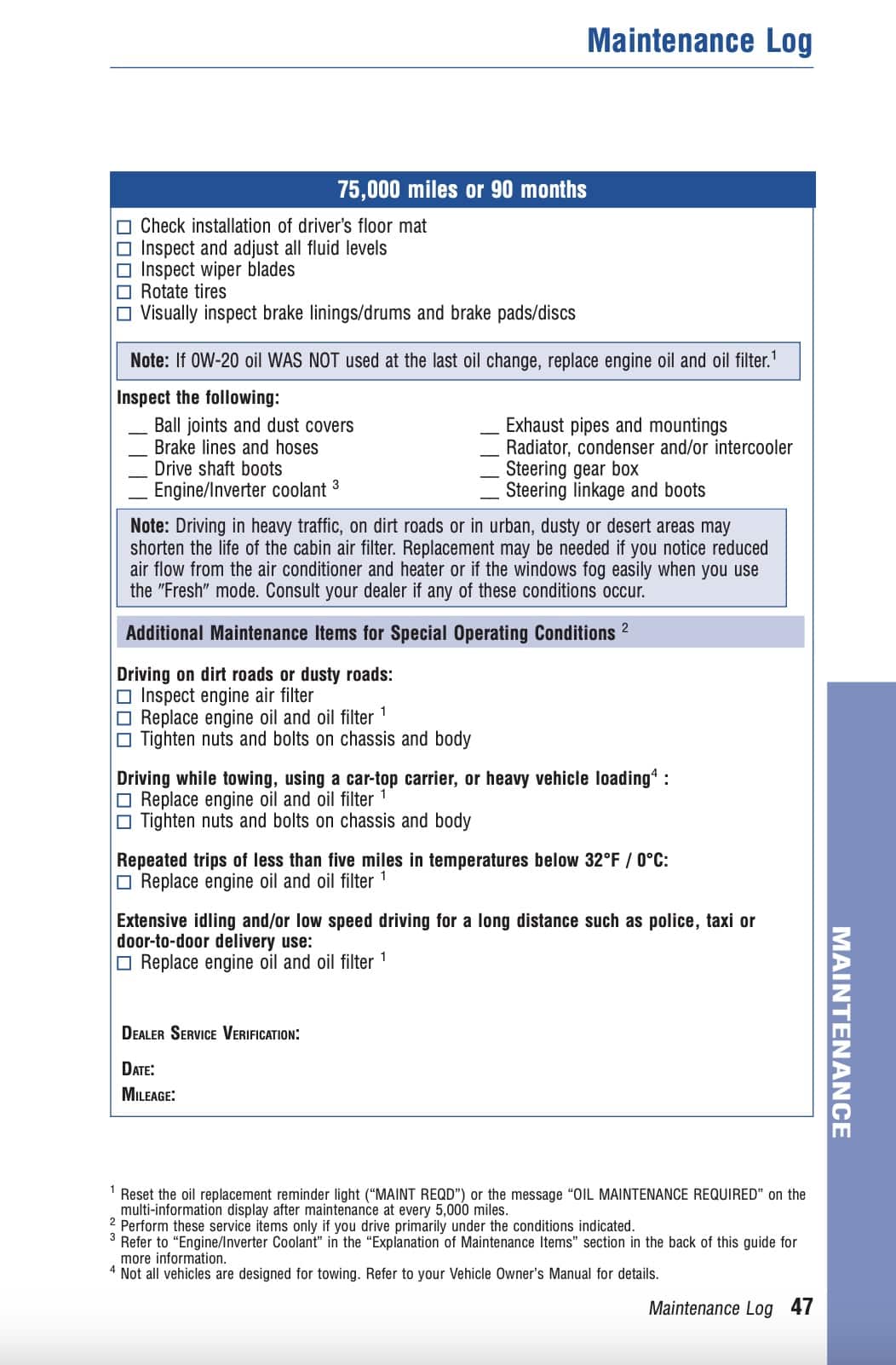
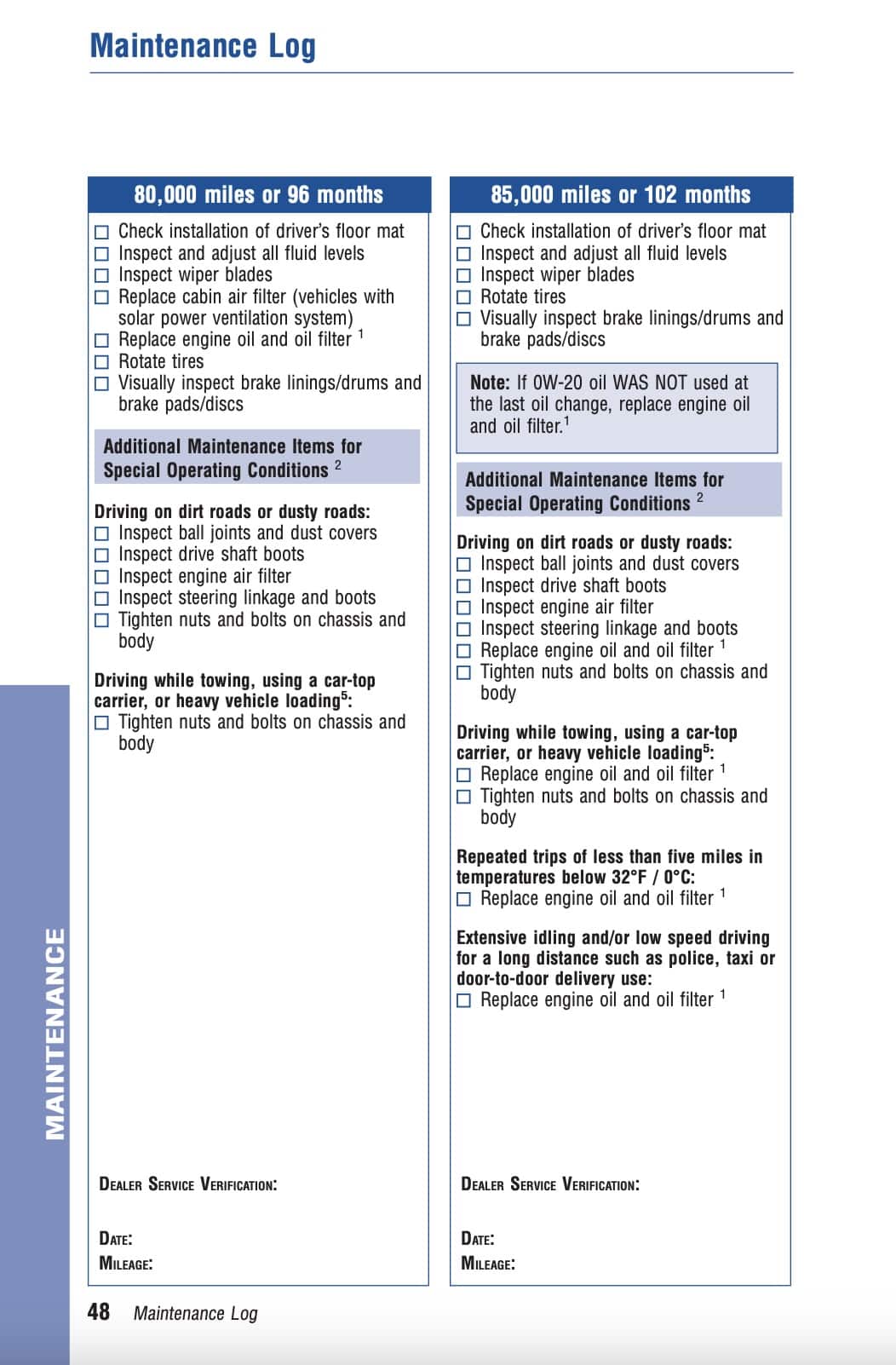
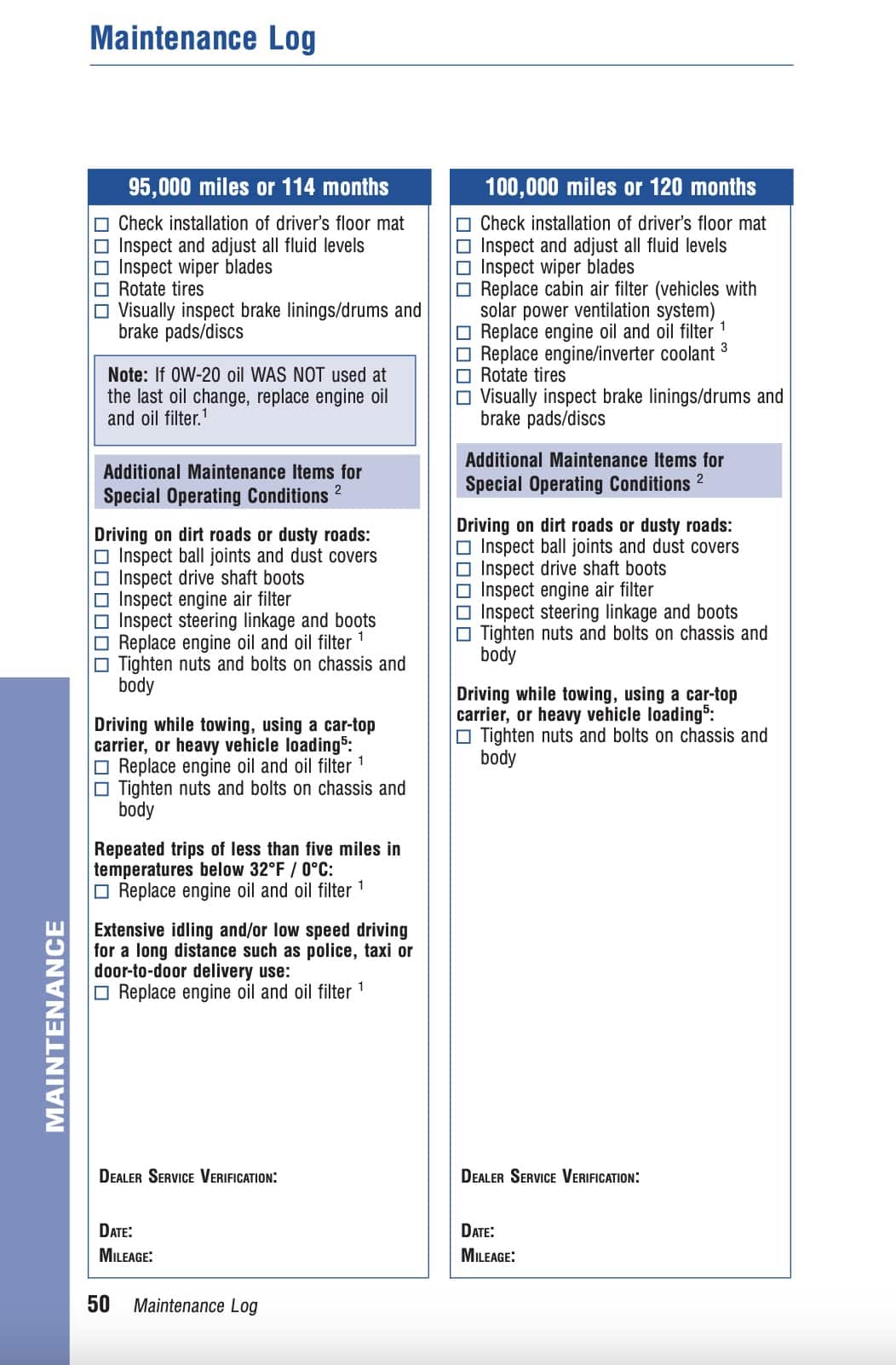
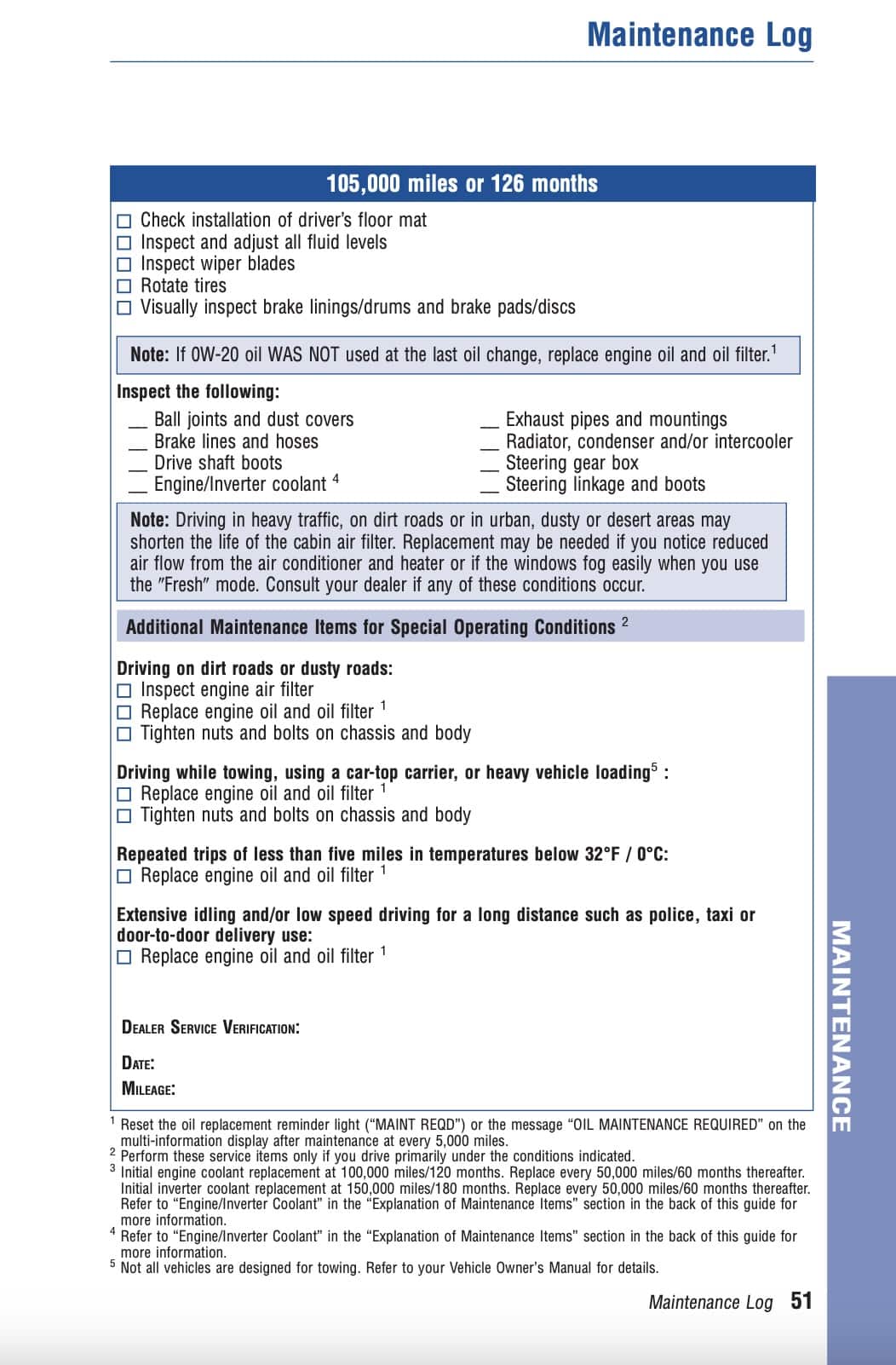
Below is a selection of screenshots from the maintenance schedule for the Prius 3rd gen XW30 (2010-2015) from the official manual.