Ducati Panigale V2 / V2s (2025+) Maintenance Schedule and Service Intervals

This is the maintenance schedule and service intervals for the Ducati Panigale V2 and Ducati Panigale V2s.
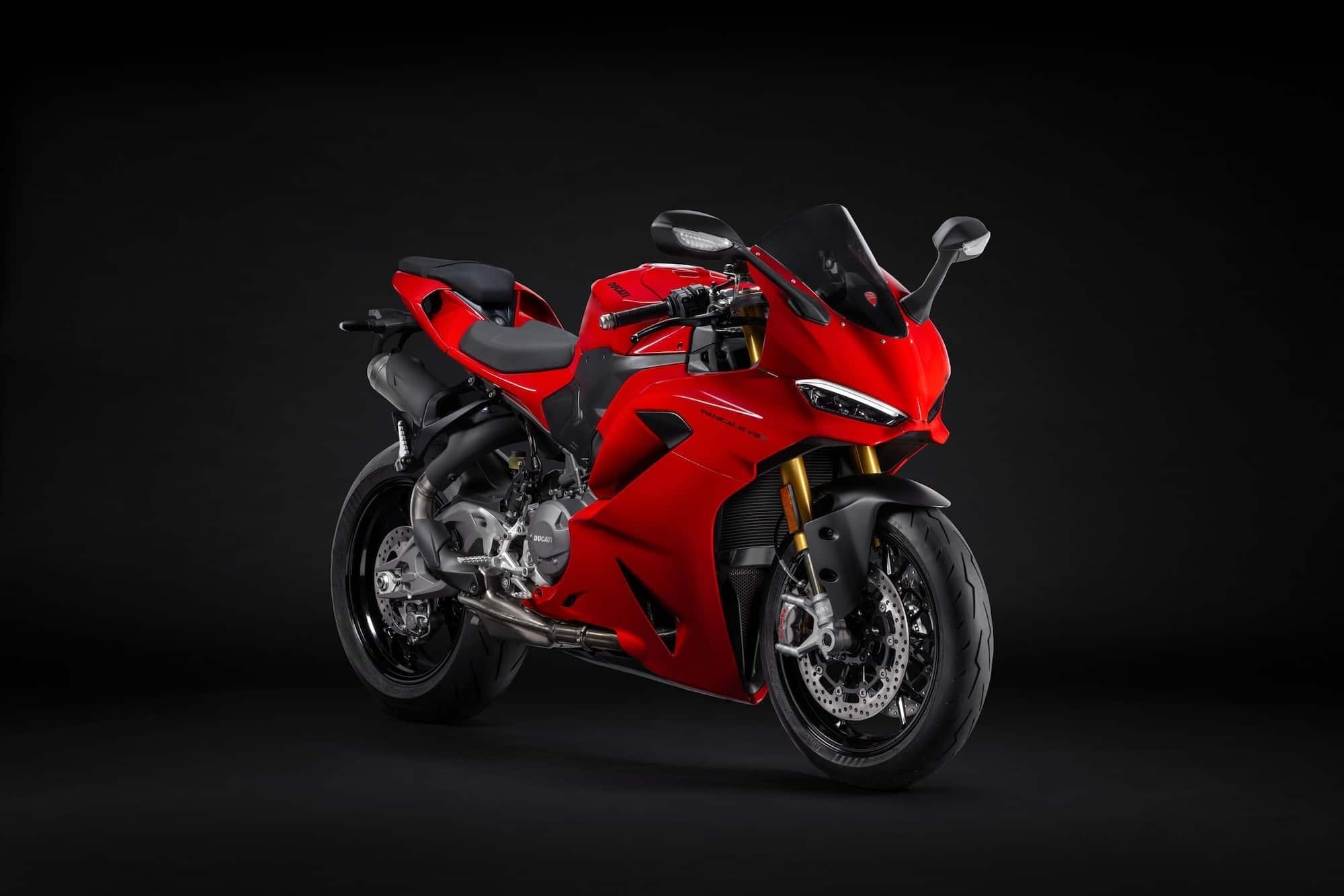
The Ducati Panigale V2 is Ducati’s middleweight sportbike, part of the Panigale family that also includes the flagship Ducati Panigale V4. For the 2025 model year, the Panigale V2 got a major overhaul — including a new 890cc V-twin engine (shared with the 2025 Streetfighter and 2026 Monster) and significant weight reduction — while maintaining its position as a more road-friendly alternative to the V4 superbike.
The Ducati Panigale V2 and V2s share the same engine and core chassis. The V2s version adds Öhlins suspension, a lithium battery, and a few electronic upgrades. Despite these differences, the maintenance schedule is the same for both models.
This update replaces the previous 955cc Superquadro-powered Panigale V2 2020. Ducati changed the service schedule for the V2 engine to require valve services less frequently.
Note: Ducati updated the service schedule for the Panigale V2 some time during 2025 (not sure when). This content below reflects the updated schedule.


This site has links for things like oil and spark plugs from which we earn a commission (which unfortunately nobody can save, not even us). If you appreciate this work, then please use those links. Thanks!
Ducati Panigale V2 / V2s Service Intervals
The basic service interval for the Ducati Panigale V2 and V2S is every 9,000 miles / 15,000 km or every 24 months, whichever comes first. At each service, you should change the engine oil and filter, and inspect or adjust components according to the checklist (see below).
In addition, Ducati specifies an Annual Service Check every 12 months, even if the mileage interval hasn’t been met. This check includes a safety inspection, fluid checks, a road test, and diagnostic scanning.
The major service — a valve clearance inspection — is required every 28,000 miles / 45,000 km (updated from the previous requirement of 18,000 miles / 30,000 km on the V2 engine’s initial release). This is the most involved and expensive maintenance item and should be performed by a Ducati-certified technician. But the good news is that with no Desmodromic timing, there are fewer clearances to inspect and adjust!
Regular Maintenance for the Ducati Panigale V2 / V2s
This is maintenance that you can do yourself.
Assuming you ride in everyday conditions (on sealed roads, under “normal” engine stress, every 1000 km / 500 miles OR 6 months (whichever comes first), perform the following maintenance:
| Panigale V2 / V2 — Regular maintenance |
|---|
| Check engine oil level (Motul 300V 15W-50) |
| Check brake fluid level (Castrol DOT 4) and clutch fluid level |
| Check tire pressure and wear (see below for recommended pressures) |
| Check the drive chain tension and lubrication (Motul chain paste) |
| Check brake pads and replace if necessary |
Checking and Adjusting Chain Tension
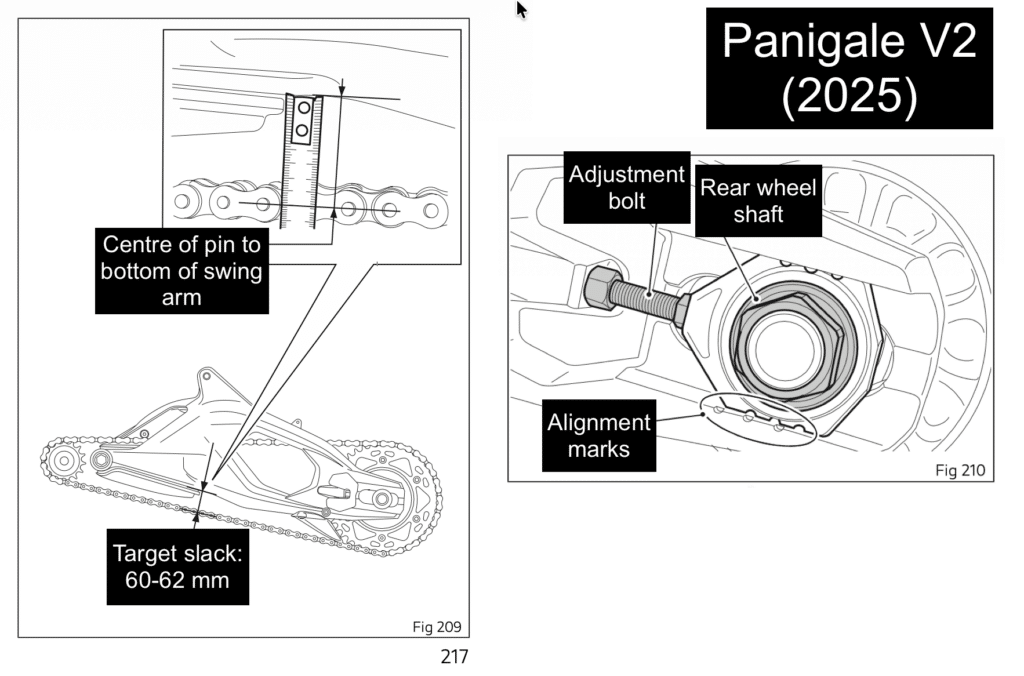
When checking drive chain tension, follow this procedure for the Panigale V2.
- Put the motorcycle on its side stand.
- Use a finger to push the chain down at the measurement point (indicated in the image), roughly half way between the sprockets (the loosest point of the chain)
- Use a ruler or tape measure to measure the distance between the centre of the chain pins and the bottom surface of the sing arm
- Make this measurement at a number of points on the chain, moving the bike around.
Target chain slack for the Ducati Panigale V2: 60-62 mm (2.36-2.44 in)
To adjust the chain slack, you have to loosen the axle, loosen the lock nut on the axle slider, and adjust it by the same amount on both sides. Use the positioning marks to make sure the axis is aligned.
Ducati Panigale V2 / V2s Maintenance Schedule Table
Below is the full maintenance schedule for the Ducati Panigale V2 / V2S, adapted from the official Ducati owner’s manual and service documentation.
The schedule has been streamlined for clarity. Some dealer-specific notes have been omitted, and certain recommendations have been updated for practical use.
| km x 1000 | 15 | 30 | 45 | 60 | Time |
|---|---|---|---|---|---|
| mi x 1000 | 9 | 18 | 28 | 36 | (Months) |
| Annual maintenance checklist (see below) — Perform | ✓ | ✓ | ✓ | ✓ | 12 |
| Change engine oil (Motul 300V 15W-50) | ✓ | ✓ | ✓ | ✓ | 24 |
| Change oil filter (HF159) | ✓ | ✓ | ✓ | ✓ | 24 |
| Check and clean the air filter | ✓ | ✓ | ✓ | ✓ | 24 |
| Change the air filter | ✓ | ✓ | |||
| Check and/or adjust valve clearances (Updated in 2025) | ✓ | ||||
| Check secondary air reeds | ✓ | ||||
| Change spark plugs (LMDR10A-JS) | ✓ | ||||
| Replace the water pump seal and bushing | ✓ | ||||
| Change coolant (ENI Agip Spezial) | ✓ | 48 | |||
| Change front fork fluid (Shell Donax TA) | ✓ | ||||
| Change brake and clutch fluid Fluid level drops with wear of the brake and clutch. Top up with Castrol DOT 4 or similar | 24 | ||||
| Check and lubricate the rear wheel shaft | ✓ | ||||
| Check the cush drive damper on rear sprocket | ✓ |
* Not a typo; Ducati updated the schedule to be 28,000 miles / 45,000 km, so it goes 9, 18, 28. Anyway, the difference between 27,000 miles and 28,000 miles is not significant in practice.
Annual Maintenance Checklist
Below is the annual maintenance checklist for the Ducati Panigale V2 / V2s. Perform it according to the schedule above.
Items marked [D] require dealer tools.
| Ducati Panigale V2 / V2s Annual Maintenance Checklist |
|---|
| [D] Read the error memory with DDS 3.0 and check software version update on control units |
| [D] Check the presence of any technical updates and recall campaigns |
| [D] Fill out that the service was performed in on-board documentation (Service Booklet) and reset the service indicator. |
| Visual check front fork and rear shock absorber seals |
| Check brake and clutch fluid level Fluid level drops with wear of the brake and clutch. Top up with Castrol DOT 4 or similar |
| Check front and rear brake disk and pad wear |
| Check tightening of front/rear brake caliper bolts and front brake disc bolts |
| Visually check rear brake disk bolts (check tightening by removing rear wheel shaft) |
| Check front/rear wheel nuts and rear sprocket nut tightening |
| Check tightening of swinging arm and rear shock absorber fasteners |
| Check front and rear wheel hub bearings |
| Check tightening of rear subframe to engine and frame bracket fasteners |
| Check final drive chain elongation, tension, and lubrication (Motul chain care kit) |
| Check wear of chain and sprockets. Note: Replace chain kit within 20,000km/12,000mi |
| Check clearance of steering tube bearings |
| Check freedom of movement and tightening of side stand |
| Check all gaiters and flexible hoses (fuel, brake, clutch, cooling system, bleeding, drainage, etc.) |
| Check free play of rear brake lever and lubricate handlebar/pedal controls |
| Check tire pressure and wear (See below for standard tire pressures) |
| Check operation of all electric safety devices (clutch/side stand sensor, brake switches, engine kill switch, gear/neutral sensor) |
| Check lighting devices, turn indicators, horn and controls operation |
| Final test and road test (testing ABS, DTC, electric fans, idling) |
| Visually check coolant level and sealing of the circuit |
| Clean motorcycle |
Tyre sizes and pressures for the Ducati Panigale V2 / V2s
According to the Ducati Owner’s Manual, the Panigale V2 / V2s arrives shod with Pirelli Diablo Rosso IV “tubeless” radial tires.
Here are the tire sizes and recommended pressures.
| Wheel | Rim size | Tyre size | Tyre pressure (cold, single rider) |
|---|---|---|---|
| Front | 3.50 x 17″ | 120/70 R17 | Road: 2.3 bar (33.36 psi) On track: 2.1 bar (30.45 psi) |
| Rear | 5.50 x 17″ | 190/55 R17 | Road: 2.5 bar (36.26 psi) On track: 1.9 bar (27.55psi) |
About the Ducati Panigale V2 / V2s (2025+)
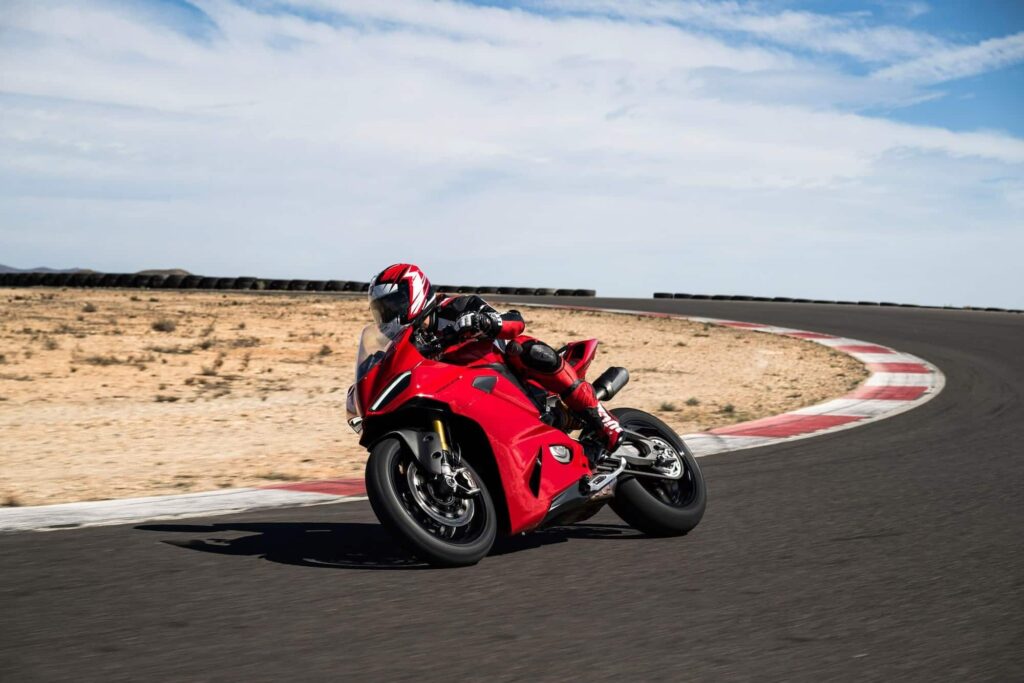
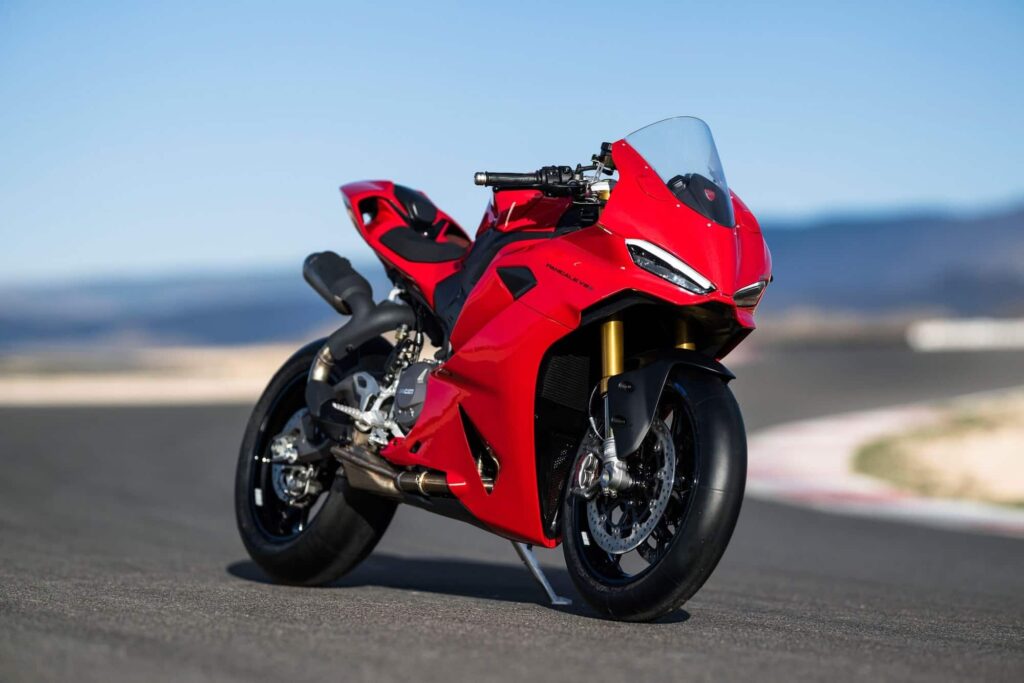
The Panigale V2 is Ducati’s twin-cylinder middleweight sportbike — and it’s probably the most rideable Panigale they’ve built. It’s the spiritual successor to the 748 and 959, but with far more polish. While the V4 hogs the spotlight, the V2 delivers a more essential, less demanding and less punishing experience for road and track alike.
Powered by a new 890cc 90° V-twin, the V2 makes 120 hp (88.5kW) at 10,750 rpm, with torque peaking at 93 Nm at 8,250 rpm — arriving early and hanging around — so you don’t have to scream it to have fun. The V2 engine is also 9.5 kg lighter than the outgoing Superquadro engine, which helps the Panigale V2 feel sharp and manageable.
The chassis is Ducati’s familiar aluminium monocoque, and it works brilliantly. Suspension on the base model is Marzocchi/Kayaba, while the V2 S gets full Öhlins and a lithium battery to shave weight. Both get Brembo M50 brakes, Pirelli Diablo Rosso IV tyres, and a full electronics suite: 6-axis IMU, cornering ABS, traction control, wheelie control, engine braking, and quickshifter.
There’s a 5″ TFT dash with Track, Road Pro, and Road info modes — borrowed from the V4 — and the ergonomics have been redesigned for less wrist pain and better thermal comfort. The V2 is narrow, flickable, and shockingly usable for everyday fast riding.
Between the V2 and the V2 S, the core experience is the same. The S just adds better suspension and a bit more poise. Either way, the V2 delivers true Ducati vibes — without needing to be going 200 km/h to enjoy them. Though it doesn’t hurt…
| Feature | Panigale V2 | Panigale V2 S |
|---|---|---|
| Fork | 43mm Marzocchi | Öhlins NIX30 |
| Shock | Kayaba | Öhlins TTX |
| Battery | Lead-acid | Lithium-ion |
| Weight (kerb, no fuel) | 179 kg | 175 kg |
| Seat setup | Two-seater | Single-seater (pillion kit optional) |
| DPL / Pit Limiter | Optional | Standard |
One lovely aspect of the V2 engine is the service intervals — a generous 45,000 km or 28,000 miles between required inspections and potential adjustments. This places the maintenance schedule of the Panigale V2 in the same league as other low-maintenance motors like the CP2 in the Yamaha MT-07. Of course, Ducati mechanics still will charge a premium!
References — Screenshots from the Ducati Panigale V2 / V2s Owner’s Manual
The above info was sourced from the owner’s manual for the 2025 Ducati Panigale V2 and Ducati Panigale V2S (the maintenance aspecs are the same).

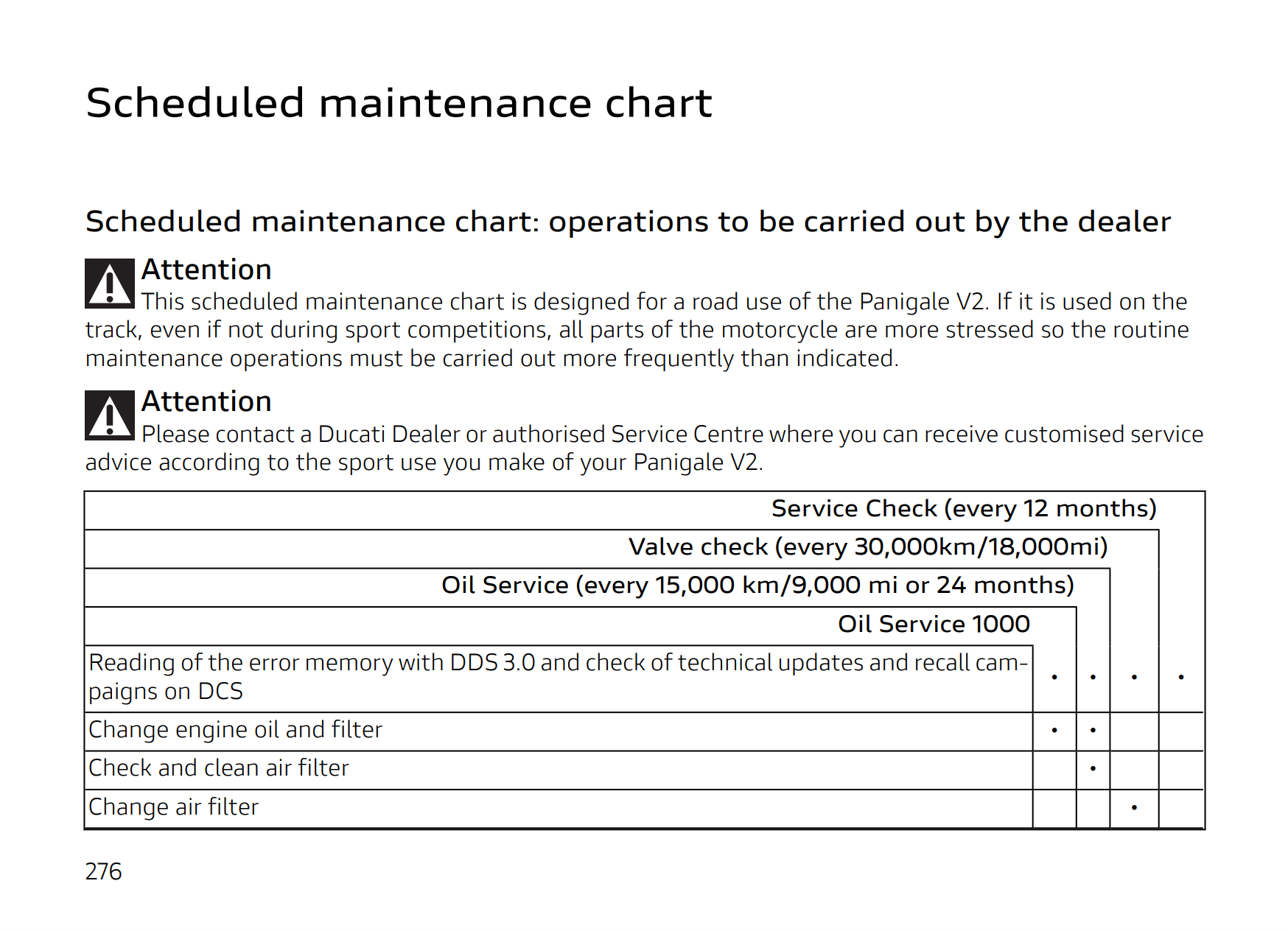

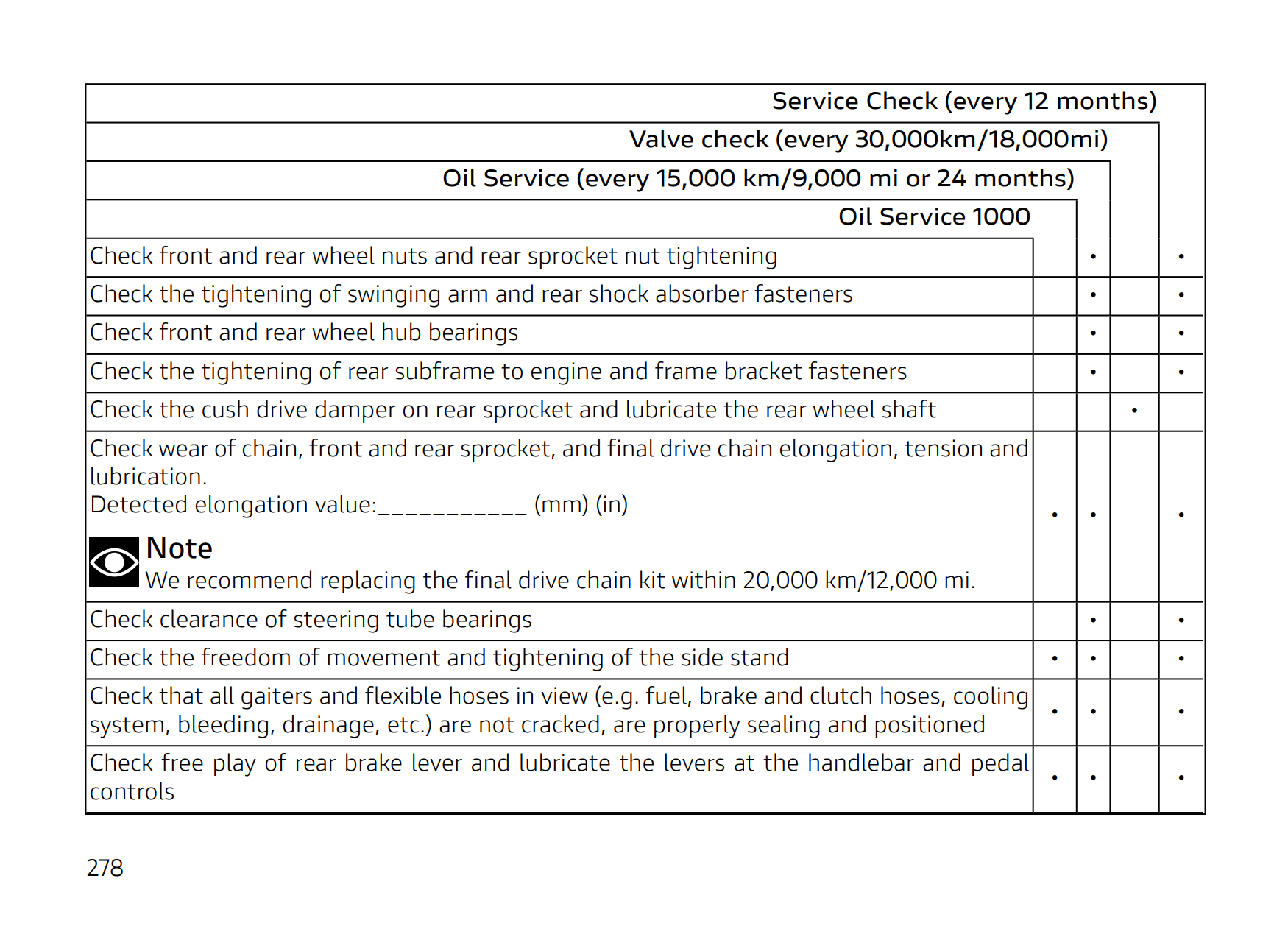
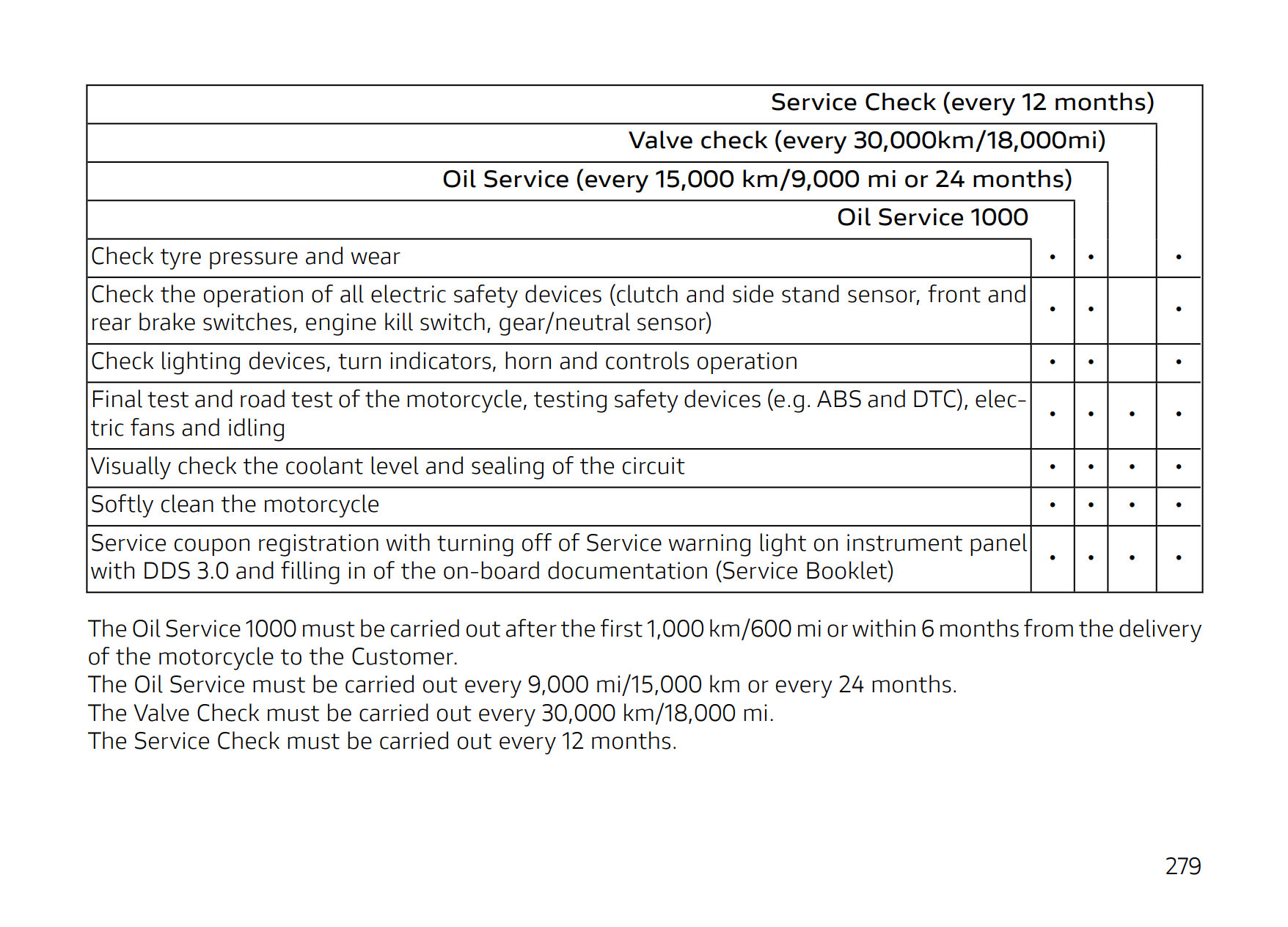
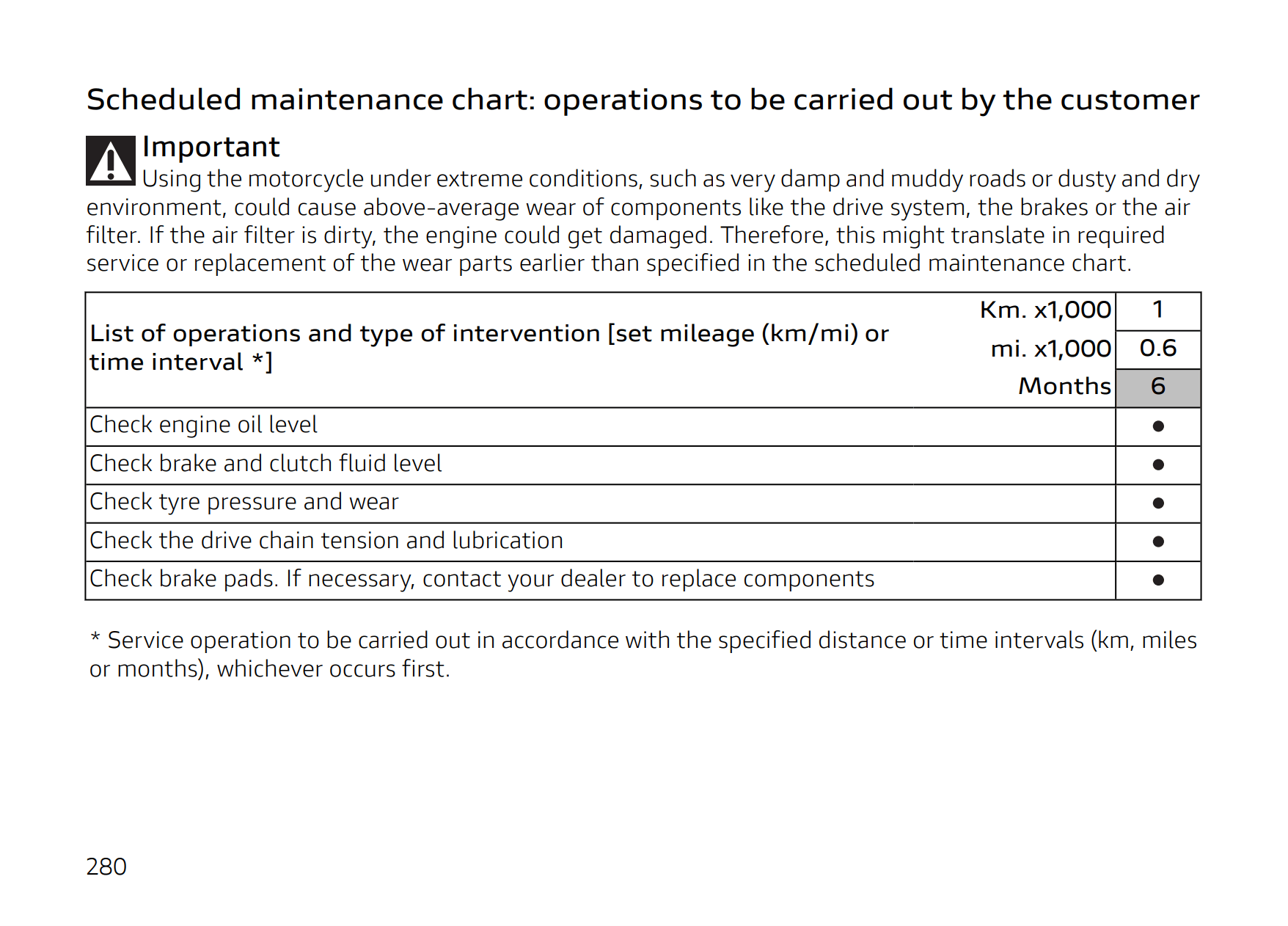


Ducati updated the service schedule for 2025 (for the 2026 model year) but removed the old manual, so it’s safe to say the modified service schedule applies to all models, with new, generous valve service intervals
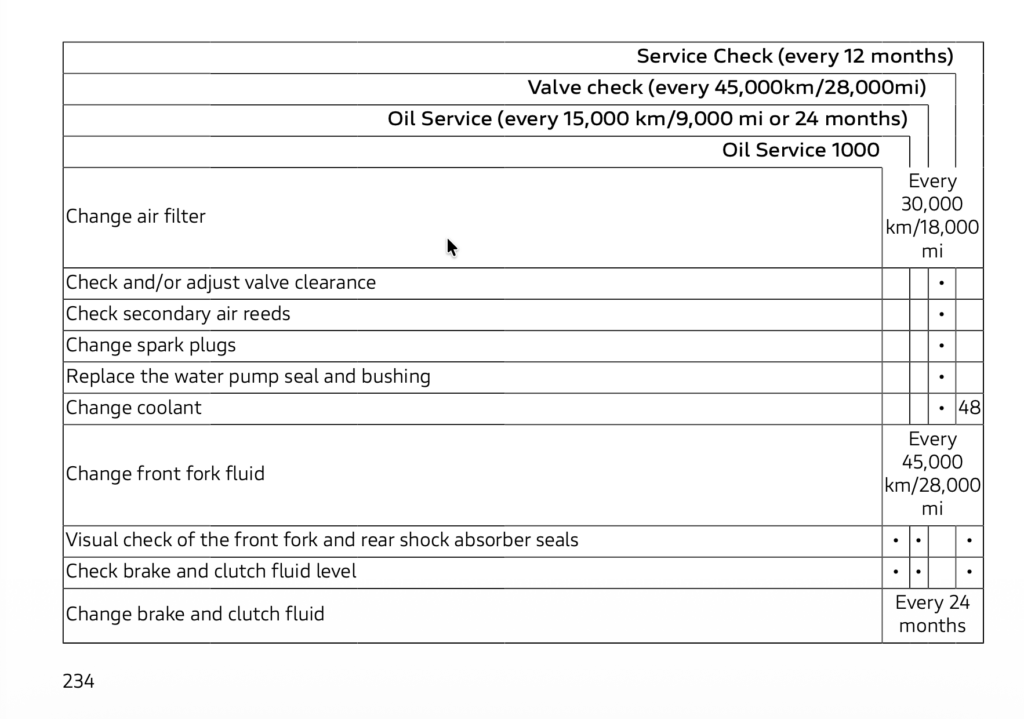
You can download it from the Ducati website here.