
Yamaha XV1600 Road Star (1670cc, carburettor, 2004-2007) Maintenance Schedule and Service Intervals

This is the maintenance schedule and associated service intervals for the Yamaha XV1600 Road Star motorcycle range. In Europe, the XV1600 was known as the Wild Star.
The Yamaha XV1600 Road Star was released in a number of variants, including the Road Star Silverado and Road Star Midnight, which is (you guessed it) blacked out. They all have the same underlying engine — a bored-out 1670cc single Mikuni BSR40 carburettor-fed V-twin engine — and thus all share the same maintenance schedule.
The 1670cc Yamaha Road Star replaced the earlier 1602cc Yamaha Road Star, and was replaced by the fuel-injected one of the same displacement in 2008 (the 2008 XV1700 Yamaha Road Star).
This was originally published July 13, 2020, but has since been considerably updated.


This site has links for things like oil and spark plugs from which we earn a commission (which unfortunately nobody can save, not even us). If you appreciate this work, then please use those links. Thanks!
Yamaha XV1600 Road Star Service Intervals
Overall, the Yamaha XV1600 Road Star has 4000-mile or 6000-km service intervals between oil changes. At that point grease external points and check everything (see the service checklist below).
Other than that, the valve service on the Road Star is every 16000 miles (25000 km).
Every 2nd service, change the spark plugs, and every 4th service, repack the bearings and change the transfer case oil.
You’re supposed to check the belt tension every 2500 miles / 4000 km, as well, but modify that as suits your riding conditions. At a minimum, do it every service!
Yamaha XV1600 Road Star Maintenance Schedule
Below is the maintenance schedule for the Yamaha XV1600 Road Star (the 1670cc, carburettor-fed version).
The maintenance schedule is shown in a simplified way compared to the manual.
Notes:
- At the end of the maintenance schedule, keep following the schedule periodically (every 1-4 intervals).
- The break-in schedule isn’t shown as this bike is no longer sold new.
| mi x 1000 | 4 | 8 | 12 | 16 | 20 | |
|---|---|---|---|---|---|---|
| km x 1000 | 7 | 13 | 19 | 25 | 31 | |
| months | 6 | 12 | 18 | 24 | 30 | Every |
| Conduct full service checklist (see below) | ✓ | ✓ | ✓ | ✓ | ✓ | |
| Change engine oil (Yamalube 10W-40) | ✓ | ✓ | ✓ | ✓ | ✓ | 1 year (Manual specifies 6 months) |
| Replace oil filter (HF303) | ✓ | ✓ | ||||
| Check spark plug condition. Adjust gap (0.8-0.9mm) and clean | ✓ | ✓ | ✓ | |||
| Replace spark plugs (NGK DPR7EA-9) (Note: the 2004-2007 model is dual-plug) | ✓ | ✓ | ||||
| Clean air filter. Replace if necessary (RK-3925-1) (Do not clean with compressed air; Yamaha updated this guidance in later years) | ✓ | ✓ | ✓ | ✓ | ✓ | More often if riding in dusty/wet areas |
| Check and adjust valve clearance when engine is cold | 16000 mi (25000 km) | |||||
| Replace brake fluid (Castrol DOT 4) and inner parts of brake master cylinder and brake caliper pistons | 2 years | |||||
| Replace the brake hoses | 4 years | |||||
| Replace fuel filter. | ✓ | |||||
| Check transfer case for oil leakage. | ✓ | ✓ | ||||
| Change transfer case oil. | ✓ | 2 years | ||||
| Moderately repack rear swingarm bearing with lithium soap-based grease | ✓ | 2 years | ||||
| Lubricate rear suspension link pivots with molybdenum disulfide grease lightly. | ✓ | |||||
| Check steering bearing assembly for looseness. | ✓ | ✓ | ✓ | ✓ | ✓ | |
| Moderately repack steering bearing with lithium soap-based grease | ✓ | |||||
| Check evap control system for damage. Replace if necessary. | ✓ | ✓ |
Service Checklist
Below is the checklist of things to check on the Road Star as per the schedule above.
| Service Checklist (Yamaha Road Star) |
|---|
| Check drive belt condition and tension. Adjust as necessary. (Should be more often, but also including it in the service checklist) |
| Adjust throttle cable free play. Lubricate the cable and grip housing. |
| Check and adjust engine idle speed. |
| Check front and rear brake operation, fluid level, and for leakage. |
| Check and replace brake pads if necessary |
| Check brake lines for cracks or damage. |
| Check fuel hoses for crack and damage. Replace if necessary |
| Check clutch operation. Adjust as necessary. |
| Lubricate control cables (Protect all cable life), including the clutch cable. |
| Check wheels for runout and damage. |
| Check tyres for cracks and damage. Replace if necessary. |
| Check shock absorber for leakage. Replace if necessary |
| Lubricate brake lever with silicone grease lightly |
| Lubricate clutch lever, brake pedal, and shift pedal with lithium soap-based grease lightly. |
| Check sidestand pivot operation and lubricate with lithium soap-based grease. |
| Check sidestand switch and clean or replace if necessary. |
| Check front fork operation and for leakage. |
| Check wheel bearings for smooth operation. |
| Check chassis fasteners and fittings. Tighten/replace as necessary. |
| Check crankcase ventilation hose for cracks or damage. Replace if necessary |
| Check exhaust system for leakage. Retighten/ replace gaskets if necessary. |
Belt Tension Maintenance
Yamaha recommends checking the drive belt tension and adjusting it every 2500 miles or 4000 km.
To check the drive belt slack, you should follow the steps below.
- Put the motorcycle on a level surface and hold it upright.
- Check the marks near the drive belt check hole
- Note the current position of the drive belt. (The marks are 5mm / 0.2 in apart.).
- Using a belt tension gauge, apply upward force of 4.5 N / 10 lbf to the belt, and note the position of the belt with the force applied.
- Belt slack: Subtract the first measurement from the second one.
Target belt slack for the Yamaha Road Star is 7.5-13mm (0.3-0.5 in).
To adjust belt tension, check your service manual.
Wheels and Tires (or “tyres”) for the 2004-2007 Road Star
The 2004-2007 Yamaha Road Star has, as standard, twin cast wheels with tubeless tires (both changes for the 2004 model). The front is a 130/90-16, and the rear is a 150/80B16.
Cast rims and tubeless tires mean that the 2004 model is even easier to maintain — no spokes to adjust or clean, and the tires are easier to repair.
About the Yamaha XV1600 Road Star
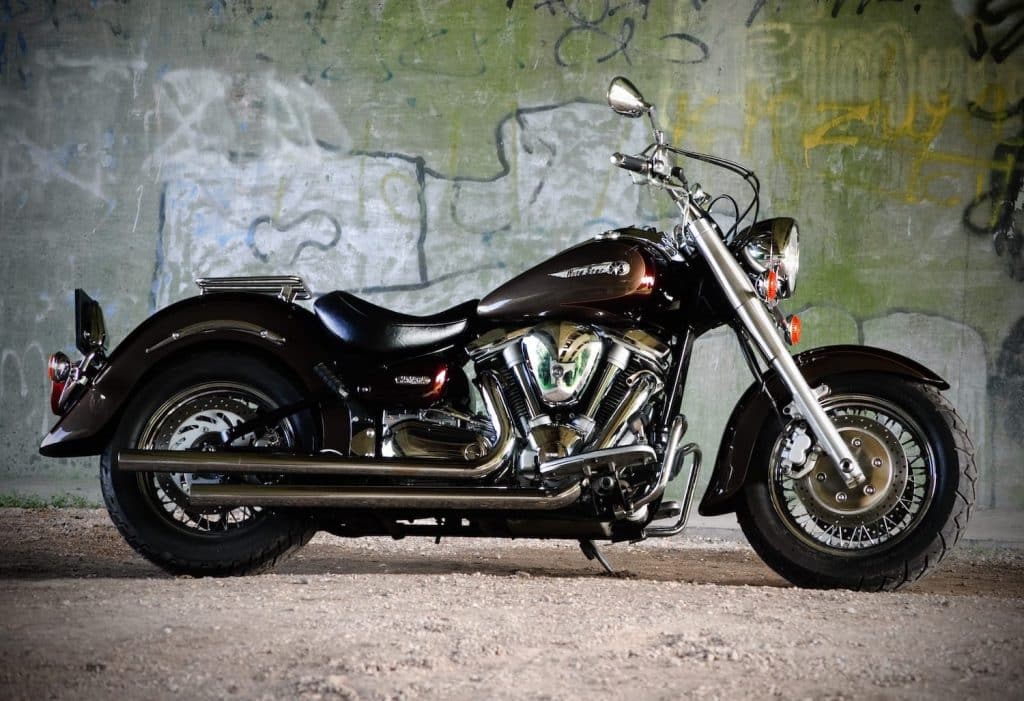
The Road Star is an iconic cruiser from Yamaha. It looks good, it goes well, and is very reliable.
The Yamaha XV1600 Road Star was first launched in 1999 with a carburettor-fed 1602cc engine.
This was updated in 2004 to be a bored-out 1670cc engine. The displacement is the same as that of the Yamaha Warrior, but the tuning and some internals are different (though to be honest, maintaining them both is very similar!)
Knowing that many riders are exceptionally aware of the livery their bikes come in, Yamaha added a Silverado variation to its Road Star line-up. The Silverado comes with bags and a windscreen.
The platform is identical, and the new machine relies on the same proven 1670 cc air-cooled V-twin with a 5-speed transmission and belt drive.
The engine, in base form, pulls a massive 99 ft-lb (134 Nm) at a low, low 2250 rpm. Peak power is 47 kW (63 hp) at 4000 rpm, but few people worry about peak power on cruisers until they hit drag strips. Yamaha also increased the airbox capacity for the 2004 model, and revised the internals of the engine for the larger displacement, increasing the cam duration, and using higher-compression, shorter-skirt pistons, and dual plugs.
Ride gear is pretty simple on the Road Star. It does have twin front disc brakes at 298mm in size, with two-piston calipers gripping them, and a rear disc. There’s a single rear shock absorber hidden away, giving the Road Star a faux hardtail look, similar to Harley-Davidson’s Softail line.
These days the Road Star models are rarely seen on the roads, but when they are, the owners are usually proud of the fact that these old cruisers are still running with little required maintenance.
Manual for the Yamaha 1600 Road Star
The above information was gleaned from the owner’s manual for the Yamaha Road Star, and it’s the same for all other Road Star variants (e.g. Silverado).
The manual is consistent for all years between 2004-2007.


You can download the manual for the Road Star from Yamaha’s website here.

Please remove service items which do not make sense for this model bike as it seriously calls into question the overall quality of this advice.
The bike has a single-carburetor air-cooled engine, so things like sync’ing carbs or checking coolant level make no sense at all. I haven’t gone through the rest in detail as these high-level mistakes make me not want to trust the remaining information here.
I apologise for these errors — I’ve made those updates (and more, I noticed a few other errors). Awesome bike, I hope you enjoy it.