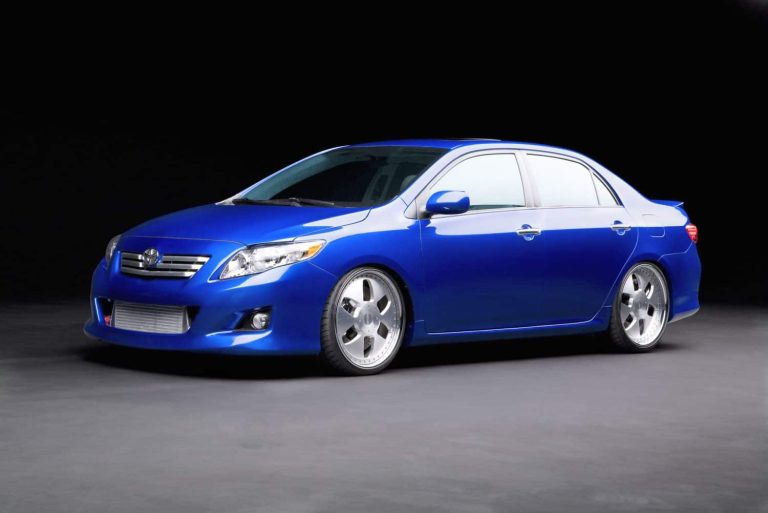
Toyota Corolla 10th Gen (2011-2013) Maintenance Schedule and Service Intervals

This is the maintenance schedule and associated service intervals for the Toyota Corolla 10th Gen (2011–2013). It applies to North American models built on the tenth-generation platform introduced for 2009, continuing with the same 1.8-litre powertrain and core chassis configuration during this period. Although the platform dates back to 2009, the 2009–2010 Toyota Corolla 10th Gen is covered separately due to differences in maintenance interval structure during those earlier model years.
The Toyota Corolla 10th Gen (2011–2013) was offered in the following variants:
L (or Base), LE, and S models equipped with a 1.8-litre DOHC 16-valve inline four-cylinder engine with Dual VVT-i, producing 132 hp and 128 lb-ft of torque (paired with a five-speed manual or four-speed automatic transmission)
All models share the same basic front-engine, front-wheel-drive layout, MacPherson strut front suspension, torsion beam rear suspension, and electric power steering. Braking hardware consists of 10.7-inch ventilated front discs and 9.0-inch rear drums across all trims. Anti-lock Braking System, Electronic Brake-force Distribution, Brake Assist, Vehicle Stability Control, and Traction Control are standard as part of Toyota’s Star Safety System.
The factory maintenance schedule for 2011–2013 models specifies service at defined mileage or time intervals, with oil change frequency dependent on oil specification and operating conditions. Core service components including engine oil, filters, brakes, cooling system, and drivetrain are common across all trims.
Between 2011 and 2013, there were no mechanical changes to the engine, transmission, suspension design, or brake dimensions that alter maintenance requirements. Trim-level differences such as wheel size, tire specification, or exterior equipment do not affect the core service schedule.
Other Toyota Corolla Models:
- Toyota Corolla 10th Gen (2009-2010)
- Toyota Corolla 11th Gen (2014-2019)
- Toyota Corolla 12th Gen (2020+)


This site has links for things like oil and spark plugs from which we earn a commission (which unfortunately nobody can save, not even us). If you appreciate this work, then please use those links. Thanks!
Toyota Corolla 10th Gen (2011-2013) Service Intervals
The basic service interval for the Toyota Corolla 10th Gen (2011–2013) is every 5,000 miles or 6 months, whichever comes first. Some models using 0W-20 synthetic oil allow extended oil change intervals of 10,000 miles / 16,000 km or 12 months, provided the correct oil specification is used.
At every 5,000-mile service:
- Replace engine oil and filter, or rotate tires if on alternating synthetic schedule
- Rotate tires and inspect tread and pressures
- Inspect brake pads, rotors, and rear drums
- Inspect steering and suspension components
- Inspect drive belts, exhaust system, and fluid levels
Additional periodic items include:
- Engine air filter inspection and replacement as required
- Cabin air filter inspection and replacement
- Engine coolant replacement at longer intervals
- Spark plug replacement at 120,000 miles / 192,000 km
The 1.8-liter 2ZR-FE engine uses a transverse layout with good access to service points, making routine maintenance straightforward. Overall service requirements are consistent across L, LE, and S trims.
General Notes on Serviceability of the Toyota Corolla 10th Gen (2011-2013)
- The Corolla uses the 1.8-liter 2ZR-FE inline four-cylinder engine with Dual VVT-i and an aluminum block and head. It is a liquid-cooled engine, so coolant condition is important. Replace engine coolant at the specified interval to prevent internal corrosion and overheating issues.
- Oil change interval depends on oil specification. Models using 0W-20 synthetic oil may follow extended intervals, but if another viscosity is used the oil and filter must be replaced at the shorter schedule. Always confirm what oil was used at the previous service.
- Brakes consist of front ventilated discs and rear drums. Rear drum brake adjustment and inspection should not be overlooked, particularly on higher mileage vehicles.
- Electric power steering eliminates hydraulic fluid service, but steering and suspension components should be inspected regularly, especially bushings and tie rod ends.
- All trims share the same drivetrain and core mechanical components. Wheel size and appearance packages do not change maintenance procedures or service intervals.
Maintenance schedule for the Toyota Corolla 10th Gen (2011-2013)
This is the maintenance schedule for the Toyota Corolla 10th Gen (2011–2013), covering L, LE, and S models equipped with the 1.8-liter 2ZR-FE engine. It is based directly on the official Toyota Warranty and Maintenance Guide, but reorganized into a clearer format so it is easier to follow in real-world use.
The schedule is divided into three parts:
- Regular maintenance: Every 5,000 miles or 6 months, whichever comes first.
- Periodic maintenance: Maintenance tasks that occur between 10,000 miles – 15,000 miles or 12 months – 18 months, whichever comes first.
- Long-term service intervals: Items that require attention at longer, sporadic intervals.
Where Toyota specifies different requirements based on oil type, driving conditions, or drivetrain configuration, those notes are included so the schedule can be followed accurately without referring back to the manual.
Regular Maintenance
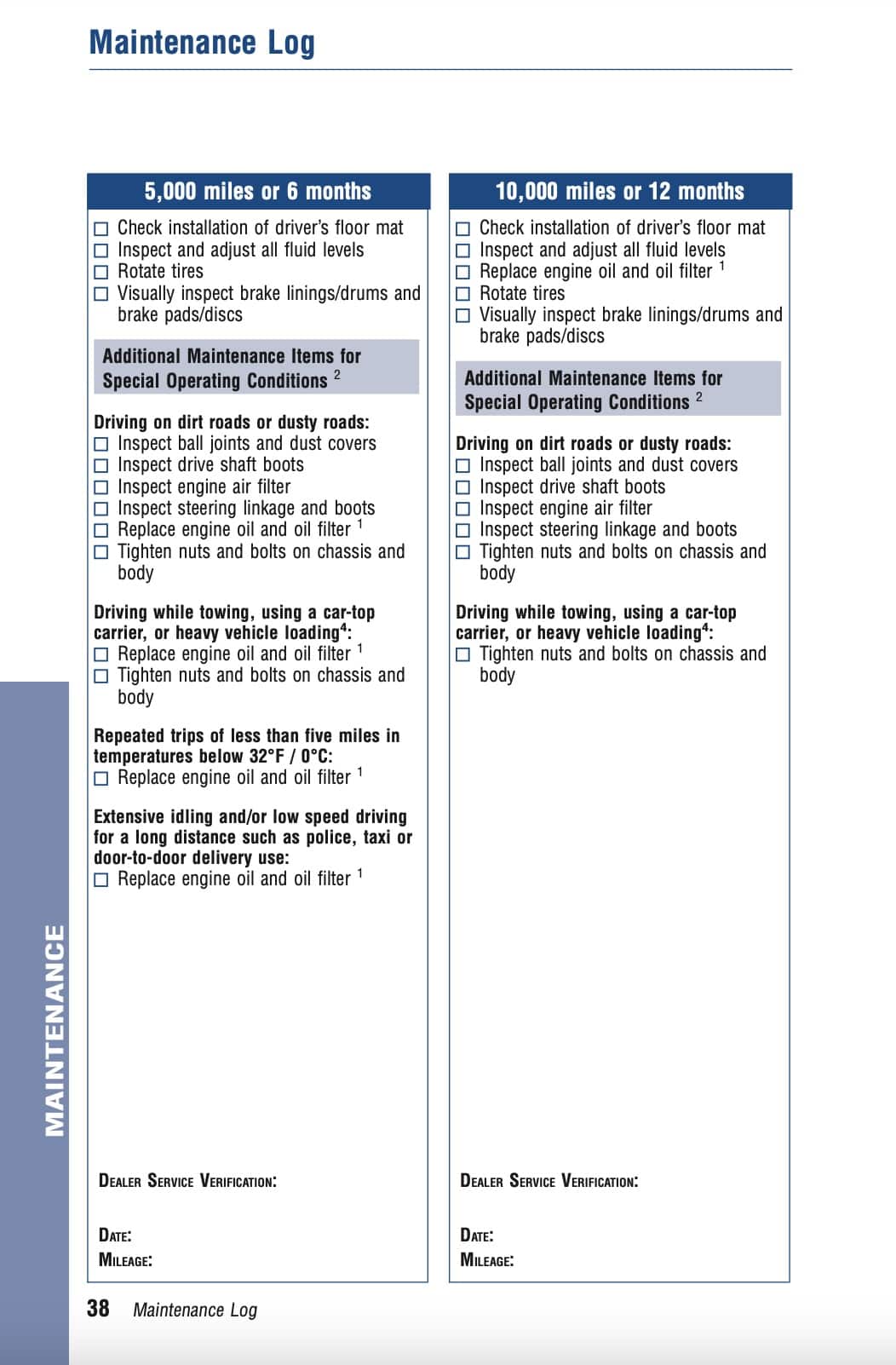
At every 5,000-mile or 6-month service, Toyota specifies a set of standard maintenance items for the Toyota Corolla 10th Gen (2011-2013). These include both required replacements and routine inspections, and they apply to all vehicles regardless of how they are driven.
| Toyota Corolla 2011-2013 Regular Maintenance Items (Standard) |
|---|
| Check installation of driver’s floor mat |
| Inspect and adjust all fluid levels |
| Rotate tires |
| Visually inspect brake linings/drums and brake pads/discs |
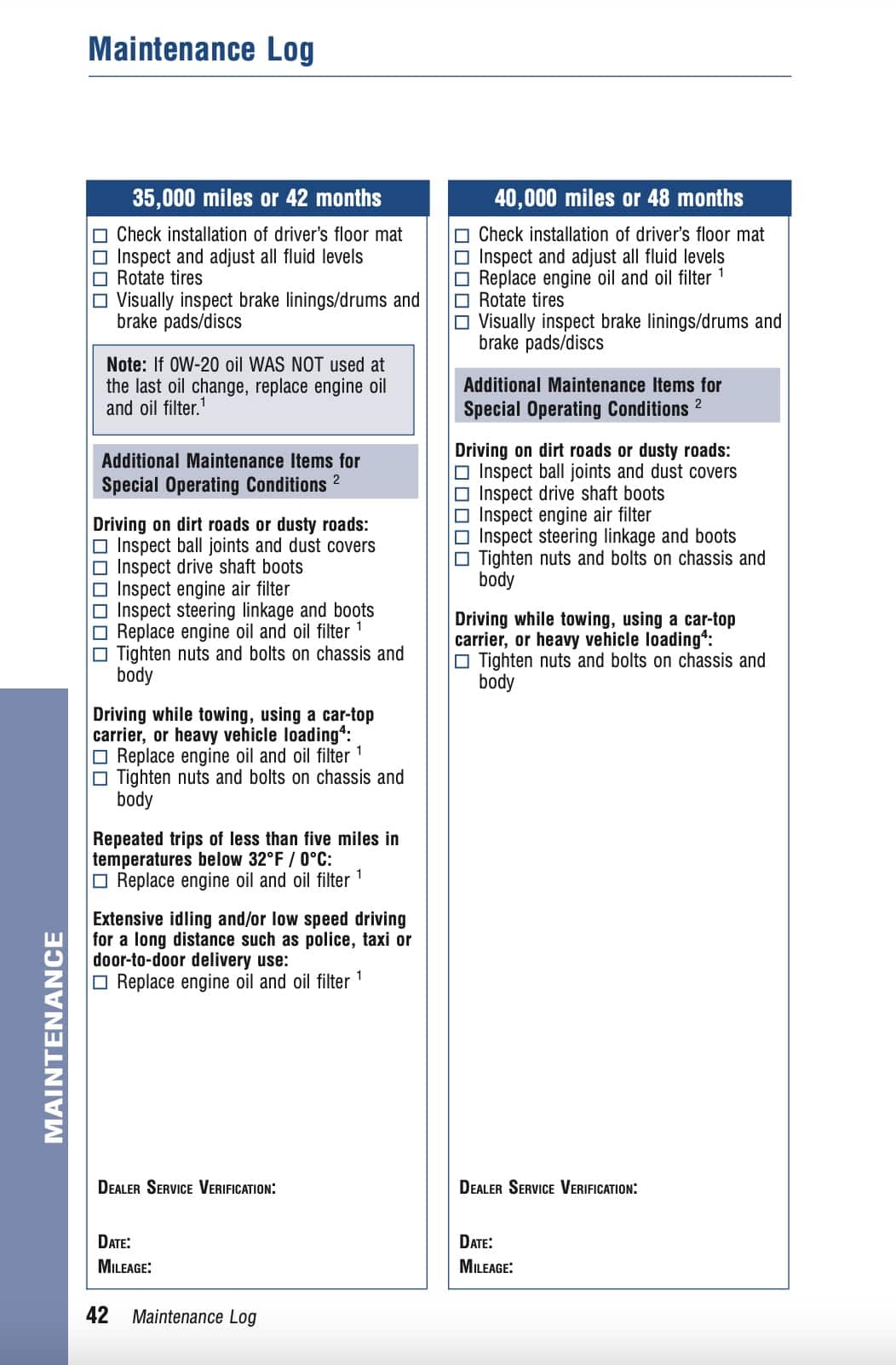
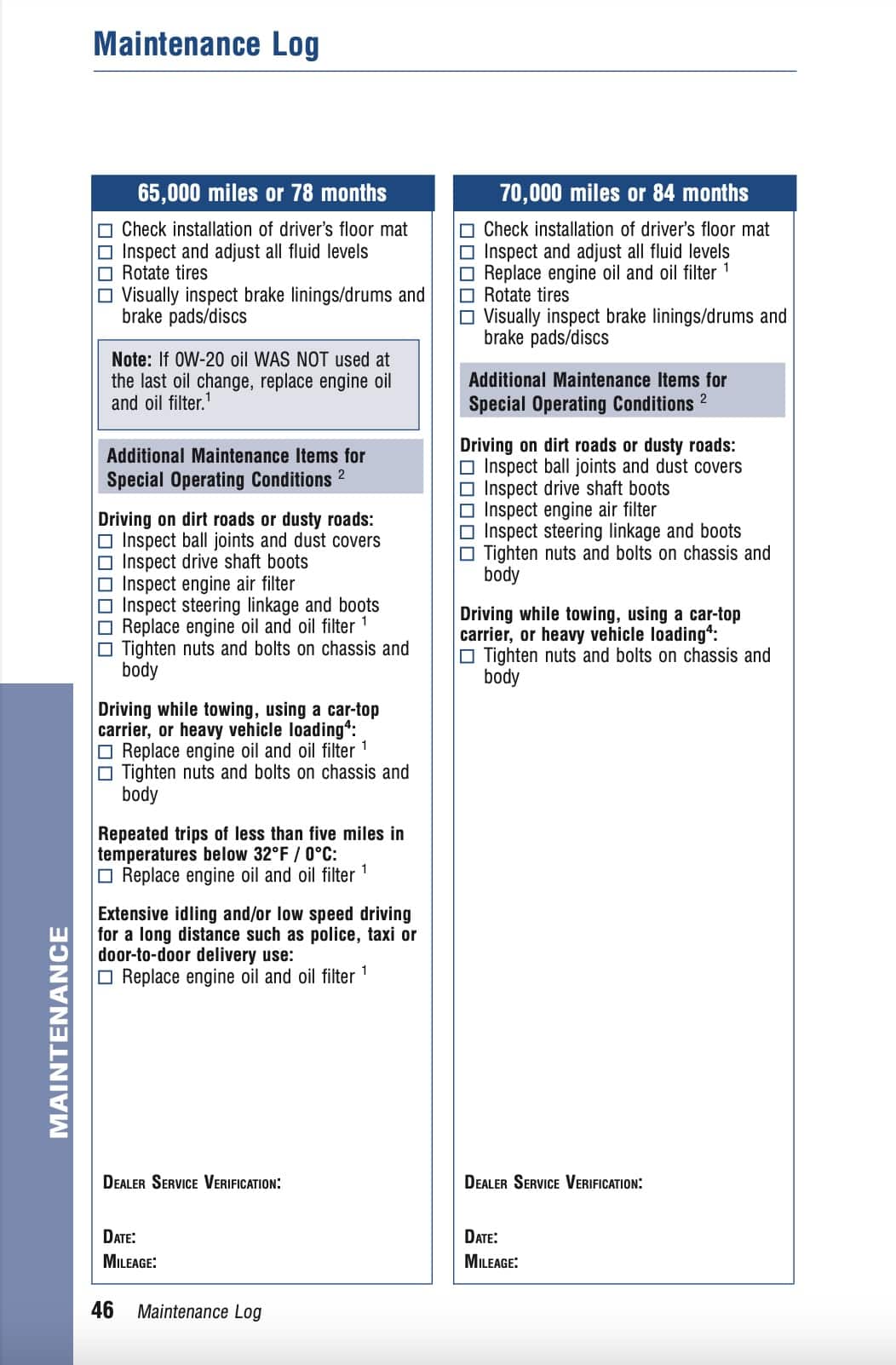
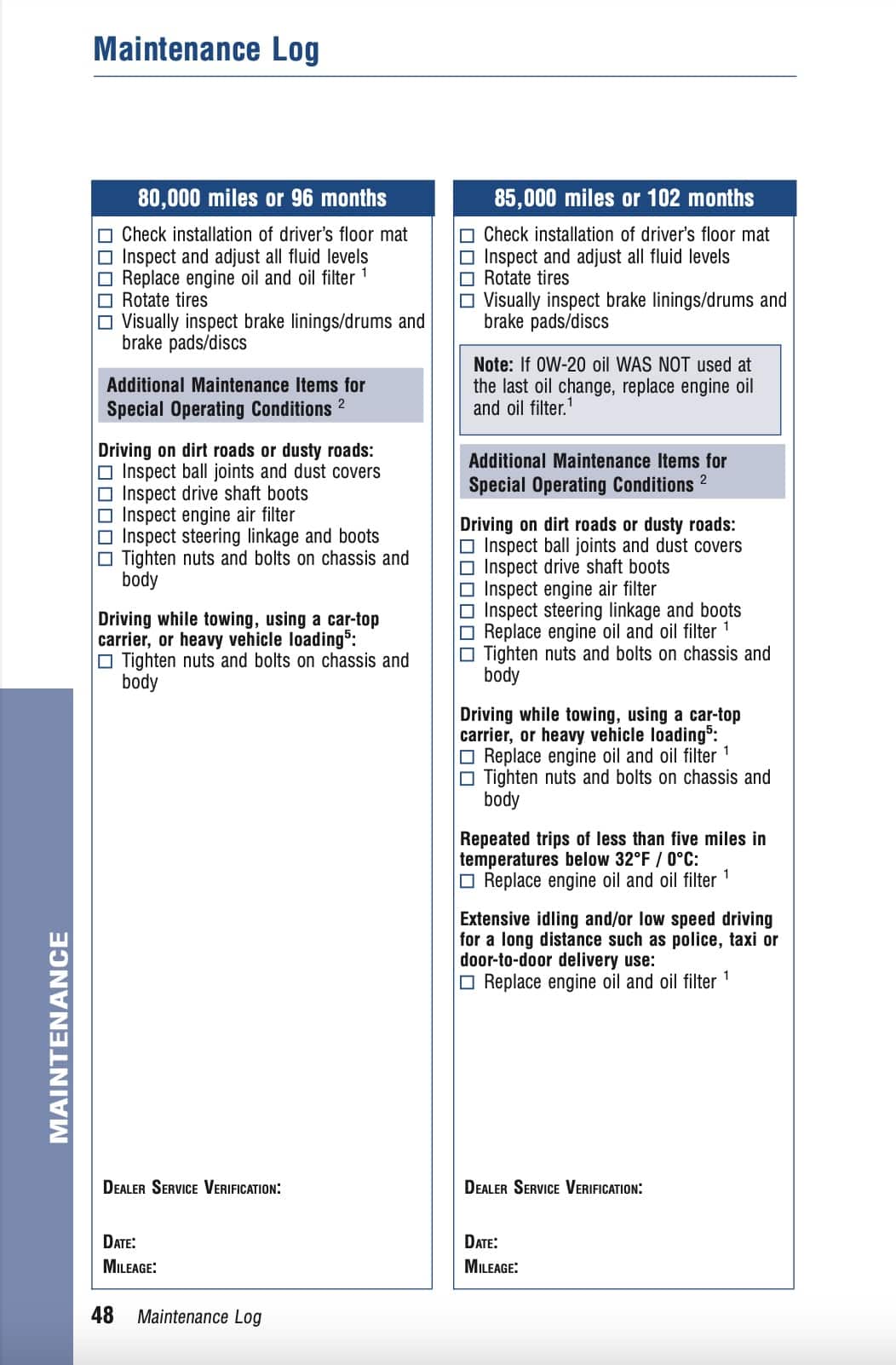
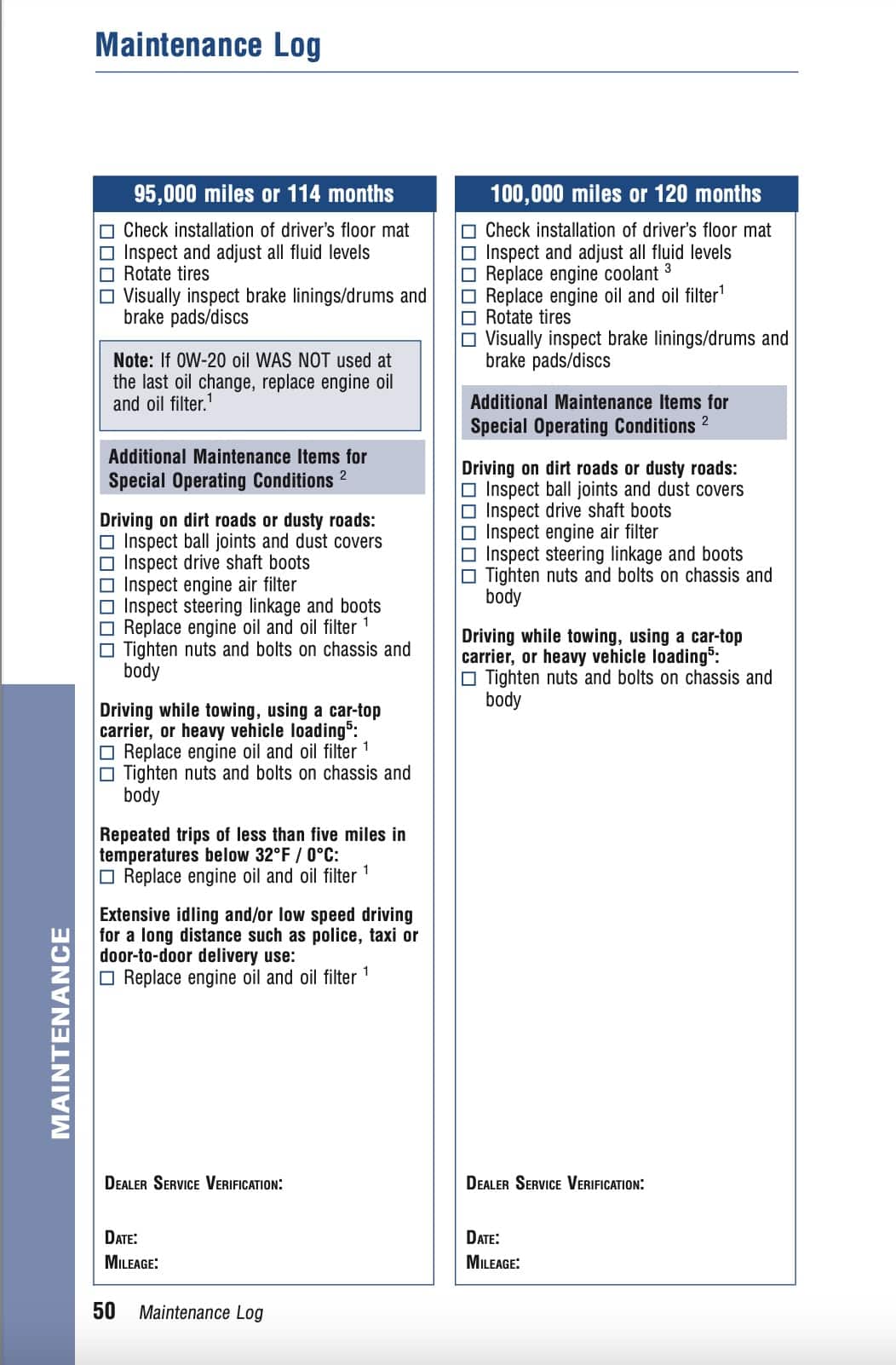
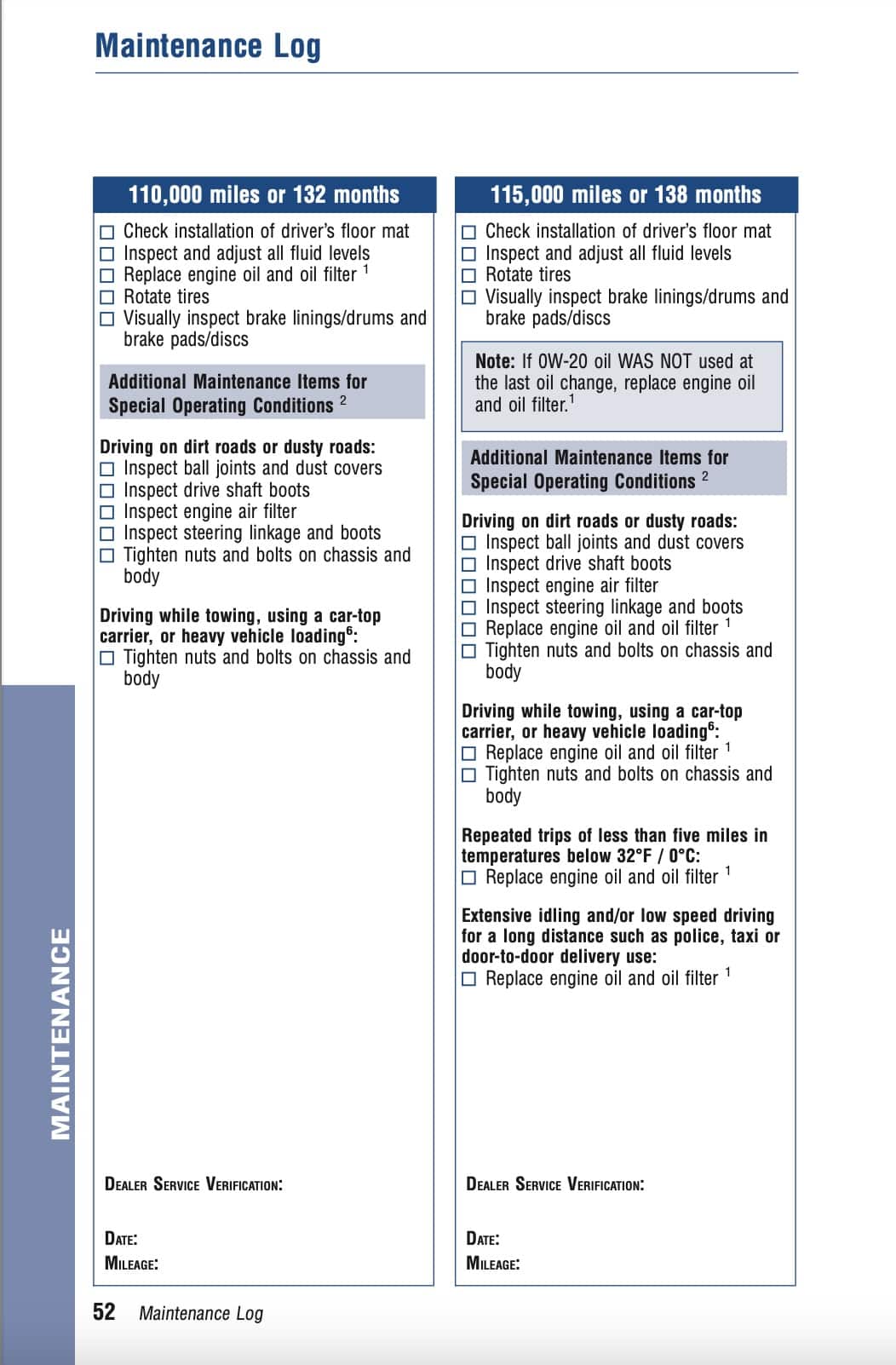
Toyota also lists additional maintenance items for special operating conditions. For the Toyota Corolla 10th Gen, these apply if the vehicle is regularly driven on dirt roads or dusty roads, or if it is used for towing.
Under these conditions, certain items require closer attention and, in some cases, earlier replacement rather than inspection. This most commonly affects engine oil and related drivetrain components, as well as suspension and steering parts that are exposed to dust or added load.
If your driving is mostly normal commuting with a mix of city and highway use, you can follow the standard maintenance table. If the vehicle is frequently driven on dusty roads or used for towing, refer to the additional maintenance section and adjust the schedule accordingly.
| Item | Dirt or Dusty Roads | Towing or Heavy Load | Extensive Idling | Repeated Short Trips Cold |
|---|---|---|---|---|
| Inspect ball joints and dust covers | ✓ | |||
| Inspect drive shaft boots | ✓ | |||
| Inspect engine air filter | ✓ | |||
| Inspect steering linkage and boots | ✓ | |||
| Replace engine oil and oil filter | ✓ | ✓ | ✓ | ✓ |
| Replace front differential oil | ✓ | |||
| Replace front differential oil (manual transmission only) | ✓ | |||
| Replace manual transmission oil | ✓ | |||
| Replace transmission fluid or oil | ✓ | |||
| Tighten nuts and bolts on chassis and body | ✓ | ✓ |
Periodic Maintenance
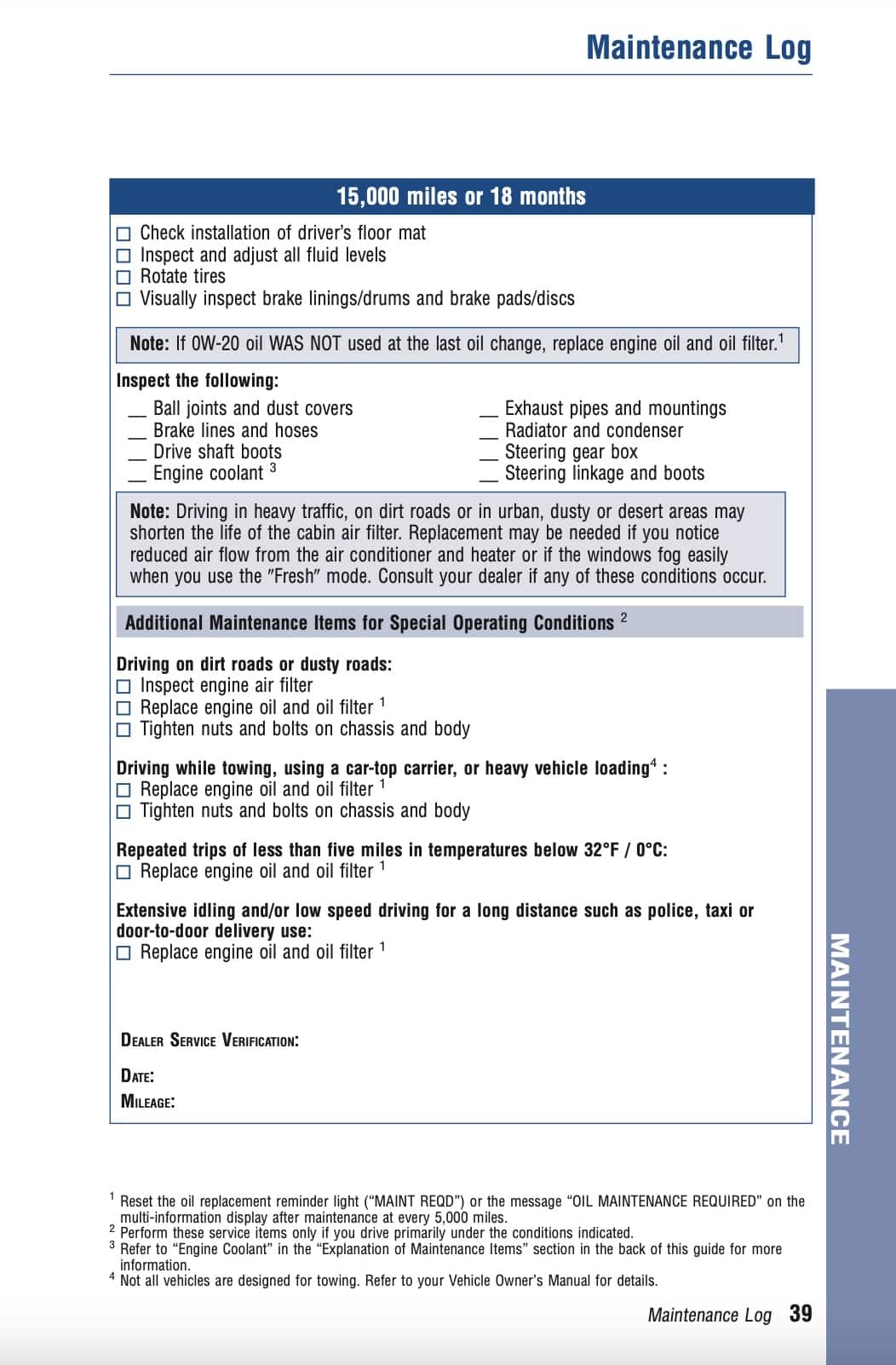
In addition to completing all items listed under Regular Maintenance (5,000 miles / 6 months), also perform the following periodic maintenance tasks.
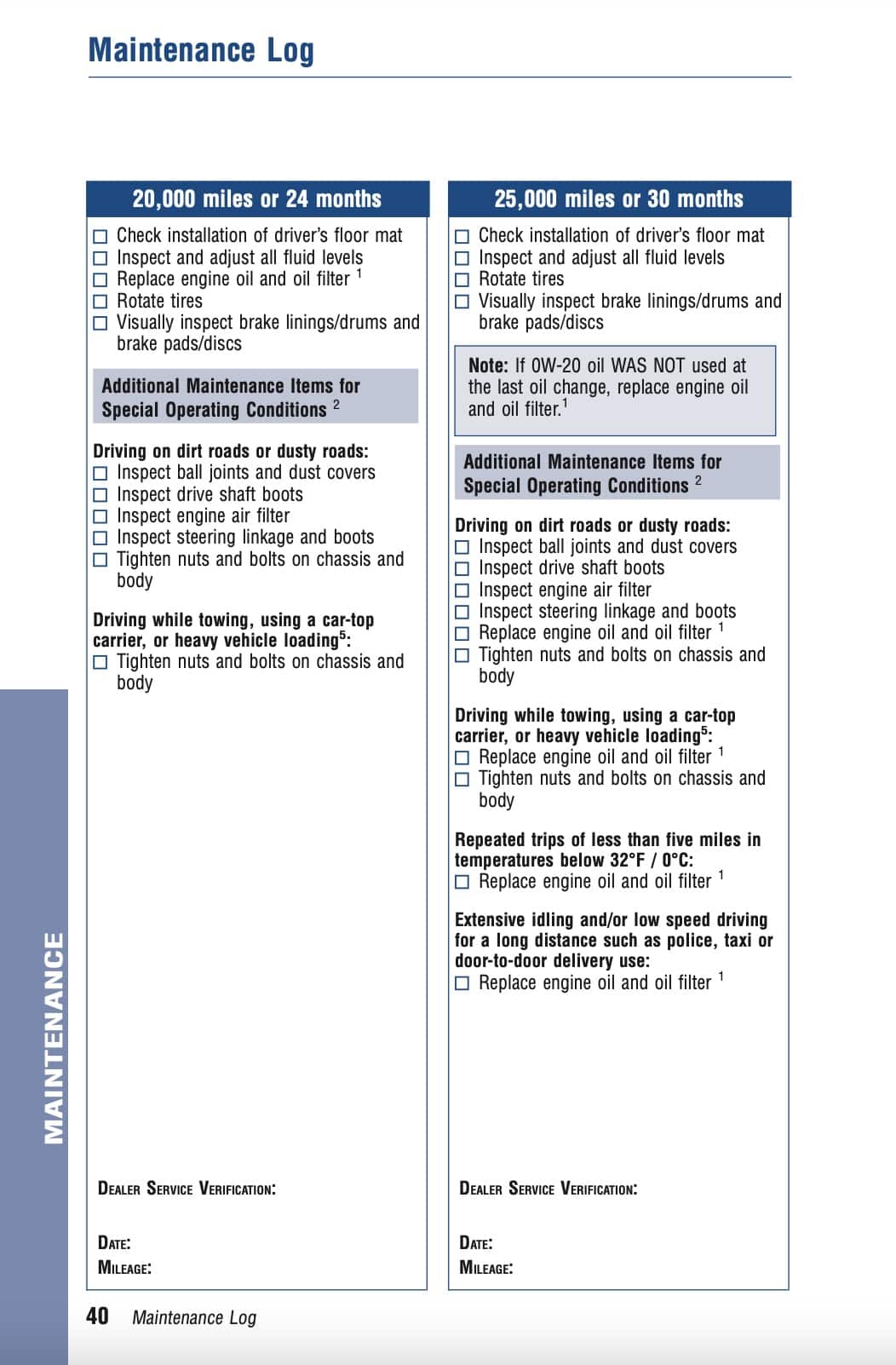
Periodic maintenance items occur between 10,000 miles – 15,000 miles or 12 months – 18 months, whichever comes first. These services introduce additional scheduled replacements beyond the routine oil and filter changes, and they build on the regular maintenance rather than replacing it.
| miles x 1000 | 10 | 15 | 20 | 25 |
|---|---|---|---|---|
| time (months) | 12 | 18 | 24 | 30 |
| Inspect ball joints and dust covers | ✓ | |||
| Inspect brake lines and hoses | ✓ | |||
| Inspect drive shaft boots | ✓ | |||
| Inspect engine coolant | ✓ | |||
| Inspect exhaust pipes and mountings | ✓ | |||
| Inspect radiator and condenser | ✓ | |||
| Inspect steering gear box | ✓ | |||
| Inspect steering linkage and boots | ✓ | |||
| Replace engine oil and oil filter* | ✓ | ✓ | ||
| Replace engine oil and oil filter (if 0W-20 not used previously)* | ✓ | ✓ |
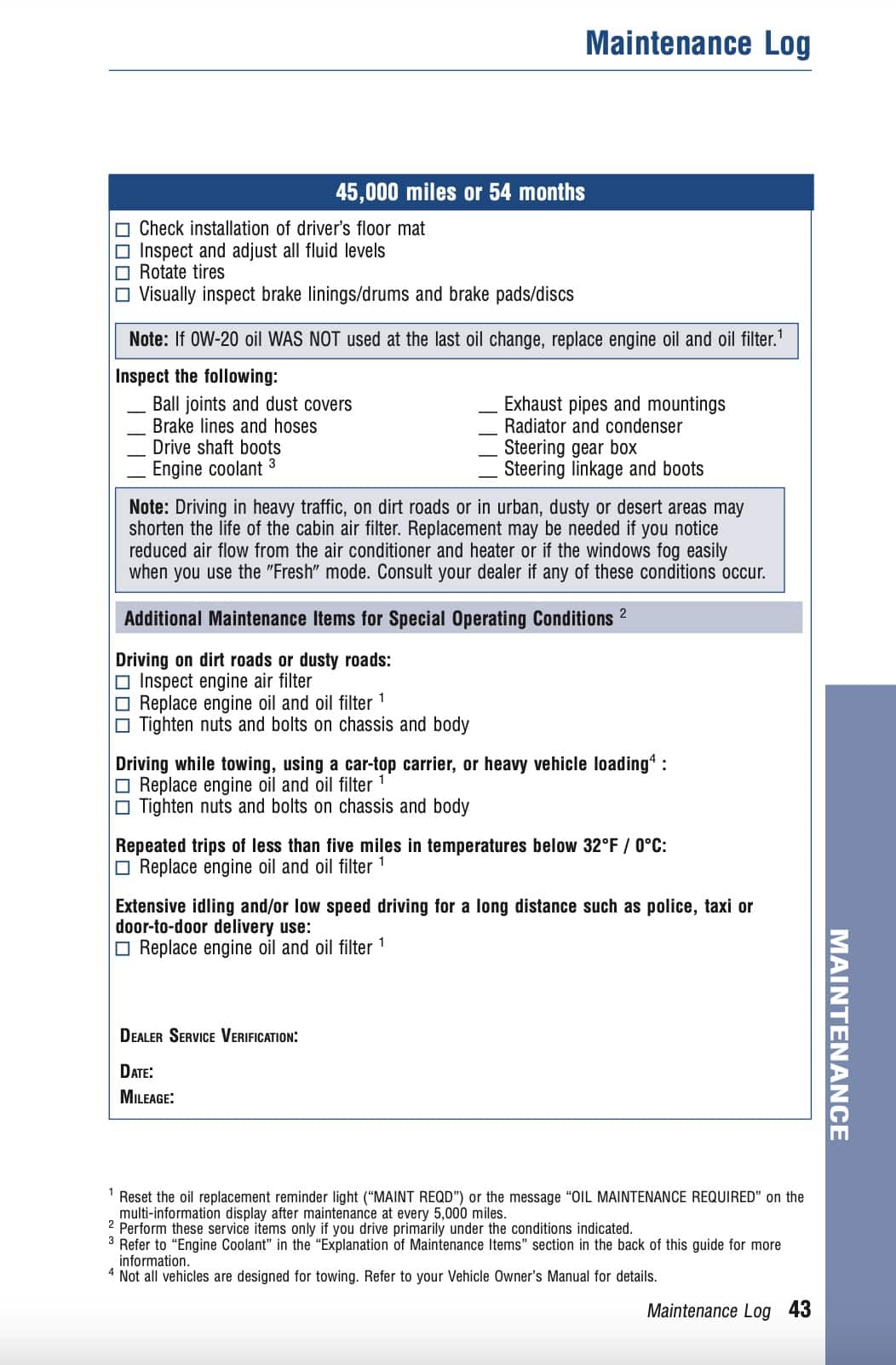
*If 0W-20 oil is used, the engine oil and filter are replaced every 10,000 miles or 12 months. If 0W-20 was NOT used in the last oil change, Toyota requires an additional oil change at 15,000 miles or 18 months, before returning to the normal 10,000-mile interval once 0W-16 is used again.
Long-Term Service Intervals
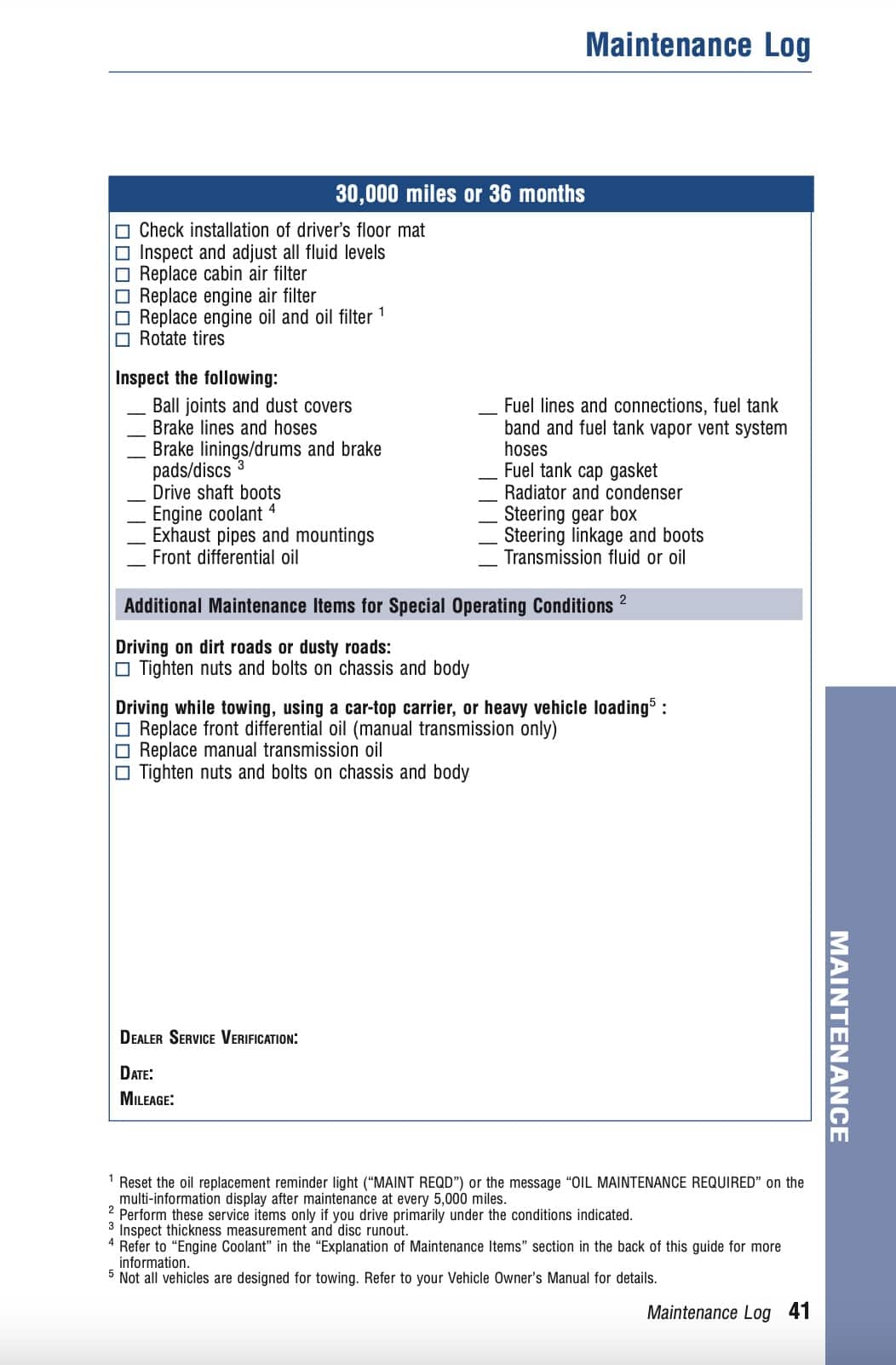
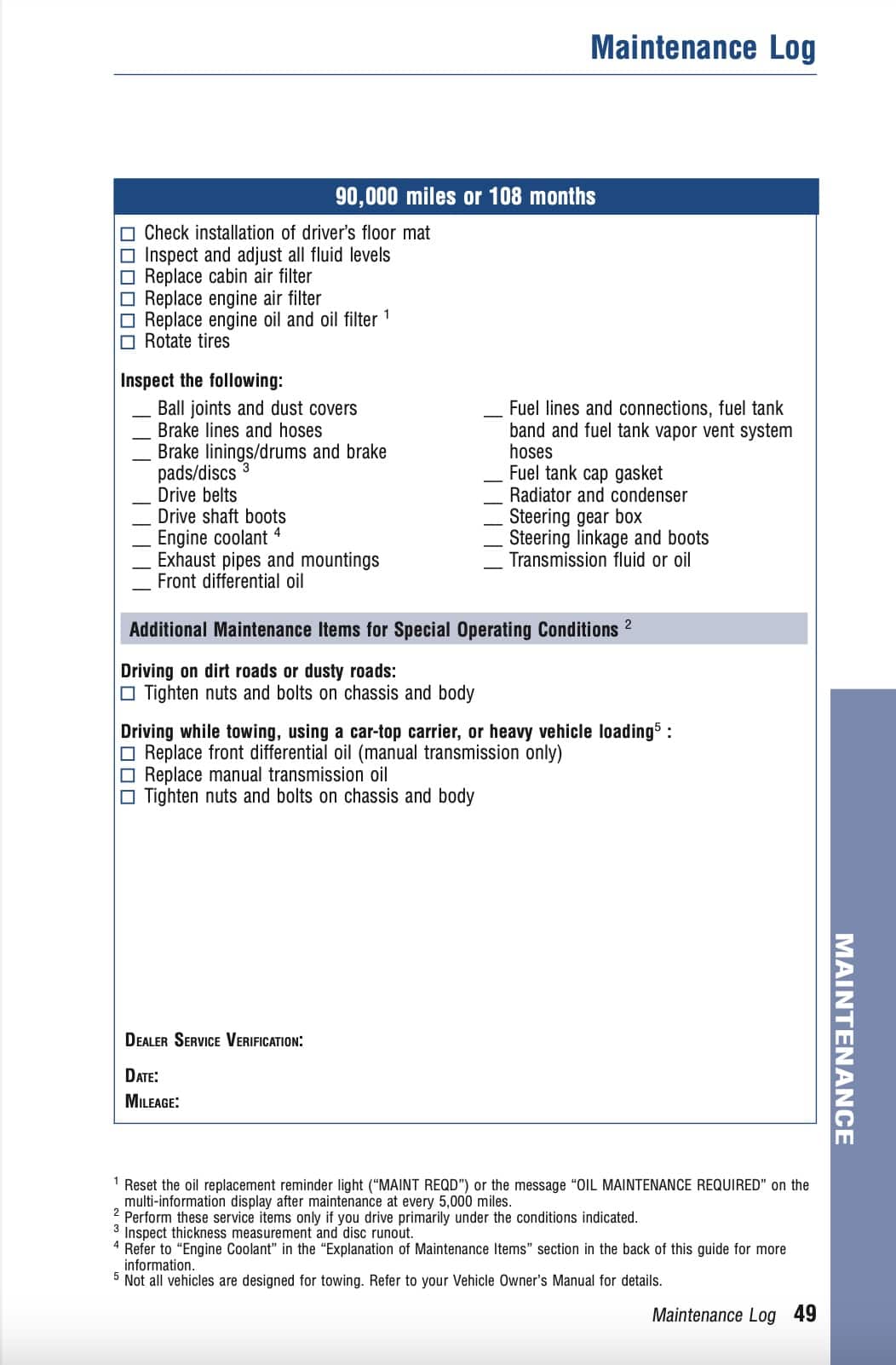
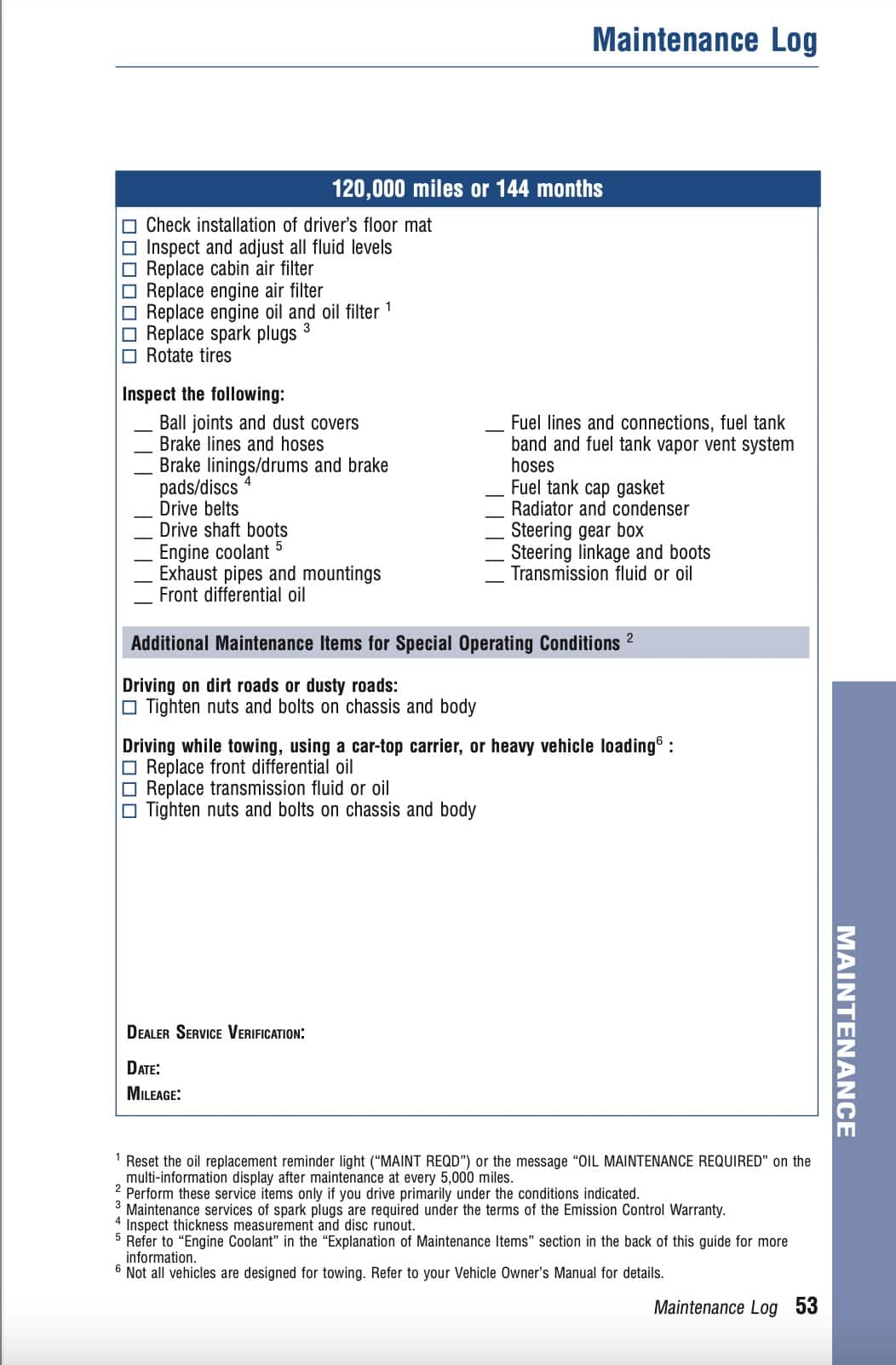
The following tasks are required less frequently, at longer mileage and time intervals. While they are not part of the regular 5,000-mile service, they are essential for long-term performance and reliability. Refer to the maintenance schedule table below for the exact mileage or time requirement, and follow whichever comes first.
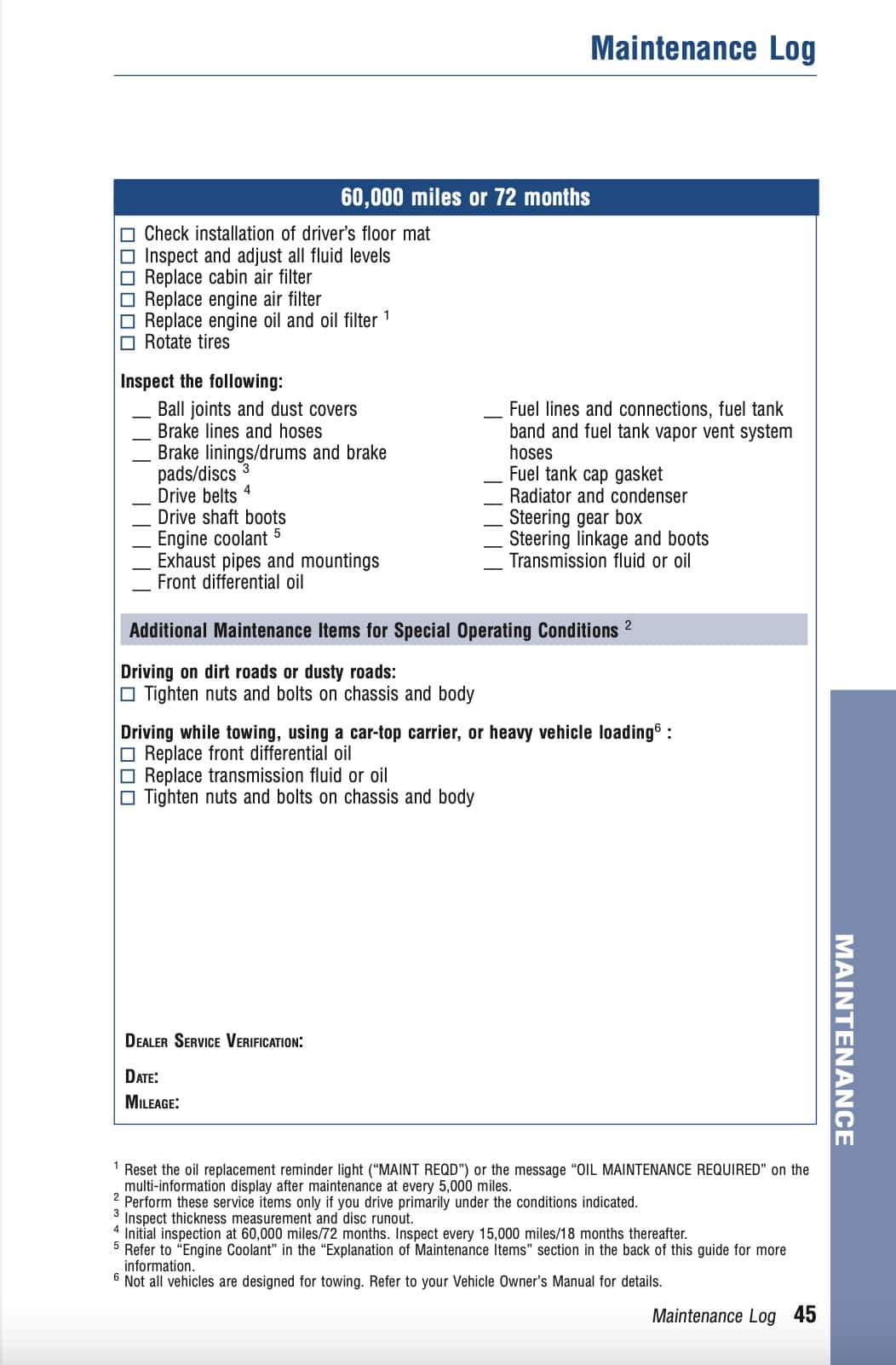
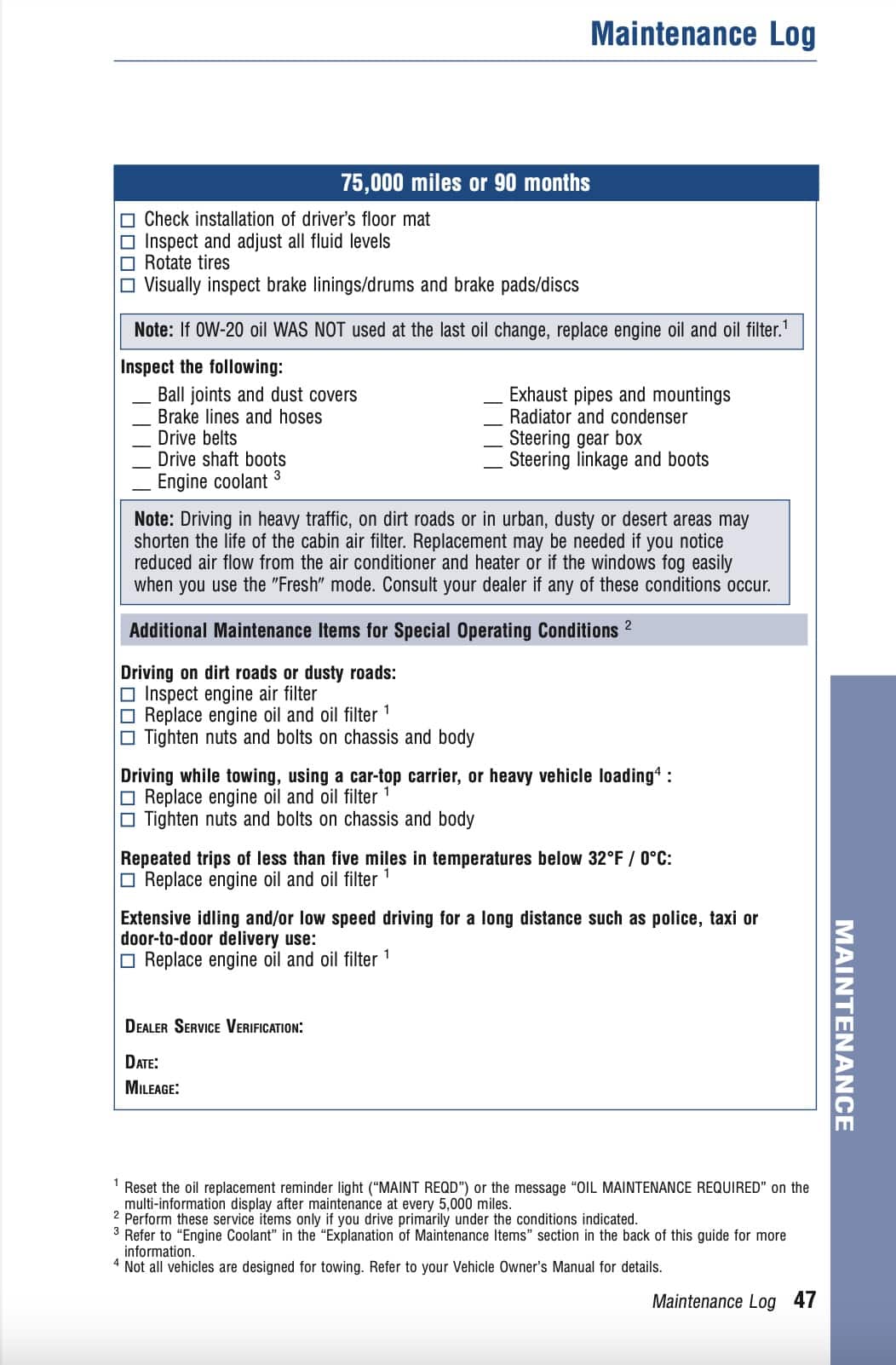
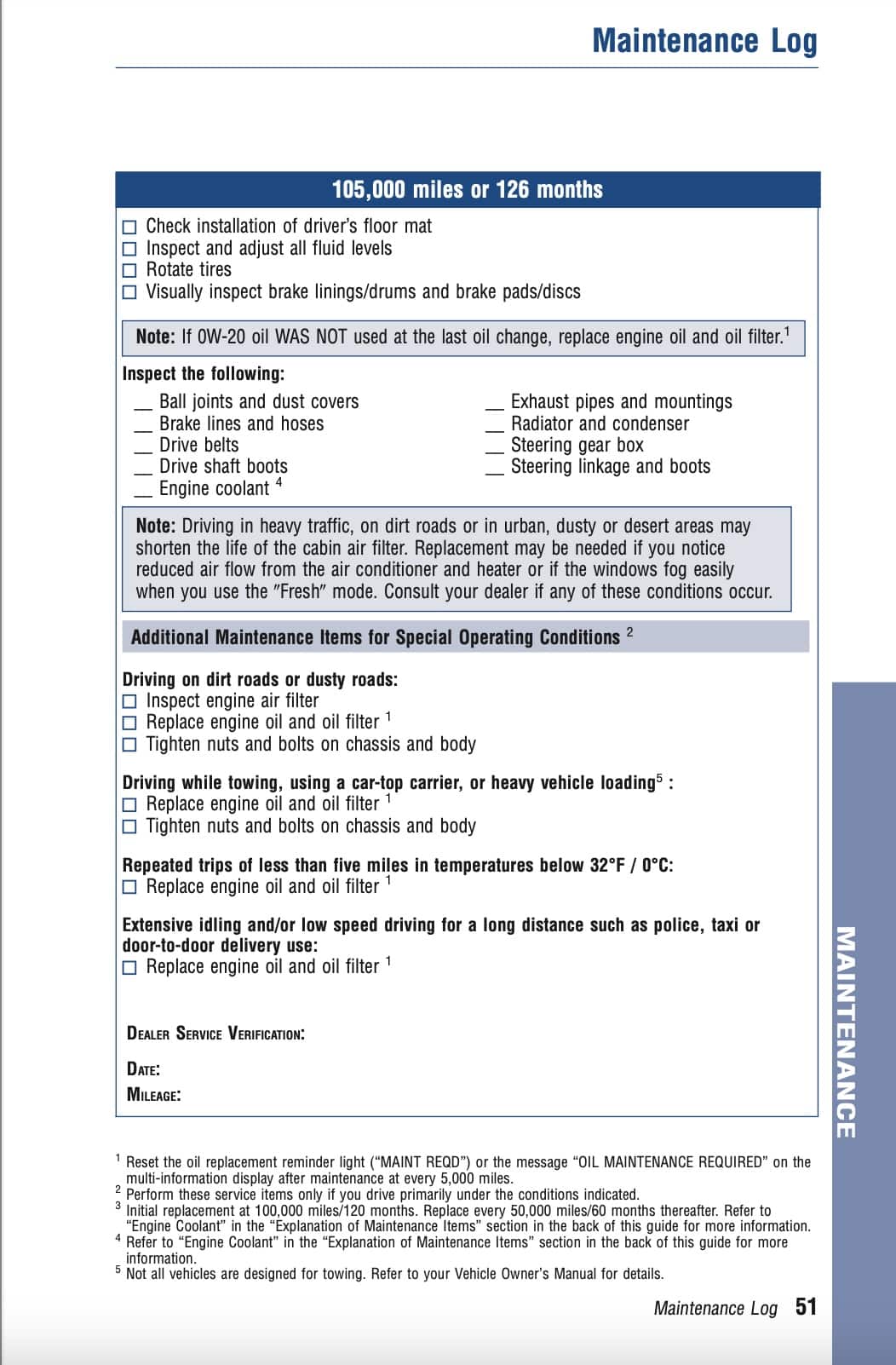
Note: Drive belts receive their first inspection at 60,000 miles or 72 months, and must then be inspected every 15,000 miles or 18 months thereafter.
| miles x 1000 | 30 | 60 | 75 | 90 | 100 | 105 | 120 |
|---|---|---|---|---|---|---|---|
| time (months) | 36 | 72 | 90 | 108 | 120 | 126 | 144 |
| Inspect brake linings/drums and brake pads/discs | ✓ | ✓ | ✓ | ✓ | |||
| Inspect drive belts | ✓ | ✓ | ✓ | ✓ | ✓ | ||
| Inspect front differential oil | ✓ | ✓ | ✓ | ✓ | |||
| Inspect fuel lines and connections, fuel tank band and fuel tank vapor vent system hoses | ✓ | ✓ | ✓ | ✓ | |||
| Inspect fuel tank cap gasket | ✓ | ✓ | ✓ | ✓ | |||
| Inspect transmission fluid or oil | ✓ | ✓ | ✓ | ✓ | |||
| Replace cabin air filter | ✓ | ✓ | ✓ | ✓ | |||
| Replace engine air filter | ✓ | ✓ | ✓ | ✓ | |||
| Replace engine coolant | ✓ | ||||||
| Replace spark plugs | ✓ |
Perform the following long-term maintenance tasks if the vehicle is regularly used for towing.
| miles x 1000 | 30 | 60 | 90 | 120 |
|---|---|---|---|---|
| time (months) | 36 | 72 | 108 | 144 |
| Replace front differential oil | ✓ | ✓ | ||
| Replace front differential oil (manual transmission only) | ✓ | ✓ | ||
| Replace manual transmission oil | ✓ | ✓ | ||
| Replace transmission fluid or oil | ✓ | ✓ |
Tire sizes and pressures for the Toyota Corolla 10th Gen (2011-2013)
Toyota Corolla tire sizes range from 15-inch to 17-inch. The following lists the tire sizes and recommended tire pressures for the Toyota Corolla 10th Gen (2011-2013).
| Wheel/Tire | Size | Pressure (cold) |
|---|---|---|
| Type A: Front | P195/65R15 89S | 30 psi / 210 kPa |
| Type A: Rear | P195/65R15 89S | 30 psi / 210 kPa |
| Type B: Front | P205/55R16 89H | 32 psi / 220 kPa |
| Type B: Rear | P205/55R16 89H | 32 psi / 220 kPa |
| Type C: Front | P215/45R17 87W | 32 psi / 220 kPa |
| Type C: Rear | P215/45R17 87W | 32 psi / 220 kPa |
About the Toyota Corolla 10th Gen (2011-2013)
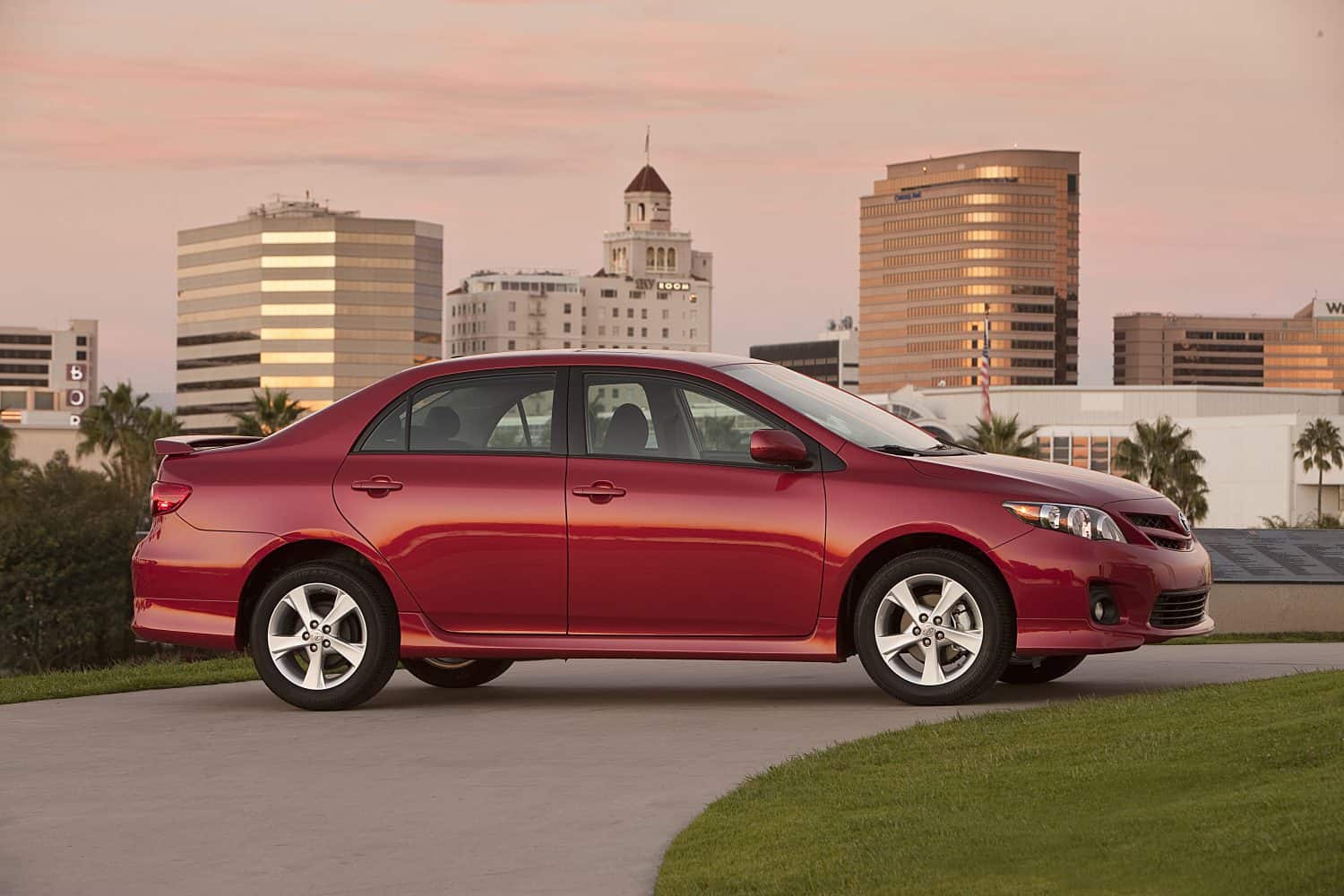
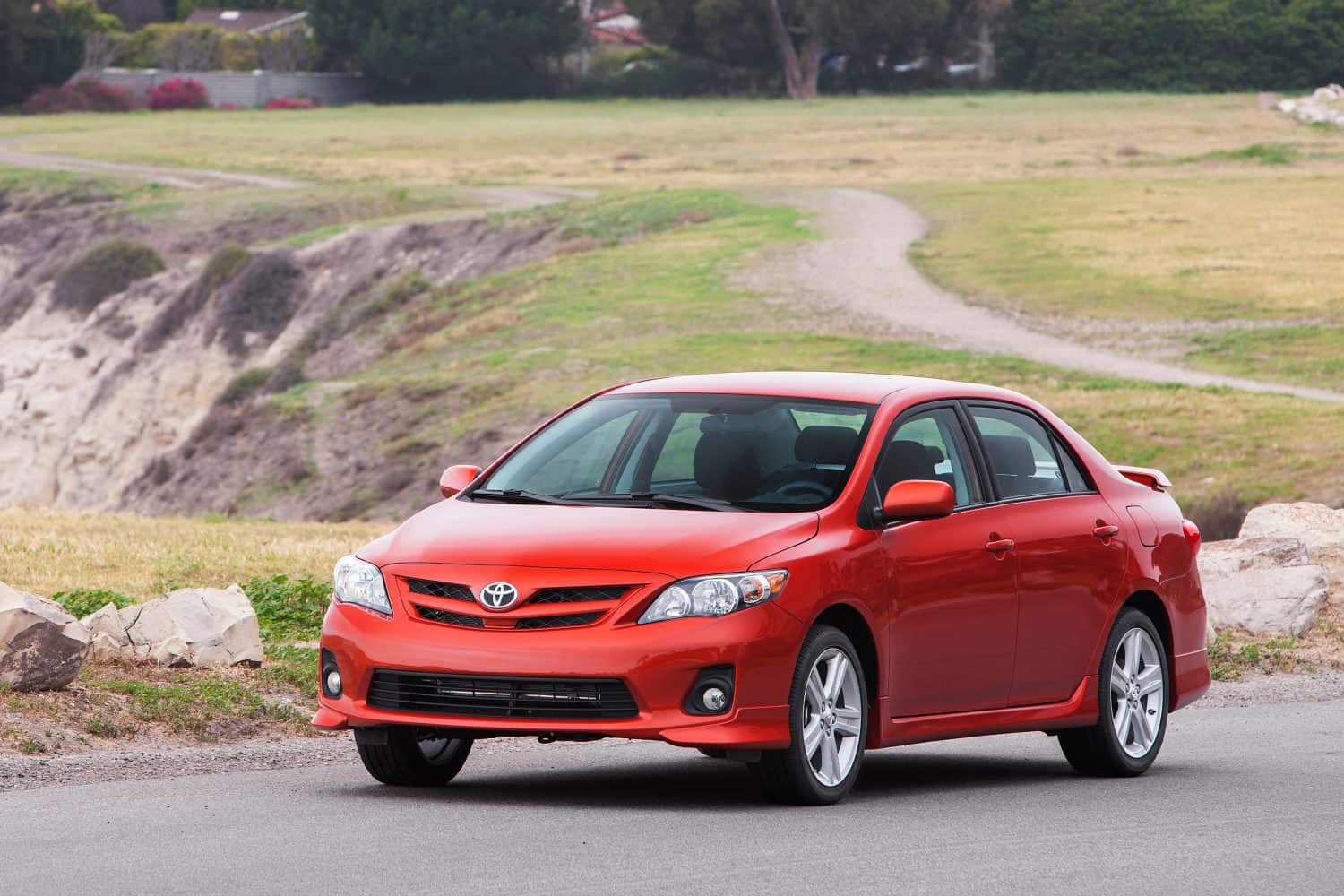
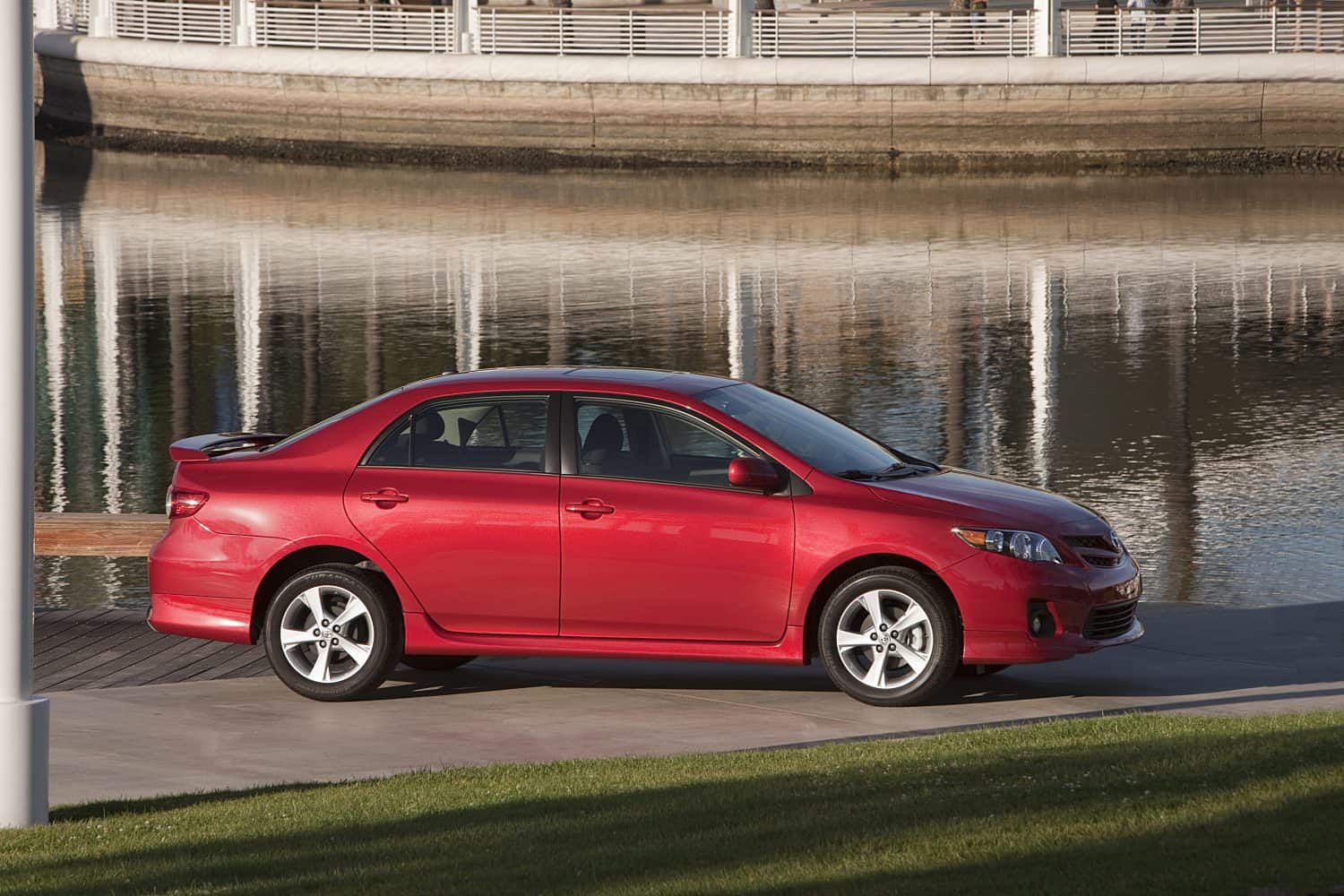
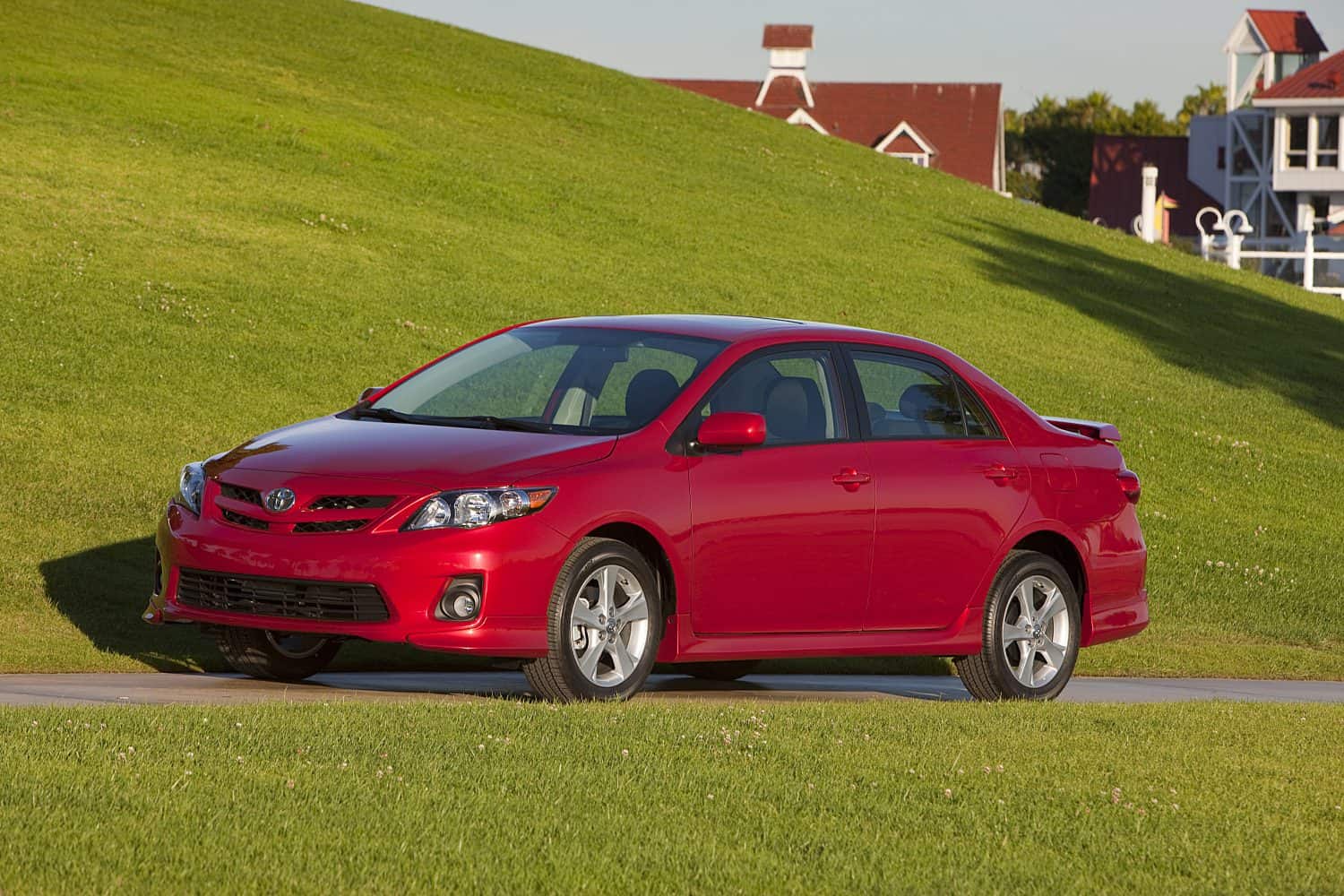
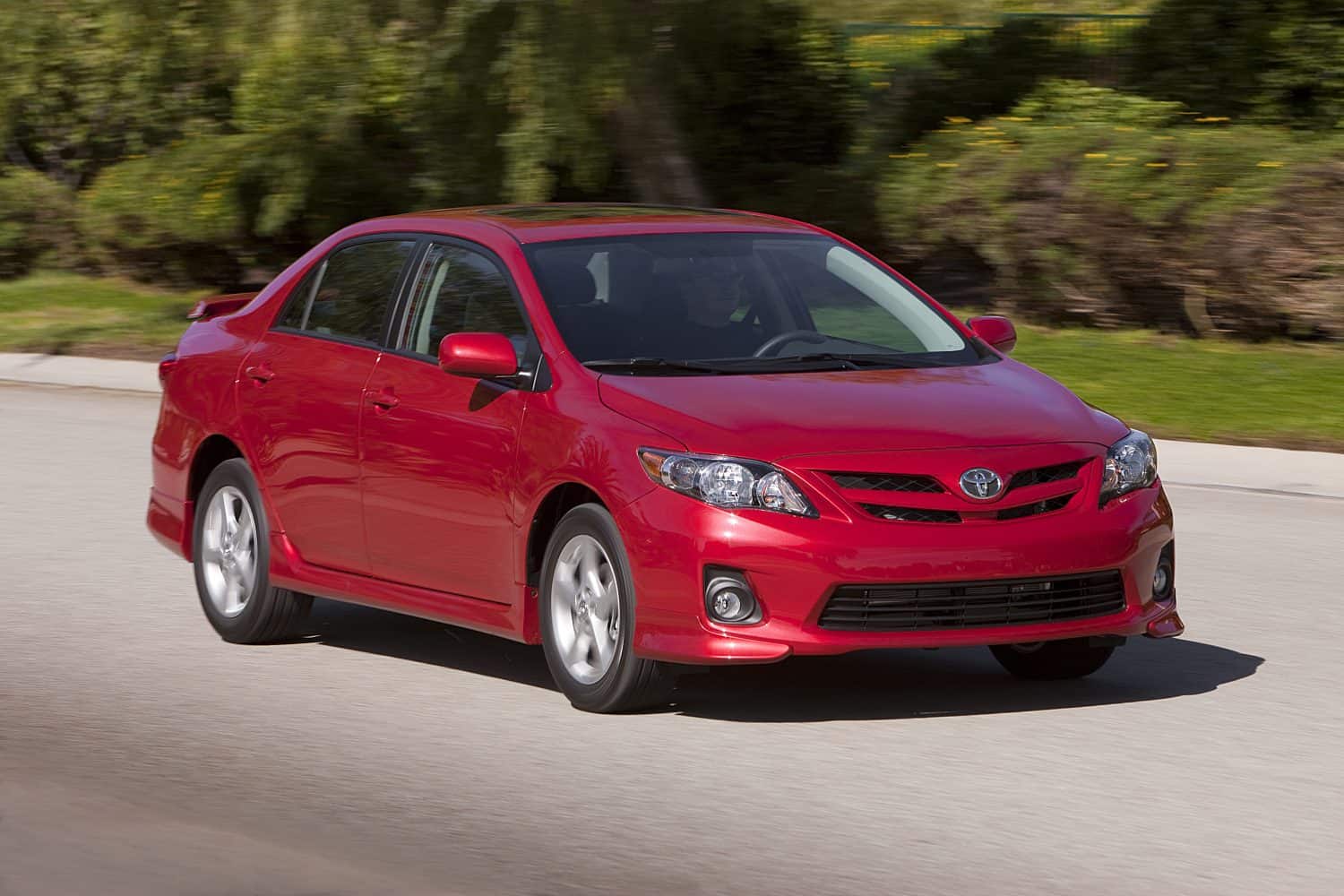


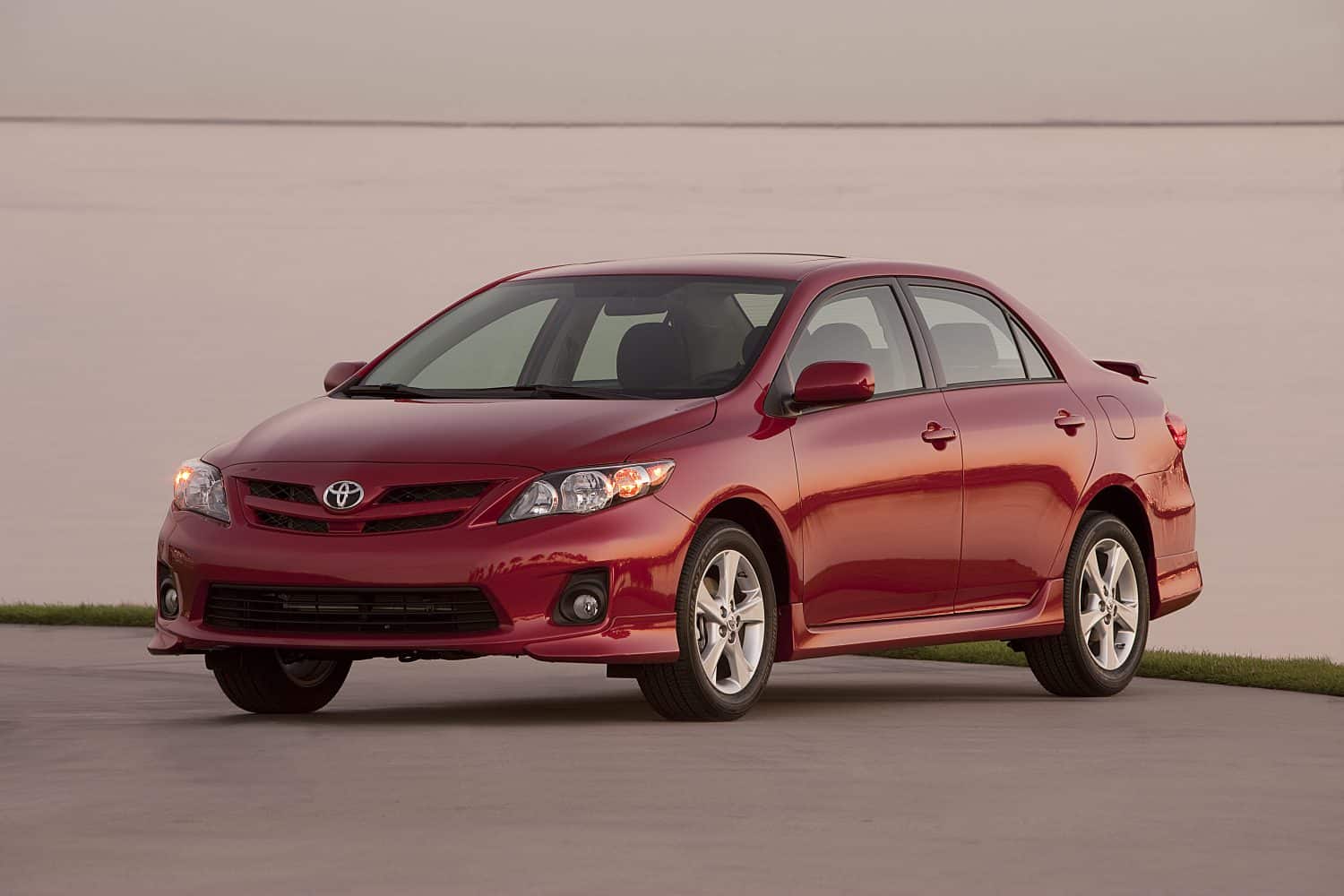
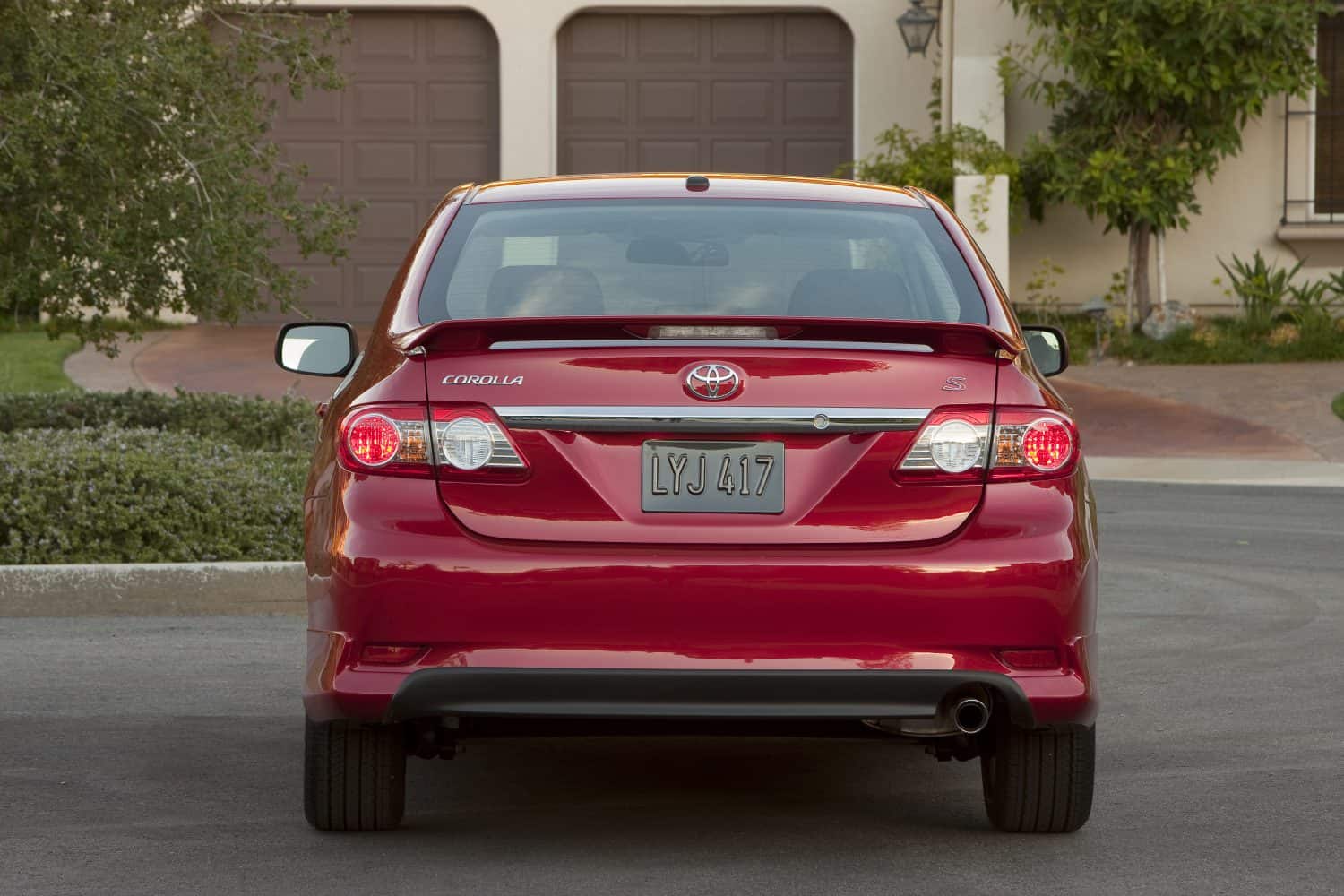
The Toyota Corolla 10th Gen (2011–2013) is the steady hand in the compact sedan world. By this point in its life cycle, Toyota had already refined the formula introduced in 2009, so what you get here is a mature, well-sorted version of a car designed to do one thing very well: daily transport with minimal fuss.
Under the hood sits the 1.8-liter 2ZR-FE inline four-cylinder engine. It is an aluminum block and head design with Dual VVT-i on both intake and exhaust cams, making 132 horsepower at 6,000 rpm and 128 lb-ft of torque at 4,400 rpm. It runs happily on regular 87-octane fuel. Buyers could choose between a five-speed manual or a four-speed electronically controlled automatic. The automatic is not cutting-edge by modern standards, but it is simple, durable, and predictable. The manual adds a bit of engagement for drivers who want it.
On the road, the Corolla feels light and straightforward. The front suspension uses a MacPherson strut setup, while the rear relies on a torsion beam design. It is not exotic, but it is compact, durable, and well suited to the car’s mission. Electric power steering keeps effort light at parking speeds and settles down at highway pace. Braking is handled by 10.7-inch ventilated front discs and 9.0-inch rear drums. It is a simple setup, but effective and easy to service.
Trim levels for 2011–2013 include L, LE, and S. Mechanically, they are the same. The differences are mostly in equipment and appearance.
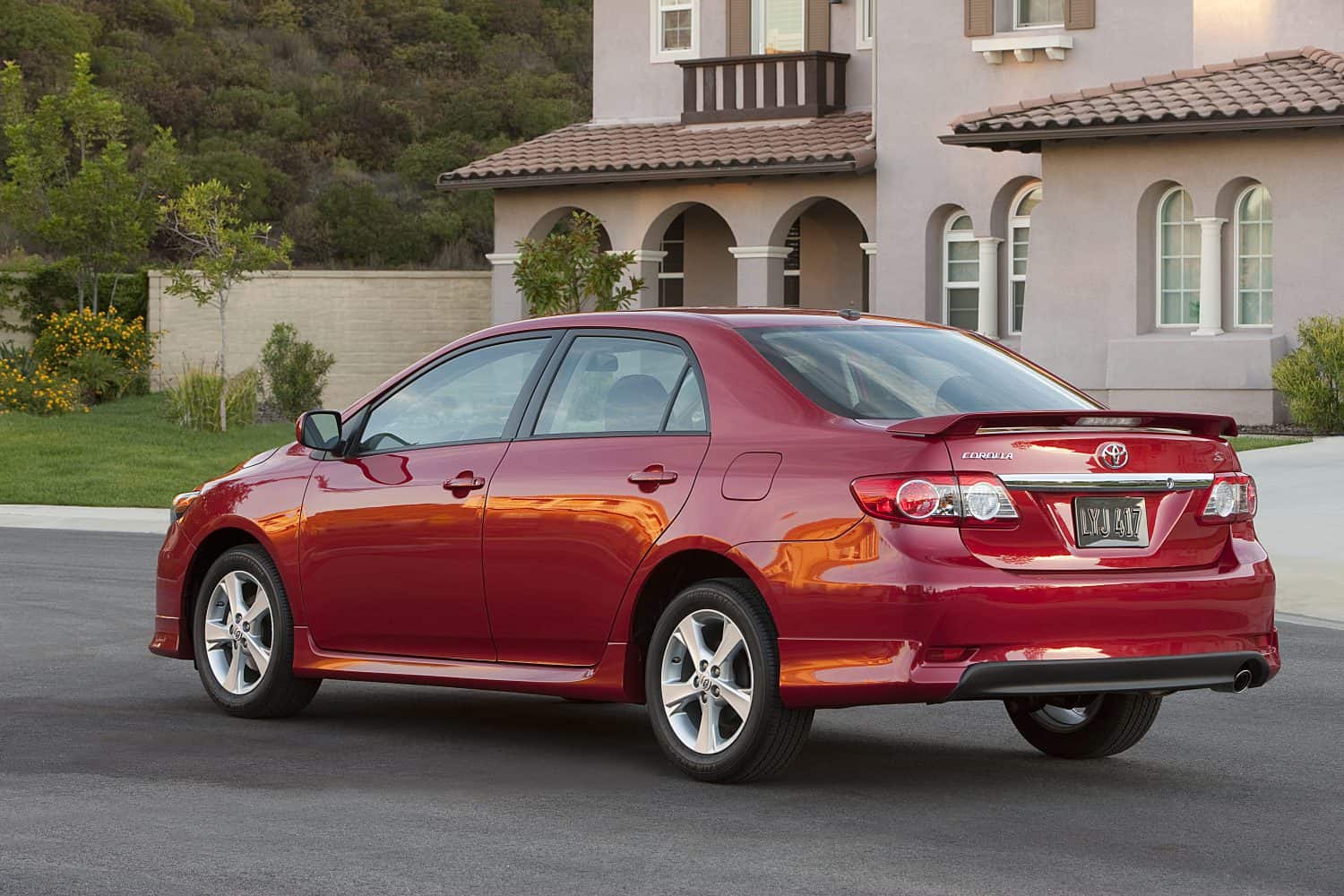
The L or Base model keeps things simple with 15-inch steel wheels and straightforward interior trim. The LE adds comfort features like cruise control, upgraded audio, and available premium packages. The S is the sporty one, with 16-inch alloy wheels, a body kit, rear spoiler, fog lamps, and sport-themed interior touches. None of these change the engine, suspension, or brake hardware.
For 2011, Toyota refreshed the exterior with revised front and rear styling, along with some interior updates. The structure, powertrain, and suspension remained unchanged. Safety features are strong for the class, with standard Vehicle Stability Control, Traction Control, ABS, Electronic Brake-force Distribution, Brake Assist, and Smart Stop Technology.
From a maintenance standpoint, the 2011–2013 Corolla is straightforward. Regular service occurs every 5,000 miles or six months, with oil change intervals dependent on oil specification. The 2ZR-FE engine is transverse-mounted and relatively easy to access for routine work. Spark plugs are long-life items, and coolant and brake service follow predictable schedules.
What stands out most about this Corolla is how little drama it brings. It is not trying to be a sports sedan or a luxury car. It is an honest compact with a proven engine, uncomplicated suspension, and parts that are widely available. For someone who values consistency and low operating costs over flash, the Toyota Corolla 10th Gen (2011–2013) makes a strong case for itself.
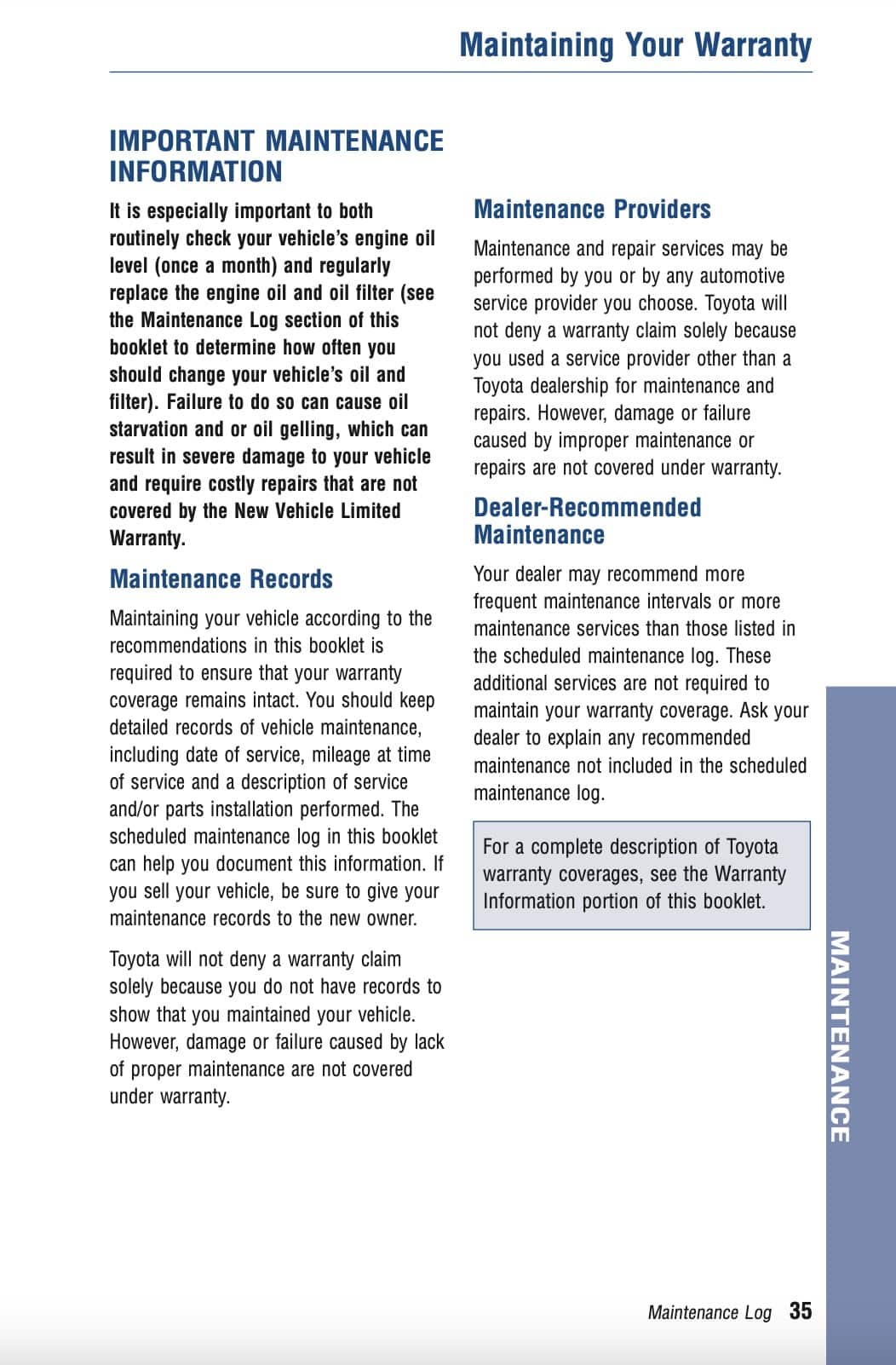
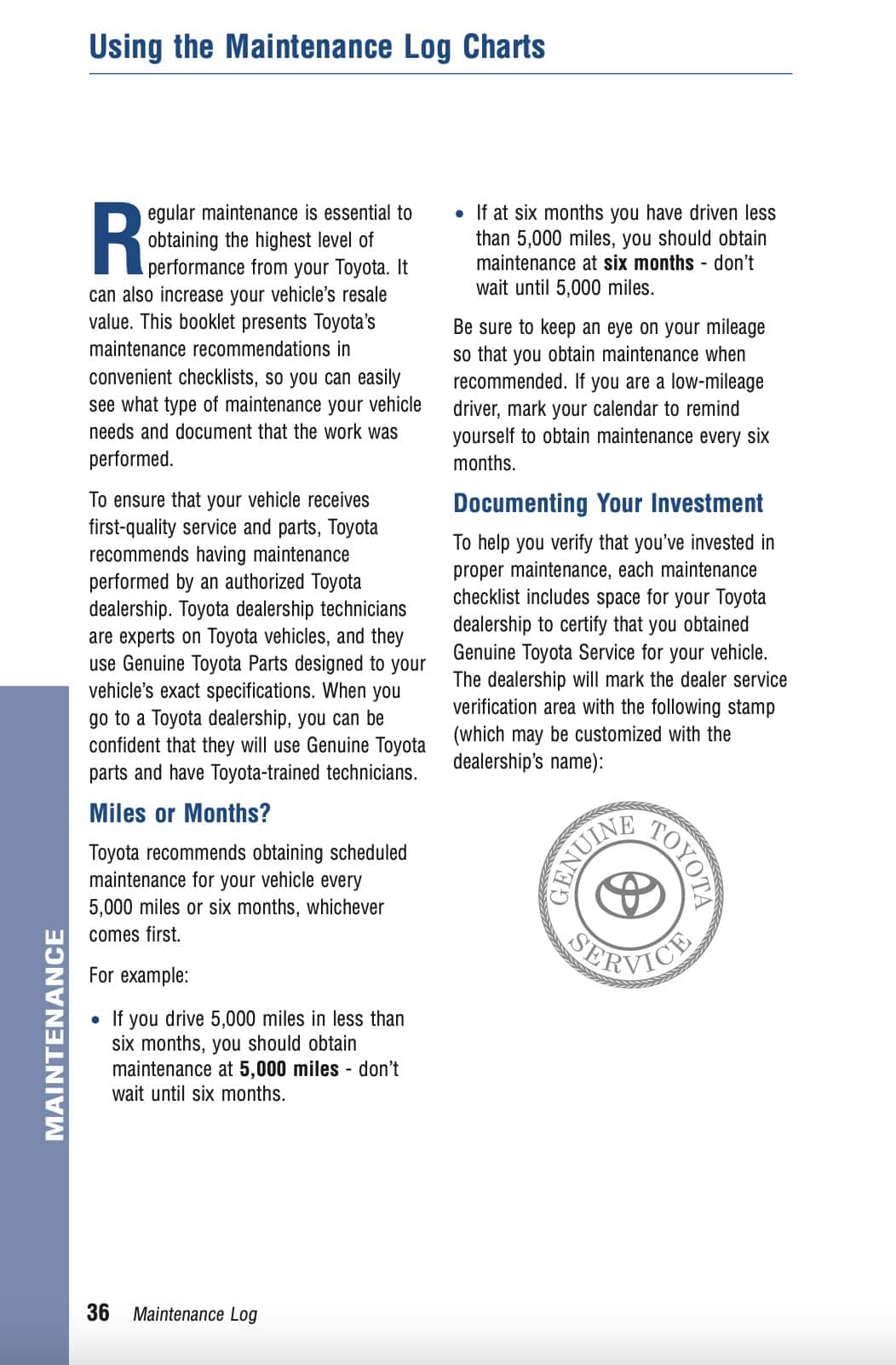
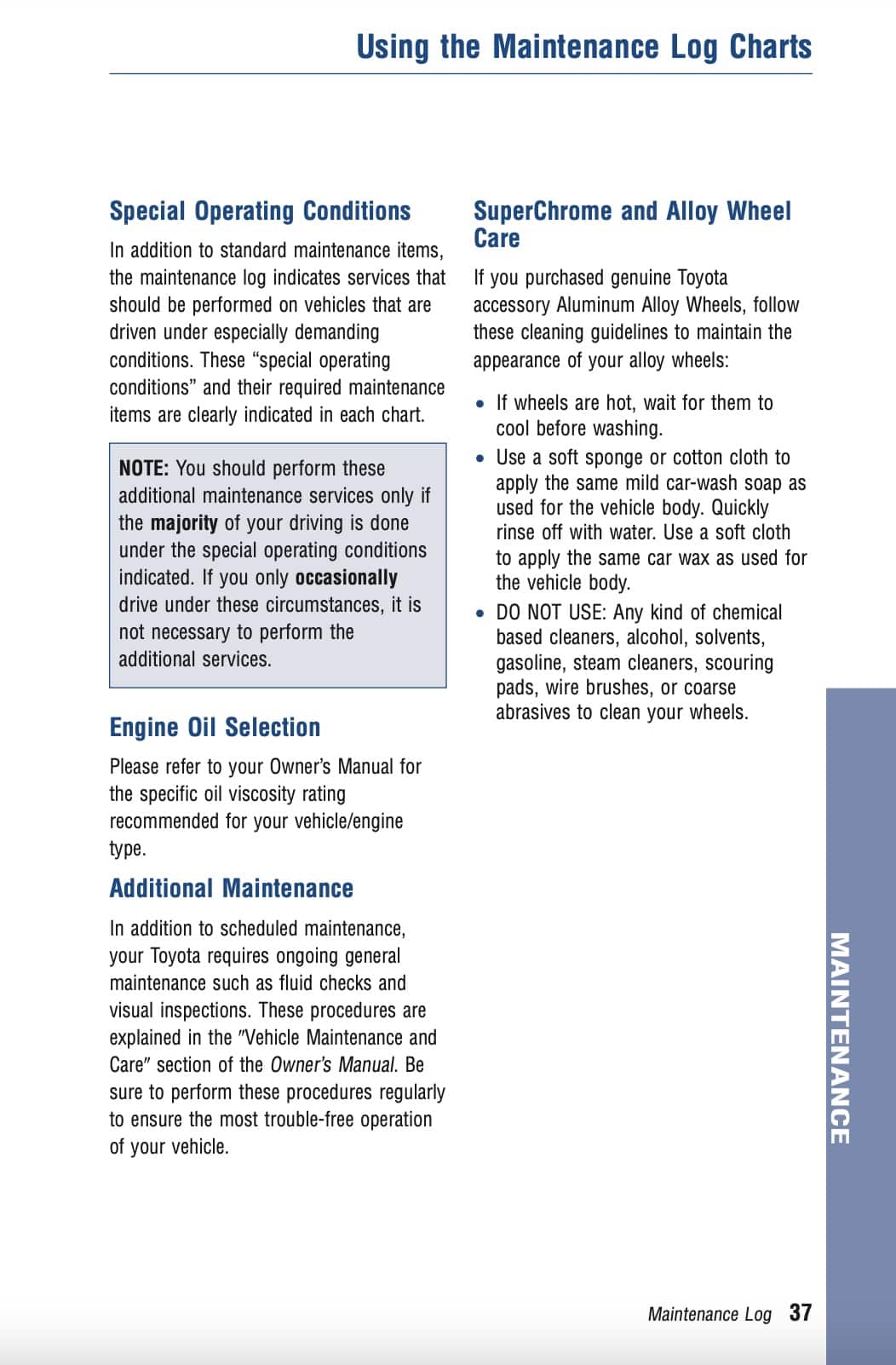
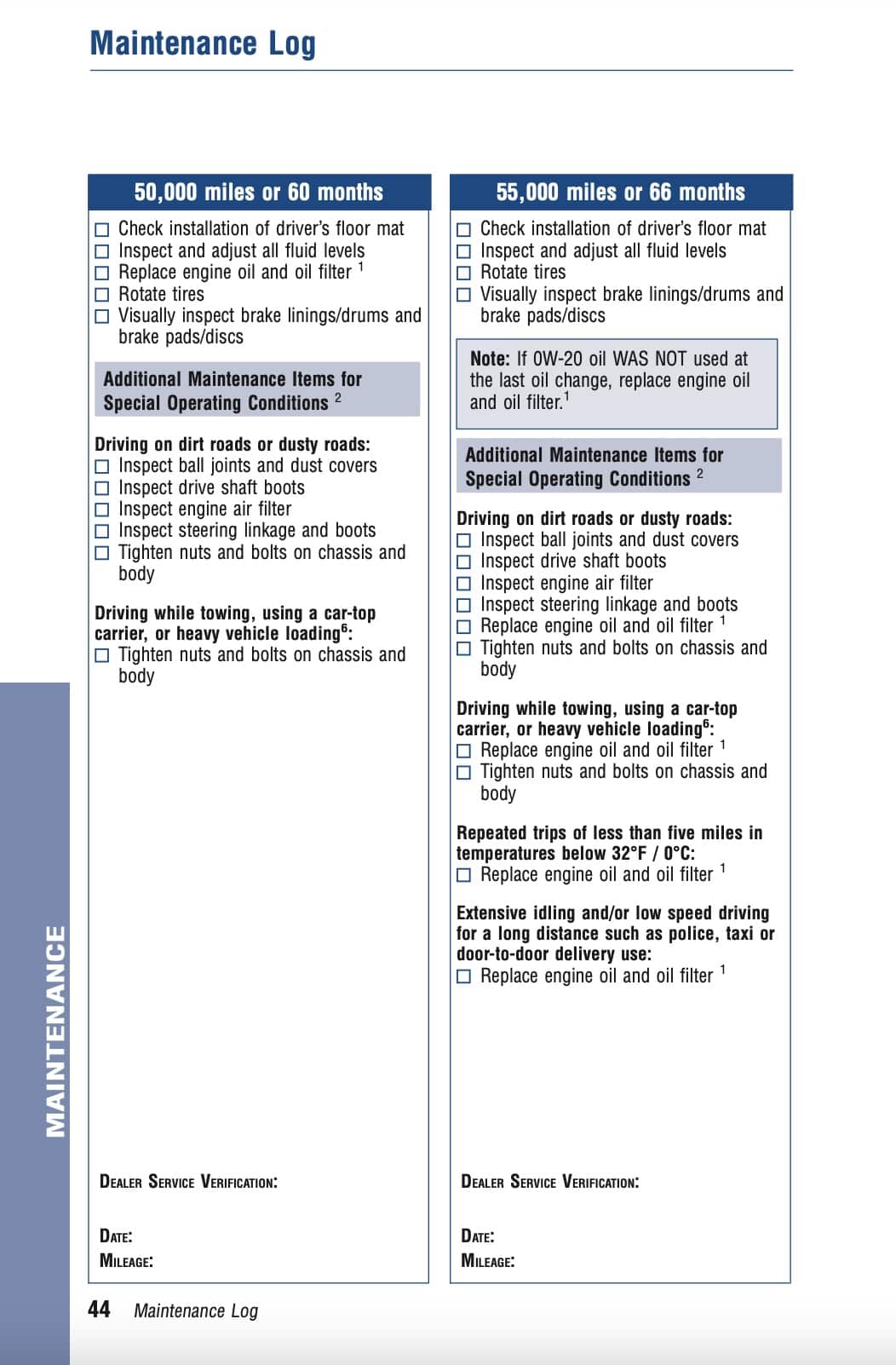
References — Screenshots from the Toyota Corolla 10th Gen (2011-2013) Owner’s Manual
Below is a selection of screenshots from the maintenance schedule for the Toyota Corolla 10th Gen (2011–2013) from the official manual.