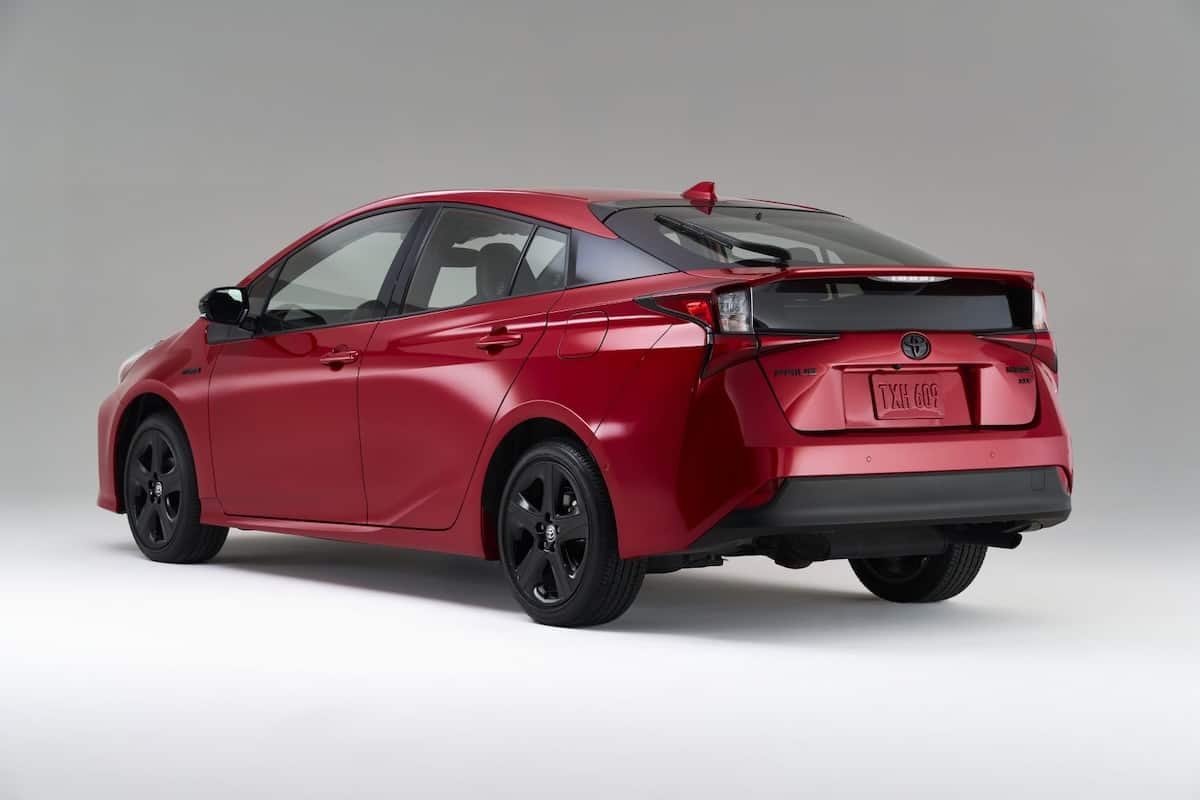
Prius 4th gen XW50 (2016-2021) Maintenance Schedule and Service Intervals

This is the maintenance schedule and associated service intervals for the Prius 4th gen XW50, covering model years 2016 to 2021. The Prius 4th gen XW50 is built on Toyota’s TNGA GA-C platform and uses a consistent hybrid powertrain architecture throughout its production run.
All variants are based around the same fundamental mechanical layout:
- A 1.8 L 2ZR-FXE inline four-cylinder petrol engine operating on the Atkinson cycle
- Toyota Hybrid Synergy Drive with a power-split eCVT
- Dual motor-generator system integrated into the transaxle
- Front-engine layout with front-wheel drive as standard (AWD-e available in some markets from later years, using an additional rear motor)
The following models share the same core mechanical basis and maintenance requirements:
- Prius L Eco (FWD, lithium-ion battery)
- Prius LE (FWD or AWD-e depending on market and year)
- Prius XLE (FWD or AWD-e depending on market and year)
- Prius Limited (FWD)
- Prius 2020 Edition (FWD, based on XLE trim)
(Regional naming and trim availability vary, but the engine, hybrid system, and service requirements remain the same.)
The Prius 4th gen XW50 is also mechanically aligned with the Prius Prime in terms of engine family and platform, though the plug-in hybrid system introduces additional components not covered here.




This site has links for things like oil and spark plugs from which we earn a commission (which unfortunately nobody can save, not even us). If you appreciate this work, then please use those links. Thanks!
Prius 4th gen XW50 (2016-2021) Service Intervals
The basic service interval for the Prius 4th gen XW50 is every 5,000 miles / 8,000 km or 6 months. At each of these services, Toyota specifies inspections rather than replacements. This includes checking and adjusting all fluid levels, rotating tires, inspecting brake pads, discs, and lines, checking wiper blades and exterior lights, and inspecting the hybrid battery cooling air intake and filter.
The Prius 4th gen XW50 uses Toyota’s 1.8 L 2ZR-FXE Atkinson-cycle engine mounted transversely, integrated with the Hybrid Synergy Drive transaxle. The engine bay is relatively open for routine work, there are no accessory drive belts, and most hybrid components are sealed and inspection-based rather than service-heavy.
Engine oil and the oil filter are replaced every 10,000 miles / 16,000 km or 12 months when the specified oil is used. Brake fluid is inspected regularly and typically replaced every 2 years. Engine coolant is first replaced at 100,000 miles / 160,000 km or 10 years, while inverter coolant follows a longer initial interval. These longer-interval items do not change the regular service schedule.
General Notes on Serviceability of the Prius 4th gen XW50 (2016-2021)
- The Prius 4th gen XW50 uses a 1.8 L 2ZR-FXE Atkinson-cycle engine paired with Toyota Hybrid Synergy Drive. Routine engine service is straightforward, but the hybrid system includes high-voltage components that require proper safety procedures and training.
- The vehicle has separate cooling systems for the engine and the inverter. Both use Toyota Super Long Life Coolant and have long service intervals, but fluid condition and levels should be checked regularly.
- Regenerative braking reduces brake wear, so pads and discs often last longer. However, brakes should still be inspected at every service, as corrosion from light use can occur.
- The hybrid battery cooling intake filter should be inspected regularly and cleaned as required, especially in dusty conditions or vehicles frequently carrying pets.
- There are no accessory drive belts, starter motor, or alternator. Hybrid-specific repairs are best handled by technicians familiar with Toyota hybrid systems.
Maintenance schedule for the Prius 4th gen XW50 (2016-2021)
This is the maintenance schedule table for the Prius 4th gen XW50, covering model years 2016 to 2021. It applies to all standard Prius variants built on the XW50 platform, including front-wheel-drive and AWD-e models. The schedule is based on the official Toyota Warranty and Maintenance Guide and Owner’s Manual, but reorganized to make it easier to read and use in practice.
The content is the same as in the manuals, though presented in a clearer and more service-focused format.
The schedule is divided into three parts:
- Regular maintenance: Every 5,000 miles or 6 months, whichever comes first.
- Periodic maintenance: Maintenance tasks that occur between 10,000 miles – 20,000 miles or 12 months – 24 months, whichever comes first.
- Long-term service intervals: Items that require attention at longer, sporadic intervals.
Where Toyota specifies different requirements based on oil type, driving conditions, or drivetrain configuration, those notes are included so the schedule can be followed accurately without referring back to the manual.
Regular Maintenance
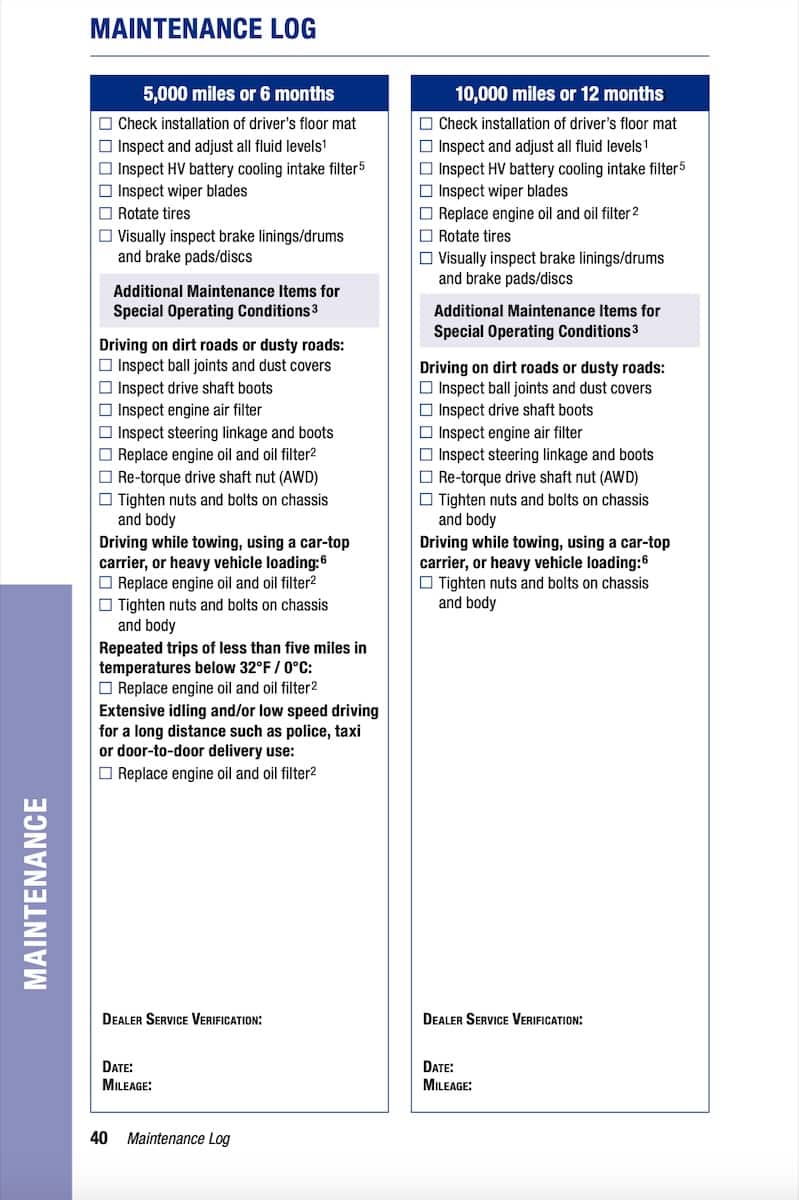
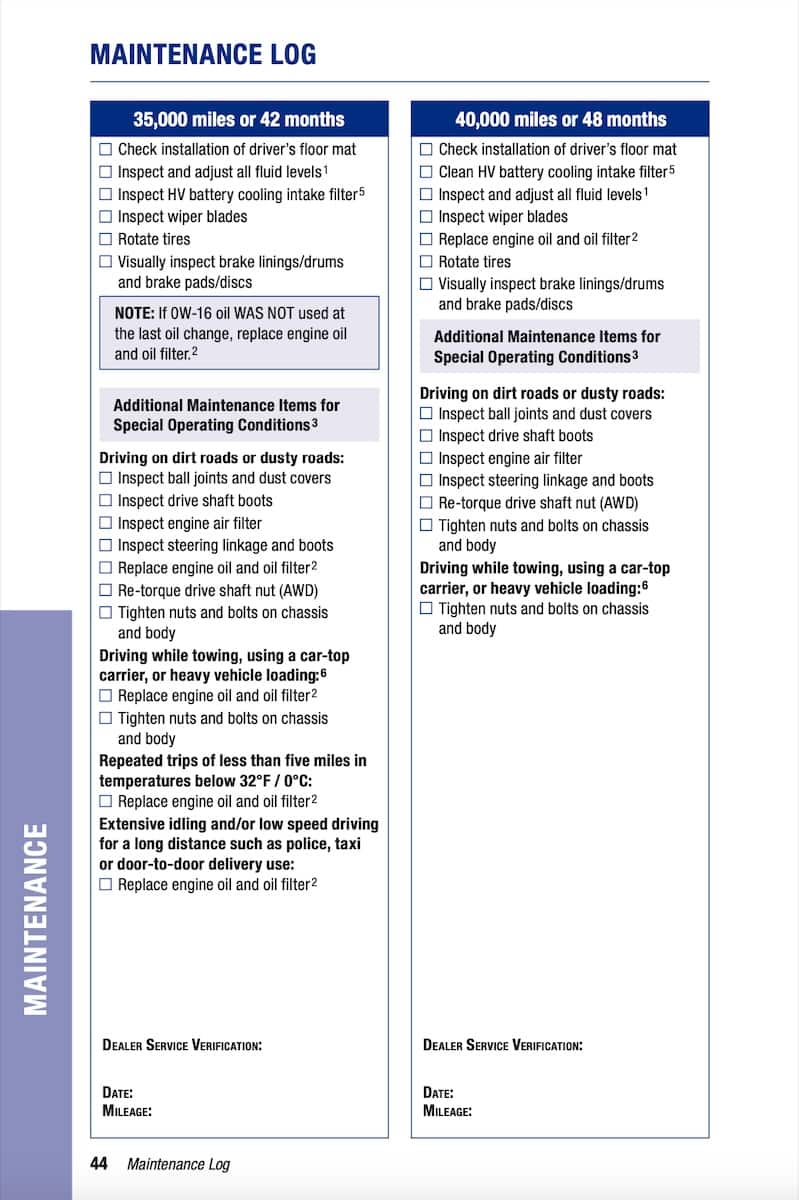
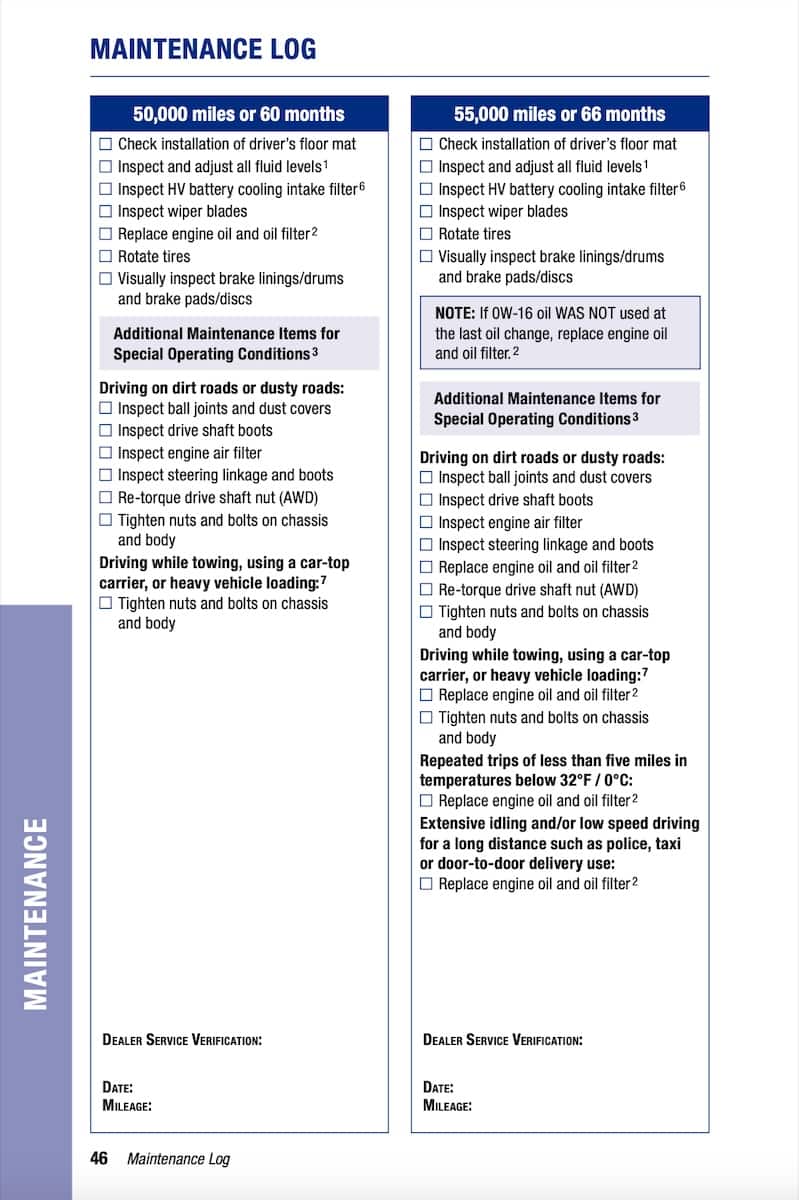
At every 5,000-mile or 6-month service, Toyota specifies a set of standard maintenance items for the Prius 4th gen XW50. These are primarily inspections and routine checks rather than replacements, and they apply to all vehicles regardless of how they are driven.
| Prius 4th gen XW50 Regular Maintenance Items (Standard) |
|---|
| Check installation of driver’s floor mat |
| Inspect and adjust all fluid levels |
| Inspect HV battery cooling intake filter* |
| Inspect wiper blades |
| Rotate tires |
| Visually inspect brake linings/drums and brake pads/discs |
| *AWD and HV battery items apply to later model years and are not included in the 2016–2017 maintenance schedules. |
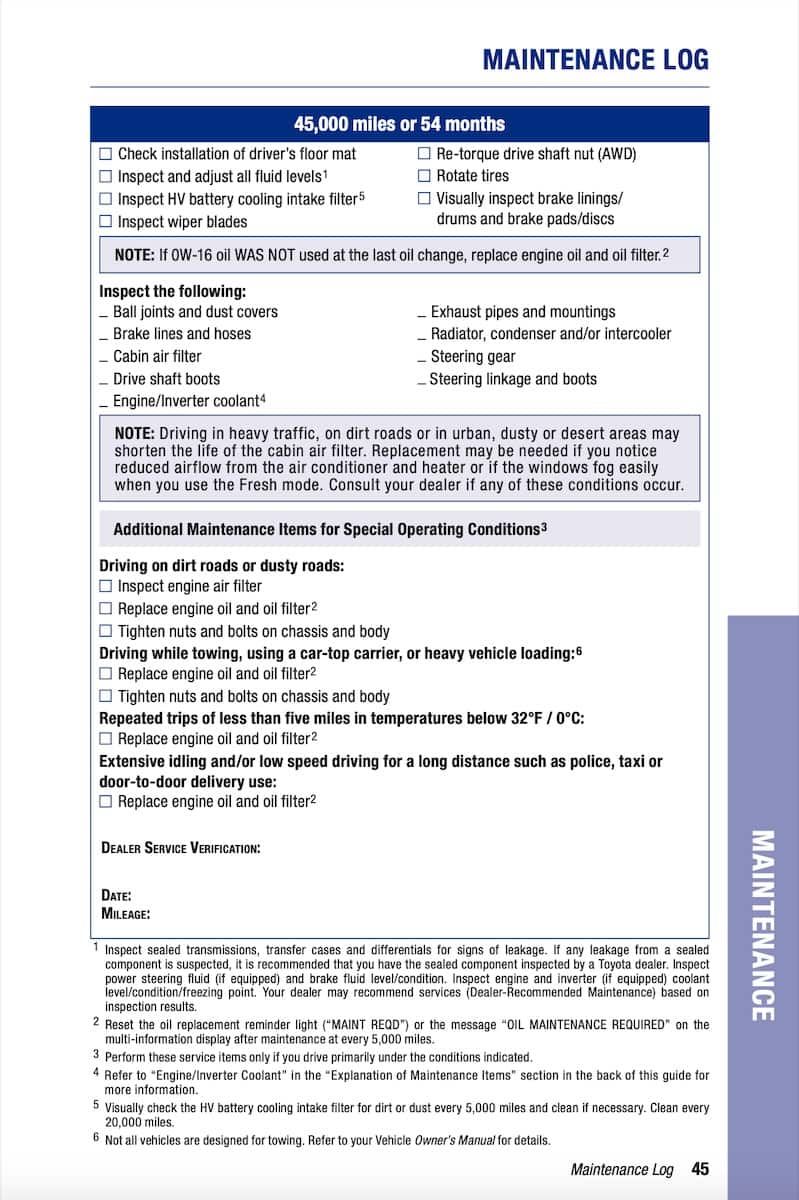
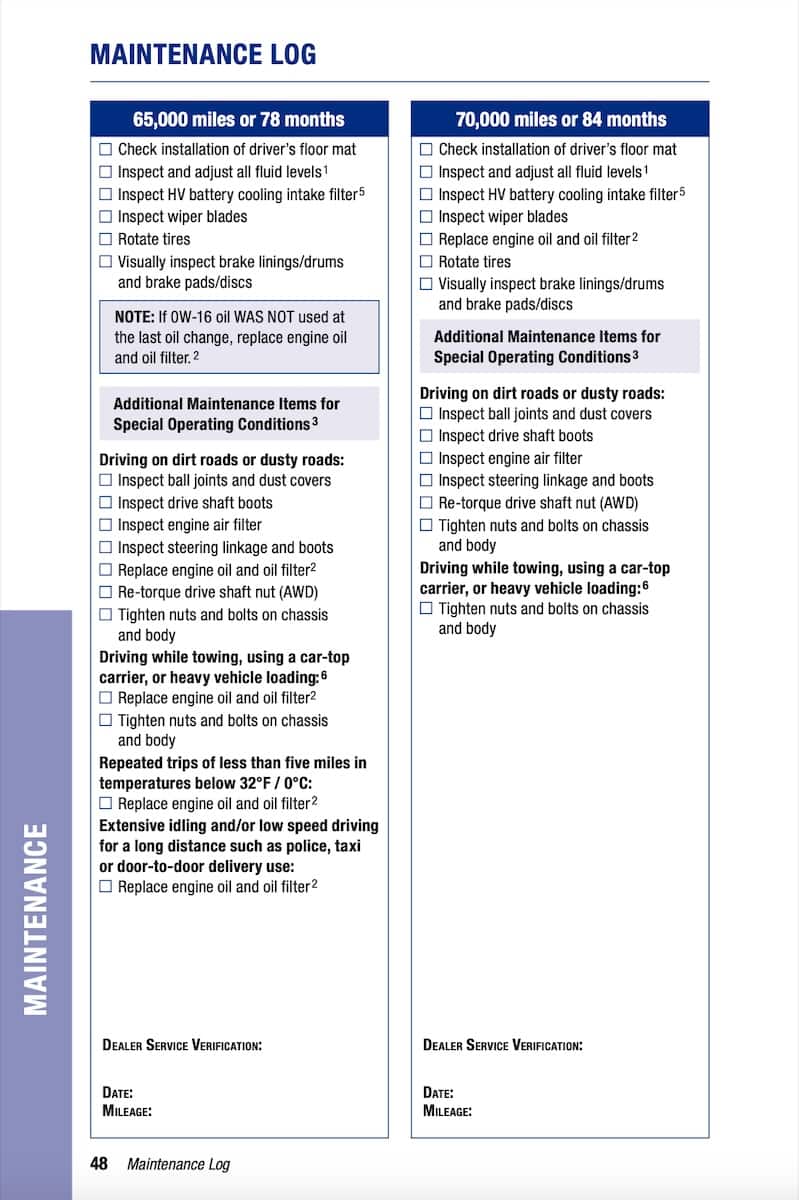
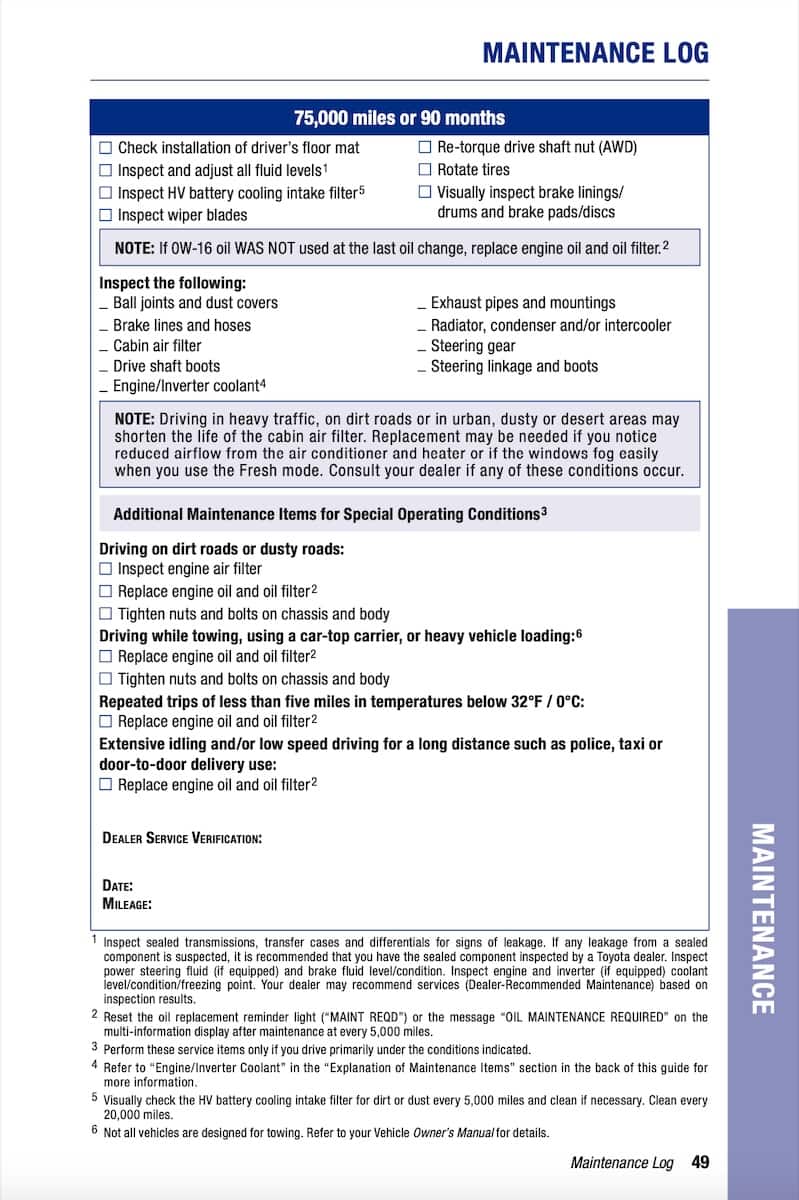
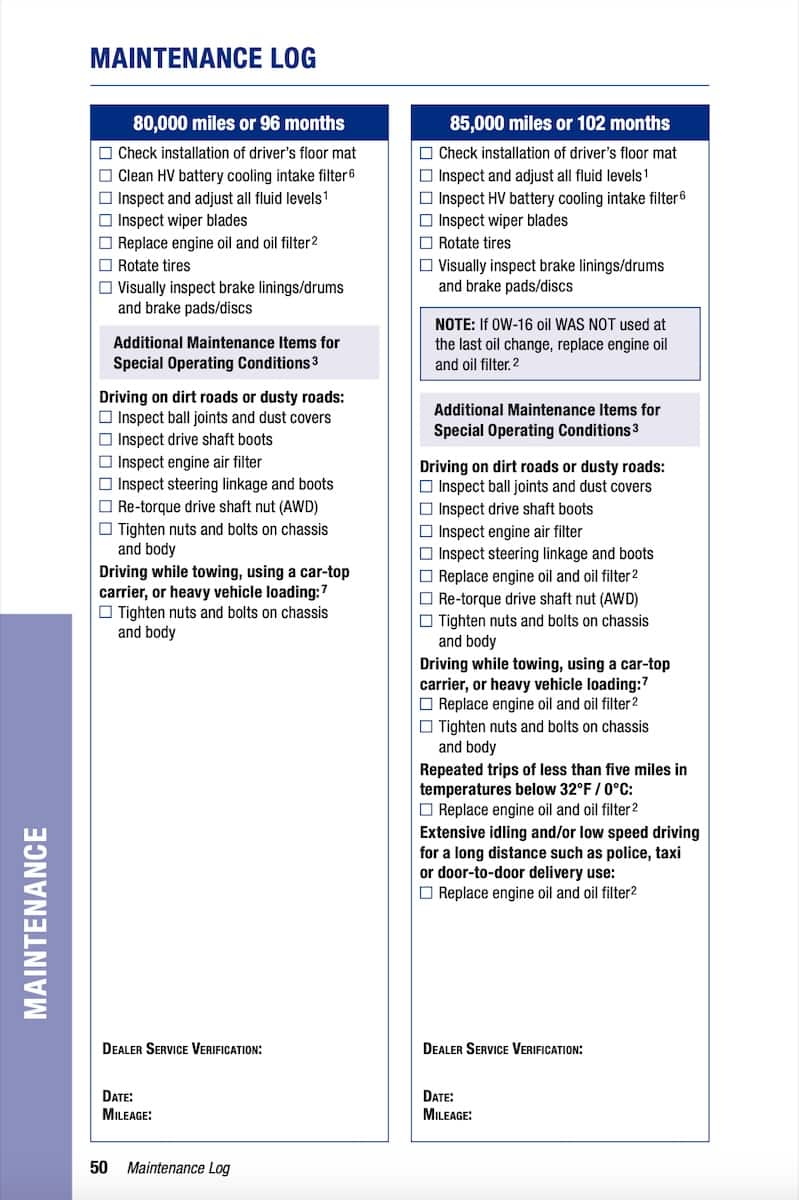
Toyota also lists additional maintenance items for special operating conditions. These only apply if the car is regularly driven under certain conditions, such as frequent short trips, extended idling, heavy loads, or dusty environments. In those cases, some items move from inspection to replacement, most commonly engine oil and the oil filter.
If most of your driving is normal commuting and mixed highway use, the standard table is what you will follow. If your usage matches the special operating conditions Toyota describes, refer to the additional maintenance table and adjust accordingly.
| Maintenance Item | Dirt / dusty roads | Extensive idling / low speed driving | Repeated short trips below 32°F | Towing / heavy load |
|---|---|---|---|---|
| Inspect ball joints and dust covers | ✓ | |||
| Inspect drive shaft boots | ✓ | |||
| Inspect engine air filter | ✓ | |||
| Inspect steering linkage and boots | ✓ | |||
| Re-torque drive shaft nut (AWD)* | ✓ | |||
| Replace engine oil and oil filter | ✓ | ✓ | ✓ | ✓ |
| Tighten nuts and bolts on chassis and body | ✓ | ✓ |
*AWD and HV battery items apply to later model years and are not included in the 2016–2017 maintenance schedules.
Periodic Maintenance
In addition to completing all items listed under Regular Maintenance (5,000 miles / 6 months), also perform the following periodic maintenance tasks for the Prius 4th gen XW50.
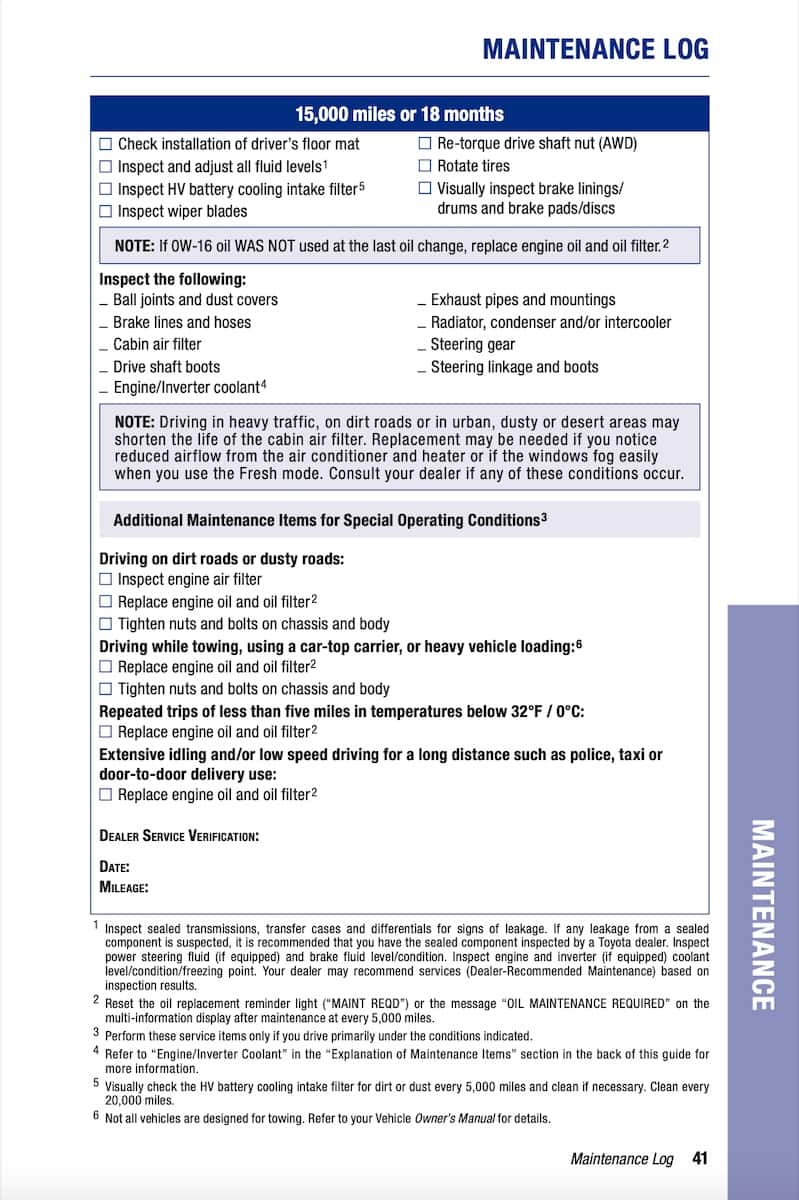
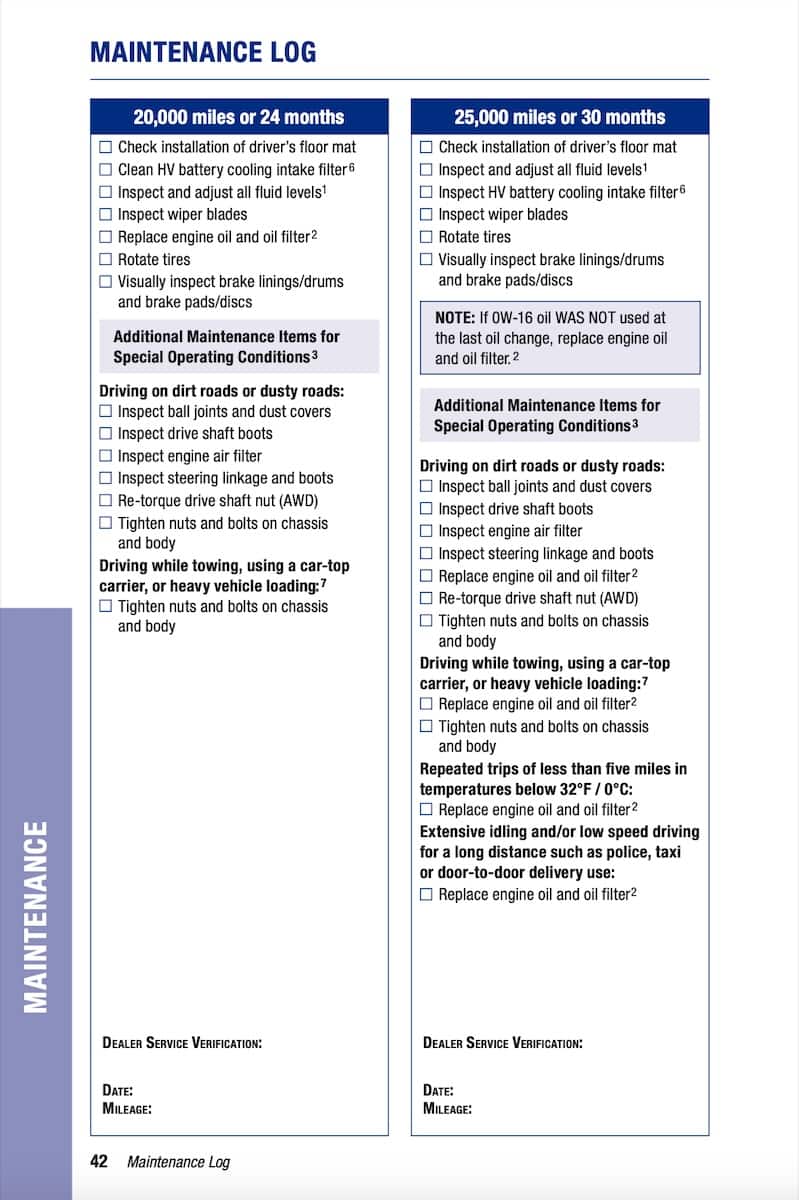
Periodic maintenance items occur between 10,000 and 20,000 miles, or 12 to 24 months, whichever comes first. These services introduce the first scheduled replacements rather than inspections, and they build on the regular maintenance rather than replacing it.
Special note: If 0W-16 oil is used, the engine oil and filter are replaced every 10,000 miles or 12 months. If 0W-16 was not used in the last oil change, Toyota requires an additional oil change at 15,000 miles or 18 months, before returning to the normal 10,000-mile interval once 0W-16 is used again.
| miles x 1000 | 10 | 15 | 20 |
|---|---|---|---|
| time (months) | 12 | 18 | 24 |
| Clean HV battery cooling intake filter* | ✓ | ||
| Inspect ball joints and dust covers | ✓ | ||
| Inspect brake lines and hoses | ✓ | ||
| Inspect cabin air filter | ✓ | ||
| Inspect drive shaft boots | ✓ | ||
| Inspect engine/inverter coolant | ✓ | ||
| Inspect exhaust pipes and mountings | ✓ | ||
| Inspect radiator, condenser and/or intercooler | ✓ | ||
| Inspect steering gear | ✓ | ||
| Inspect steering linkage and boots | ✓ | ||
| Replace engine oil and oil filter | ✓ | ✓ | |
| Replace engine oil and oil filter If 0W-16 oil was not used at the last oil change | ✓ |
*AWD and HV battery items apply to later model years and are not included in the 2016–2017 maintenance schedules.
Long-Term Service Intervals
The following tasks are required less frequently, at longer intervals. While they are not part of regular or annual service, they are essential for long-term performance and reliability. Refer to the maintenance schedule table below for the recommended intervals.
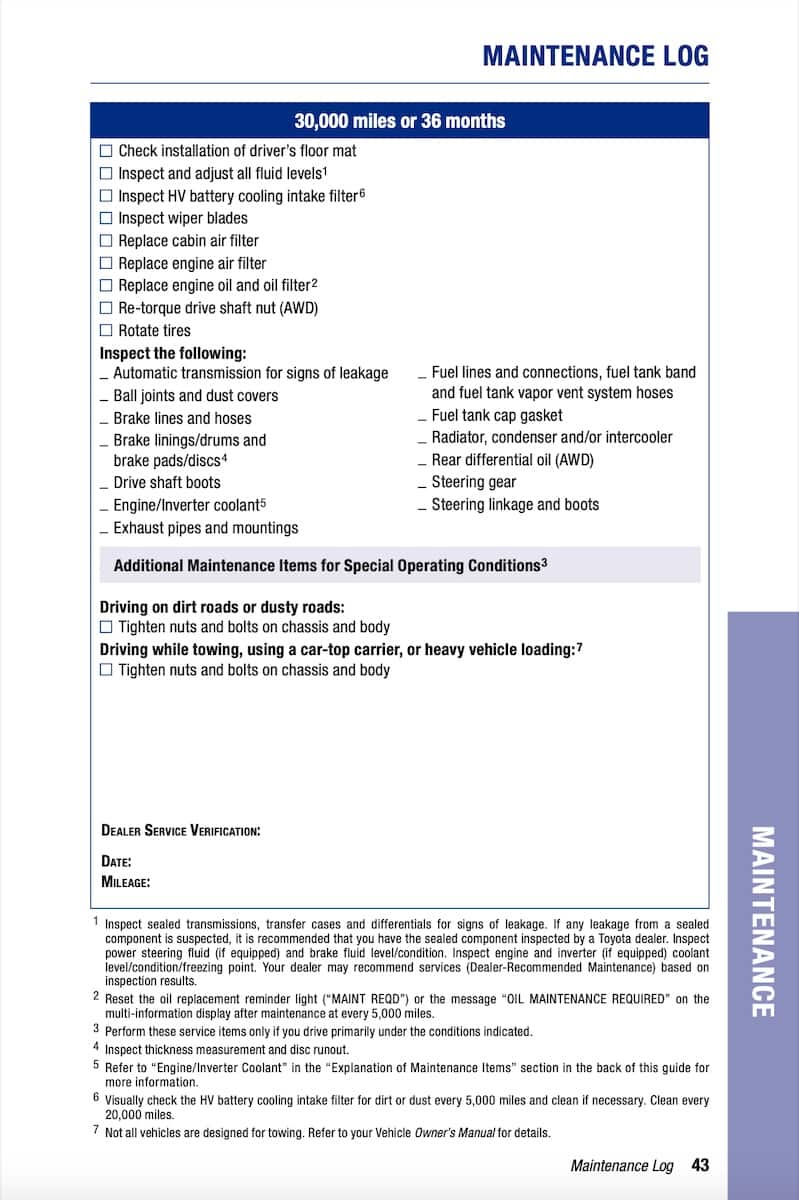
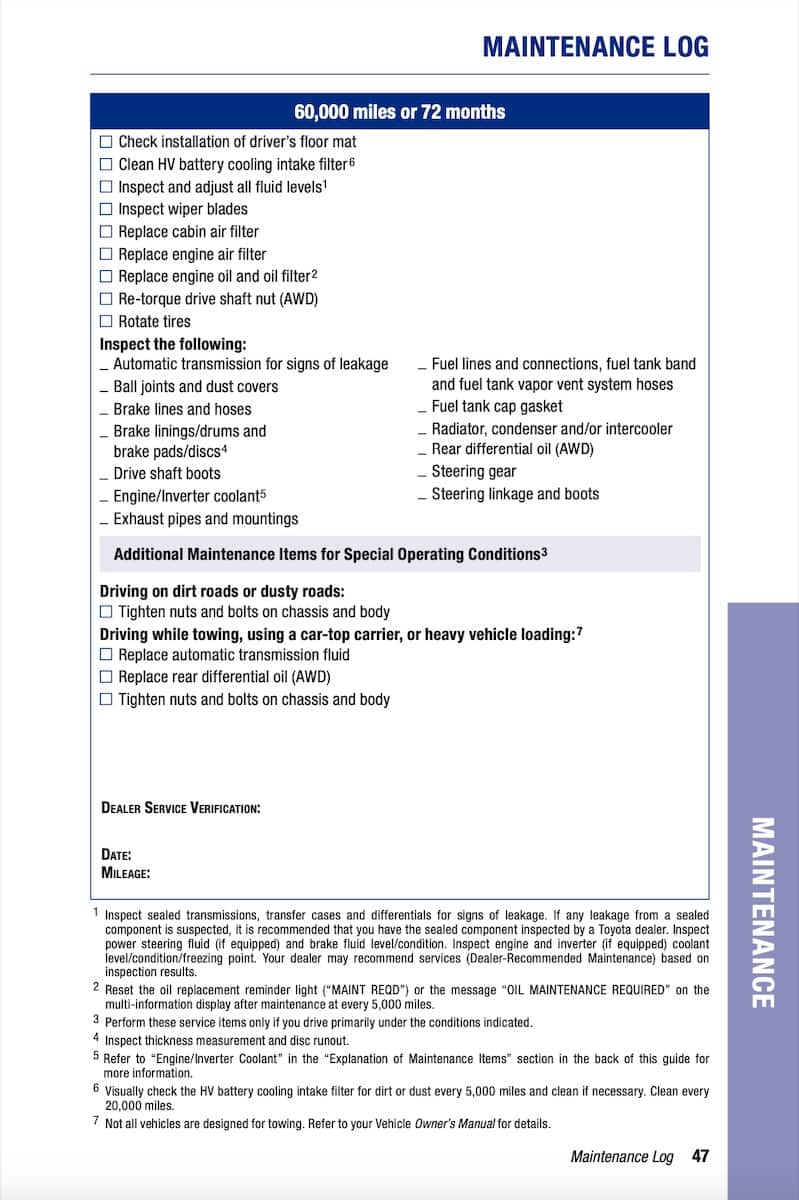
Note on additional maintenance for special operating conditions: If the vehicle is regularly driven while towing, using a car-top carrier, or carrying heavy loads, Toyota specifies the following additional maintenance at 60,000 miles or 72 months:
- Replace automatic transmission fluid
- Replace rear differential oil on AWD models
| miles x 1000 | 30 | 60 | 90 | 100 | 120 |
|---|---|---|---|---|---|
| time (months) | 36 | 72 | 108 | 120 | 144 |
| Inspect automatic transmission for leakage | ✓ | ✓ | ✓ | ✓ | |
| Inspect brake linings/drums and brake pads/discs | ✓ | ✓ | ✓ | ✓ | |
| Inspect fuel lines and connections | ✓ | ✓ | ✓ | ✓ | |
| Inspect fuel tank cap gasket | ✓ | ✓ | |||
| Inspect rear differential oil (AWD)* | ✓ | ✓ | ✓ | ✓ | |
| Re-torque drive shaft nut (AWD)* | ✓ | ✓ | ✓ | ✓ | |
| Replace cabin air filter | ✓ | ✓ | ✓ | ✓ | |
| Replace engine air filter | ✓ | ✓ | ✓ | ✓ | |
| Replace engine/inverter coolant | ✓ | ||||
| Replace spark plugs | ✓ |
*AWD and HV battery items apply to later model years and are not included in the 2016–2017 maintenance schedules.
Tire sizes and pressures for the Prius 4th gen XW50 (2016-2021)
The following are tire sizes and tire pressures for the Prius 4th gen XW50.
| Wheel/Tire | Size | Pressure (cold) Depending on load/passenger/luggage |
|---|---|---|
| Front | P195/65R15 | 35 psi / 240 kPa |
| Rear | P195/65R15 | 33 psi / 230 kPa |
About the Prius 4th gen XW50 (2016-2021)

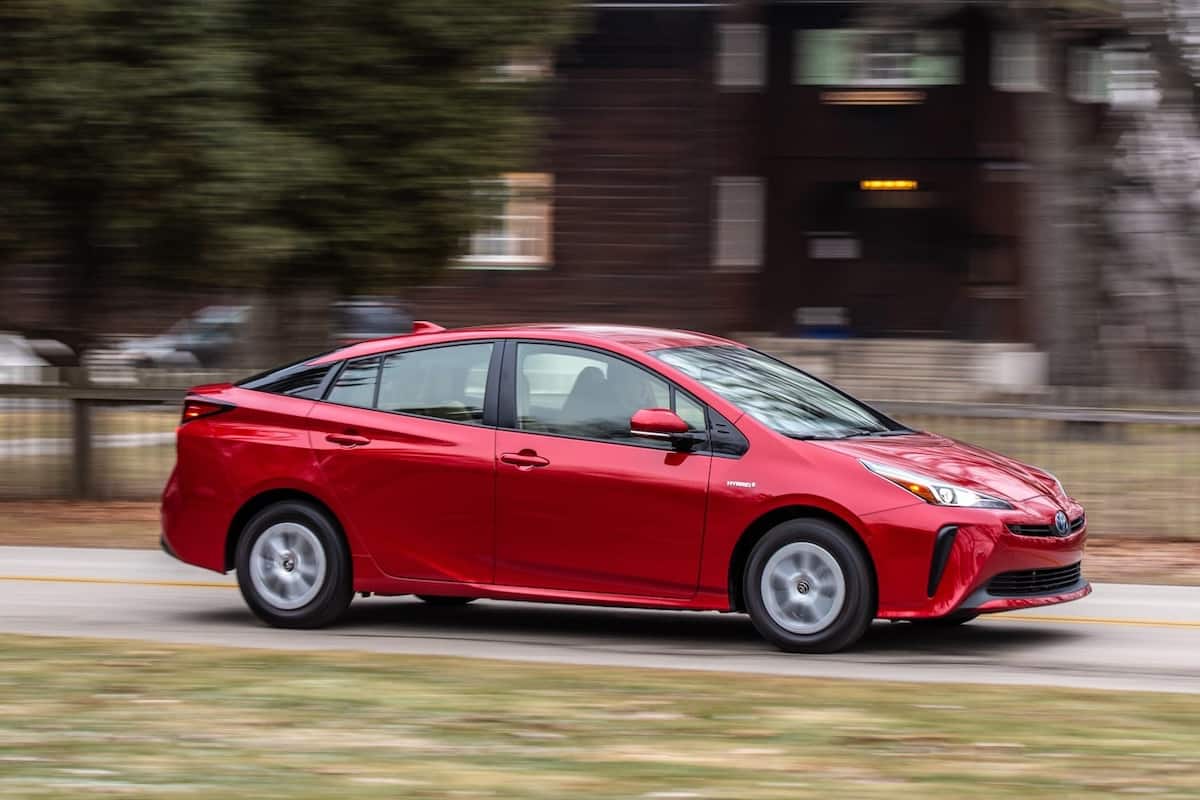



The Prius 4th gen XW50 marked a clear turning point for Toyota’s long-running hybrid. Where earlier generations leaned hard into efficiency-first thinking, this one tried to balance that mission with better driving manners, improved packaging, and a bit more personality. It is still unmistakably a Prius, but it feels more grown-up and more deliberate in almost every area.
Under the hood is Toyota’s familiar 1.8 L 2ZR-FXE Atkinson-cycle four-cylinder engine, paired with the Hybrid Synergy Drive system and an electronically controlled CVT. Total system output is 121 horsepower, which does not sound exciting on paper, but that misses the point. Like most hybrids, the Prius feels stronger at low speeds than the numbers suggest, thanks to the electric motor’s immediate torque. Around town, it pulls away smoothly and quietly, and at highway speeds it settles into a relaxed, low-effort cruise.
This generation rides on Toyota’s TNGA GA-C platform, and that change matters. Compared to the previous Prius, the XW50 sits lower, has a stiffer body, and uses a multi-link rear suspension instead of the older torsion beam. The result is a car that feels more planted and predictable, especially through corners. It is not a hot hatch, but it no longer feels disconnected or floaty. If you are coming from something like a Corolla or Civic, the Prius now feels much closer in overall composure.
Design is where Toyota clearly took a risk. The sharp creases, aggressive lighting, and low nose were a dramatic departure from the softer look of earlier models. Inside, the layout remains unmistakably Prius, with a central digital instrument cluster and a focus on efficiency feedback. Ergonomics are straightforward once you adjust, and visibility is good despite the sloping rear glass. Tech features expanded over the years, with later models adding improved driver assistance systems and broader smartphone integration.
Braking is handled by a regenerative system that blends motor regeneration with conventional disc brakes. Pedal feel is different from a non-hybrid car, but consistent once you are used to it. Suspension tuning favors comfort over sport, soaking up rough roads well while still feeling controlled at speed.
The lineup included several trims, from the efficiency-focused L Eco to the more feature-rich LE, XLE, Limited, and special editions. Later years introduced AWD-e in some markets, using a small rear electric motor for added traction. While equipment levels and wheel sizes vary, the underlying mechanical package and maintenance requirements remain largely the same across versions.
Maintenance is refreshingly low-stress. The engine uses long service intervals, spark plugs last a long time, and regenerative braking dramatically reduces brake wear. There are no accessory drive belts, and many hybrid components are inspection-only for years. The main Prius-specific item owners need to stay on top of is the hybrid battery cooling intake filter.
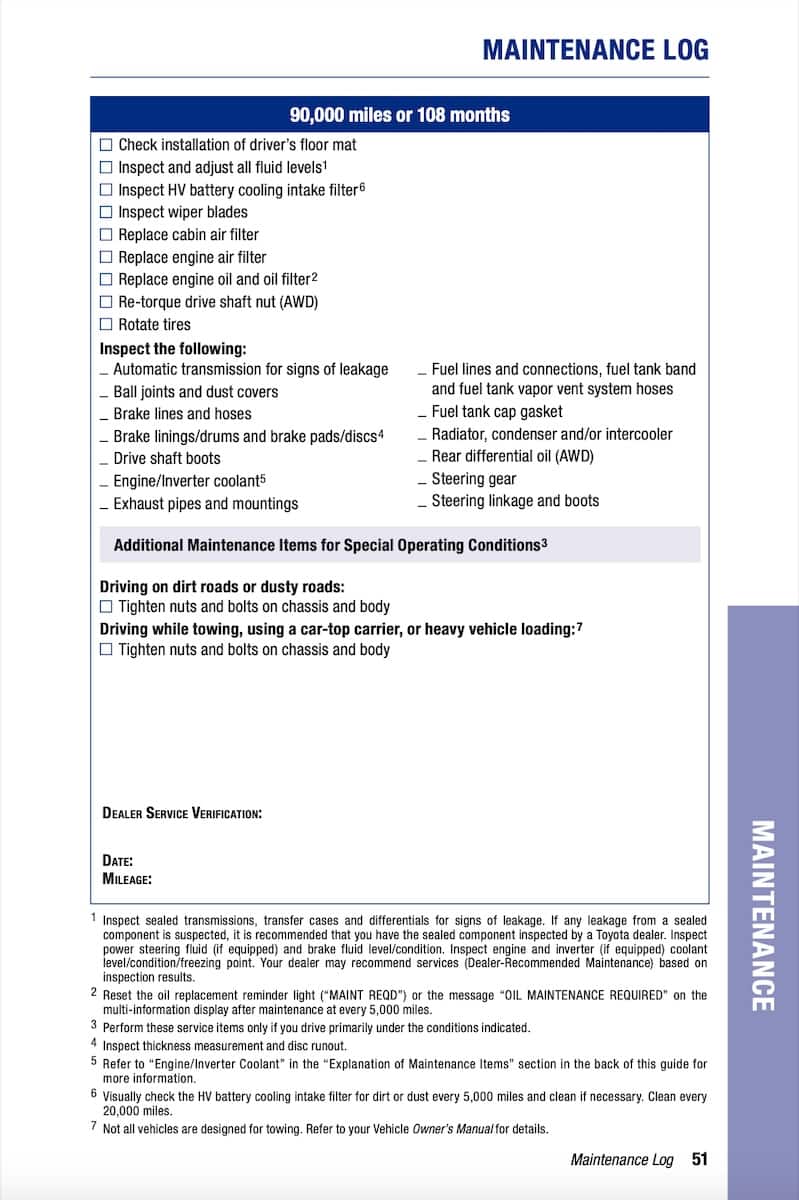
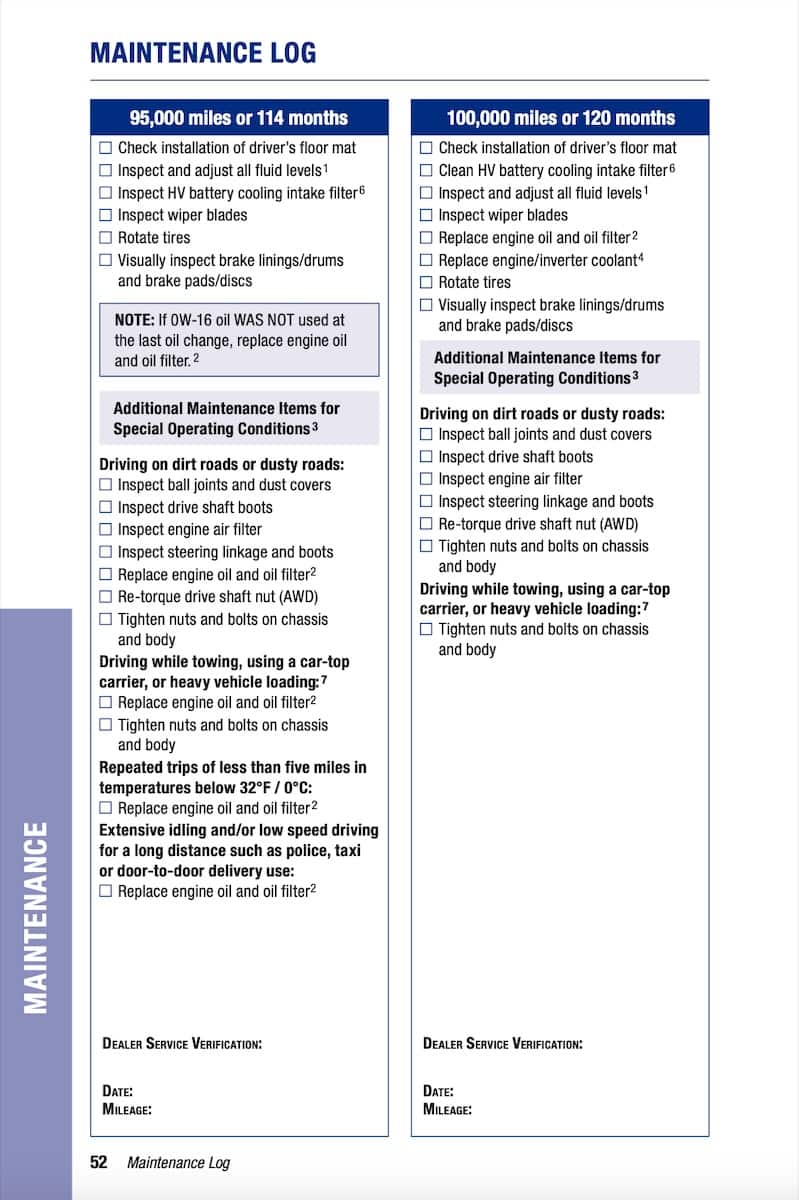
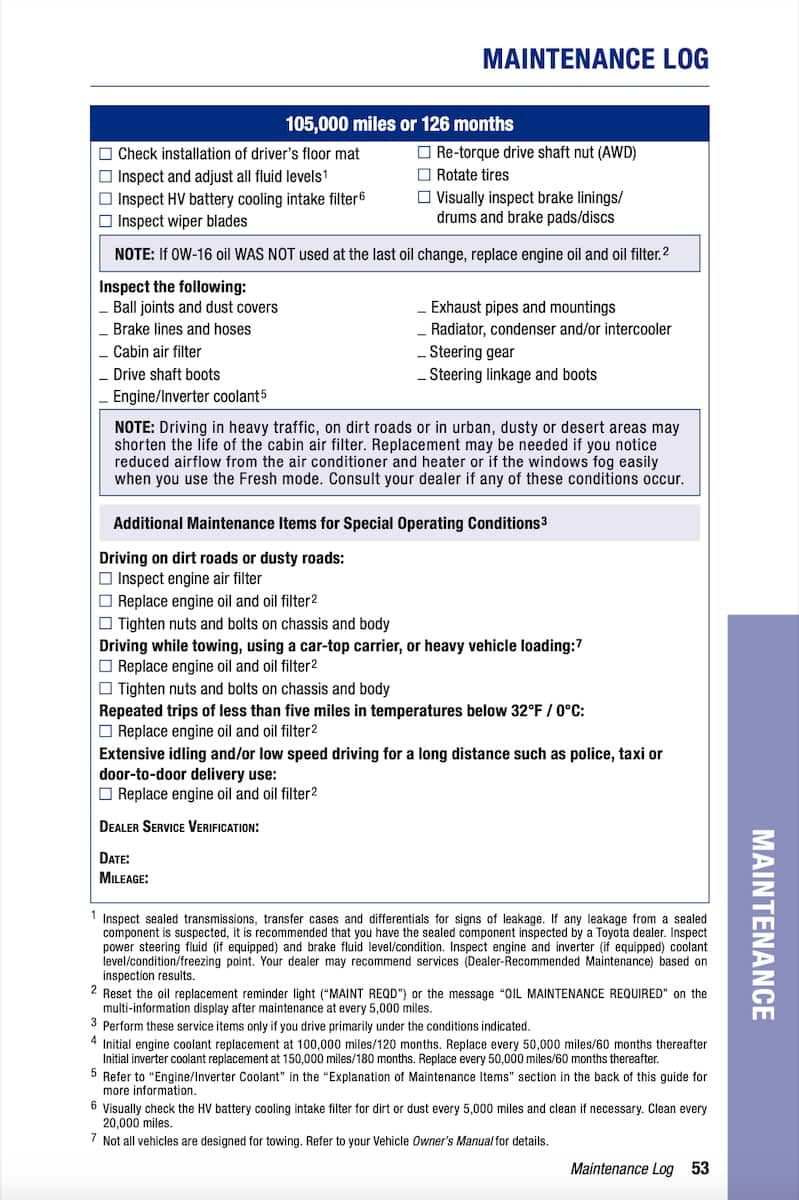
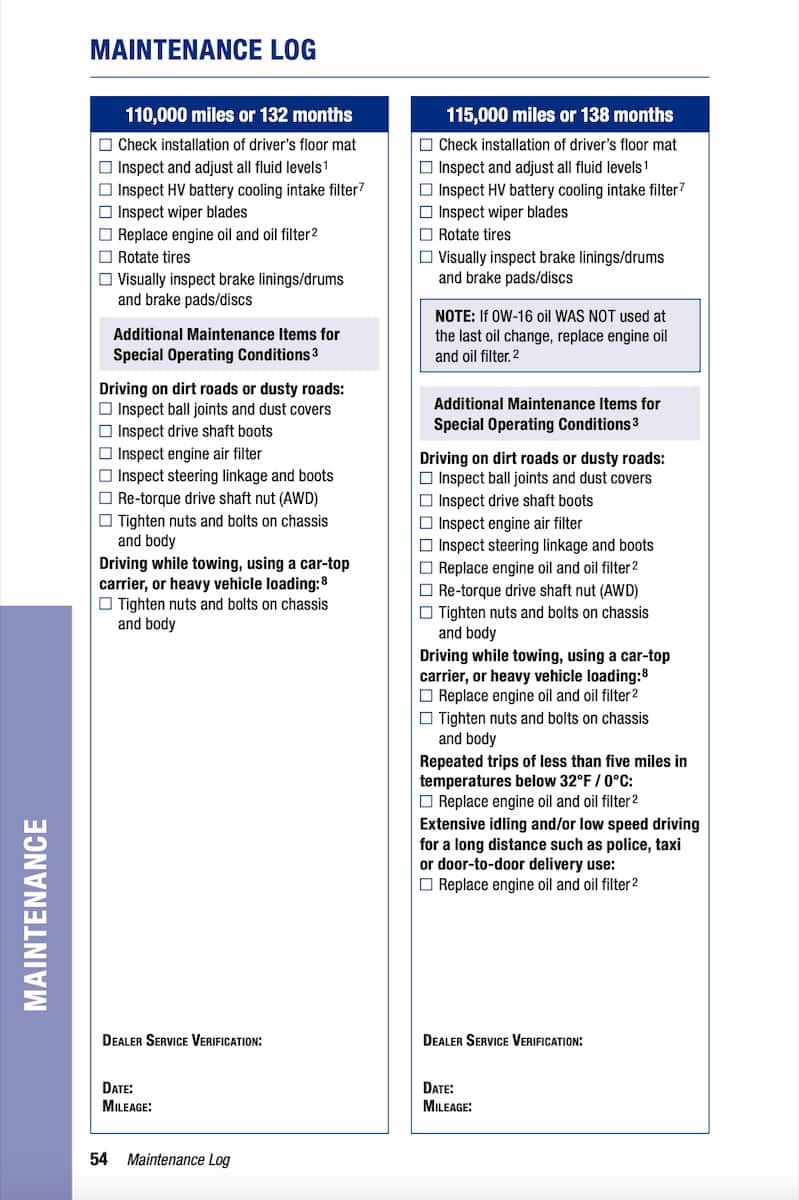
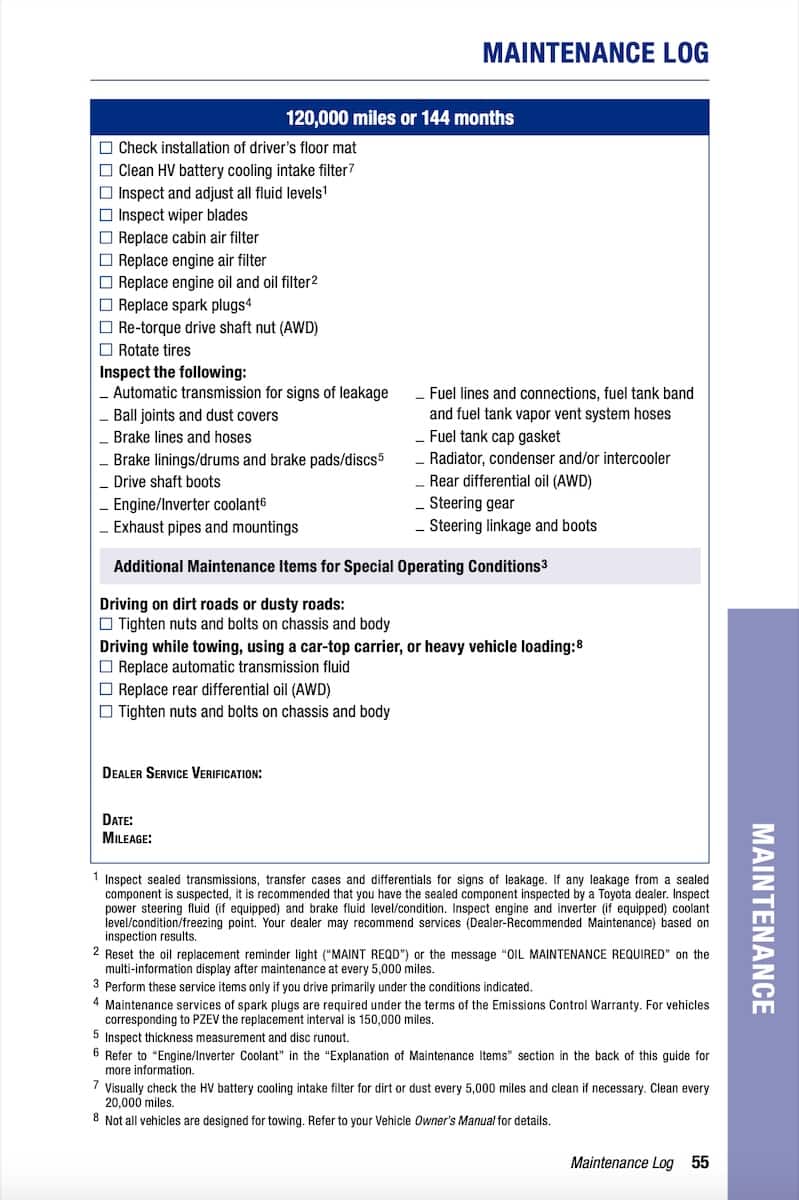
References — Screenshots from the Prius 4th gen XW50 (2016-2021) Owner’s Manual
Below is a selection of screenshots from the maintenance schedule for the Prius 4th gen XW50 (2016-2021) from the official manual.