Ducati Monster V2 (890 cc, 2026+) Maintenance Schedule and Service Intervals

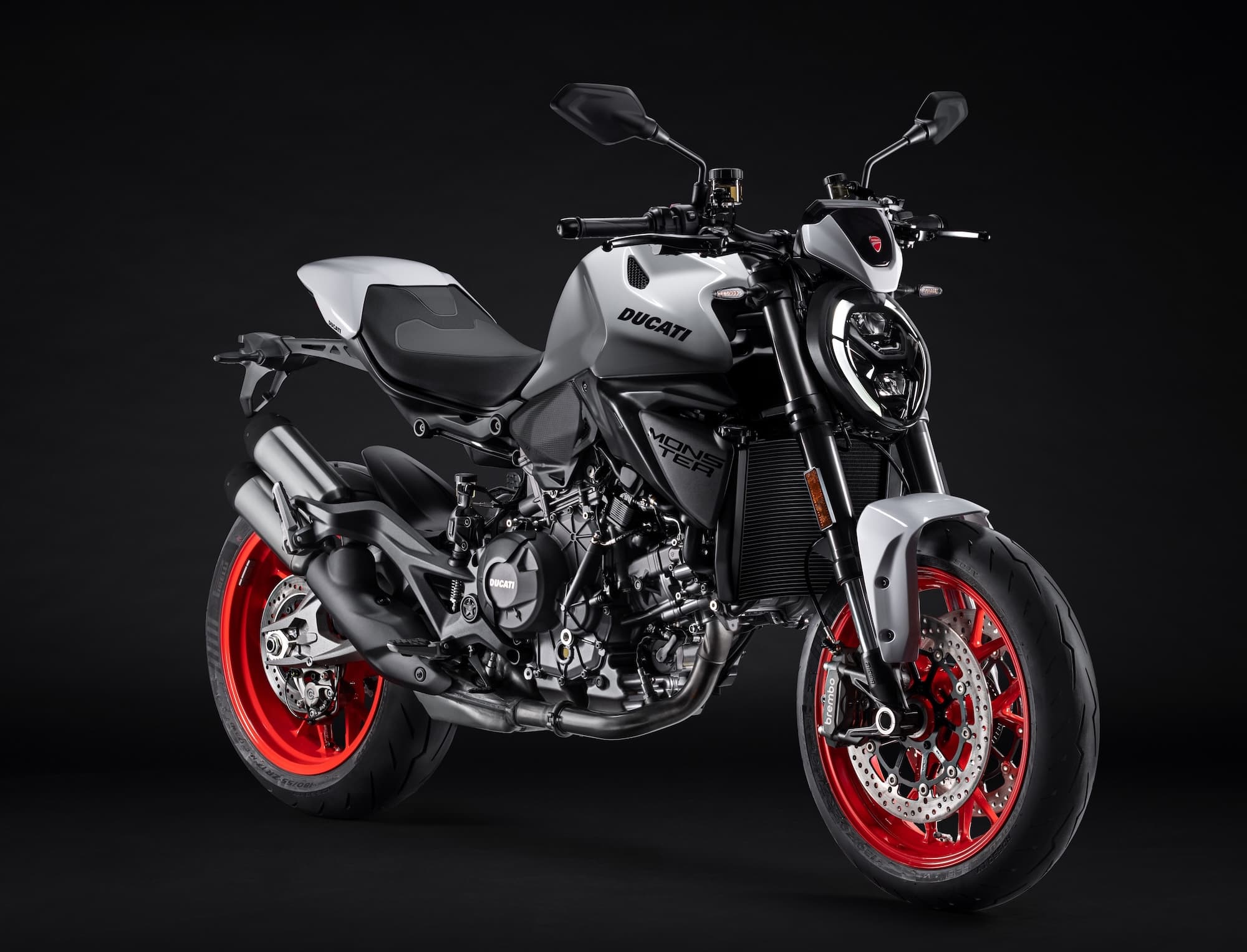
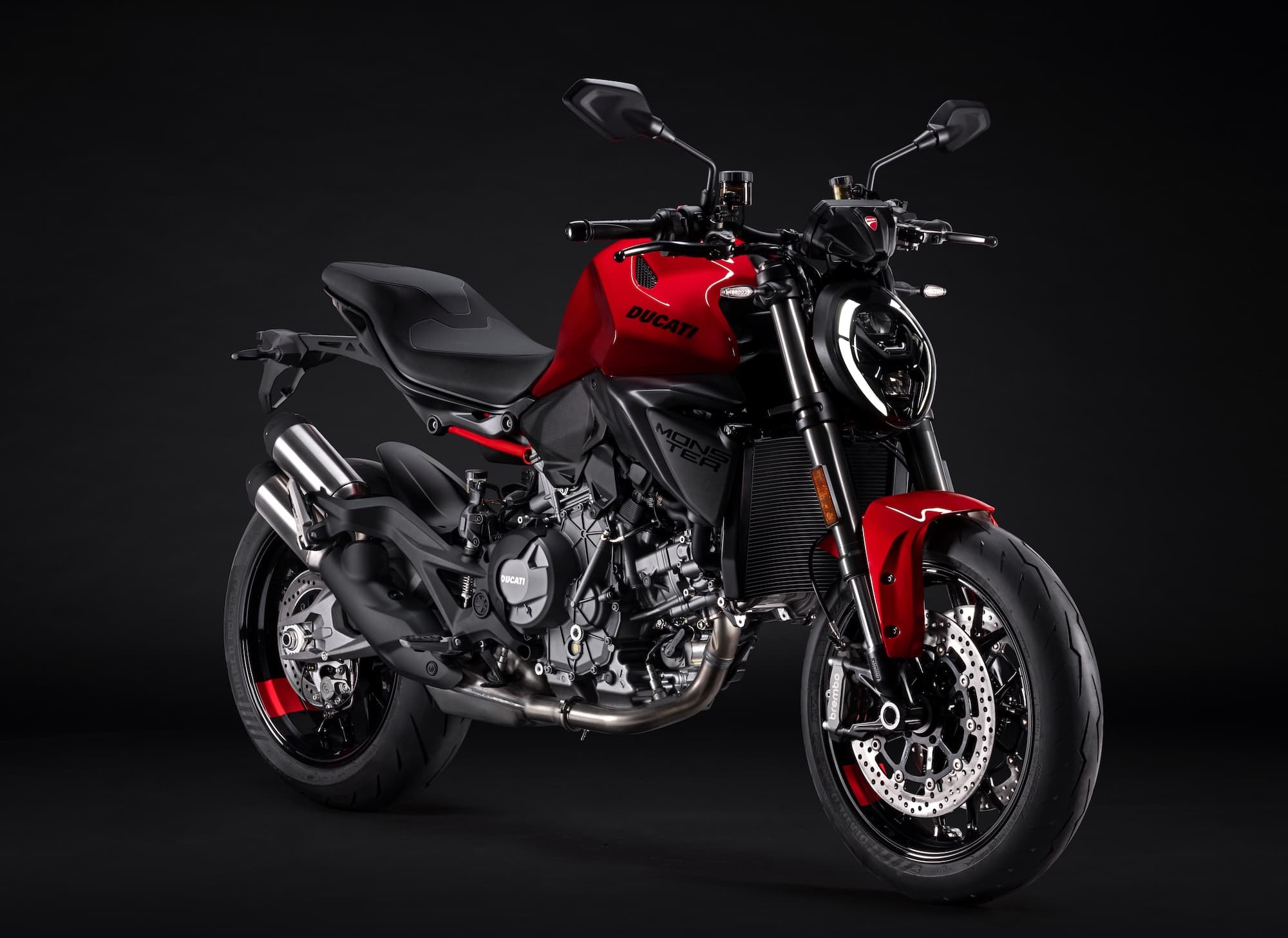
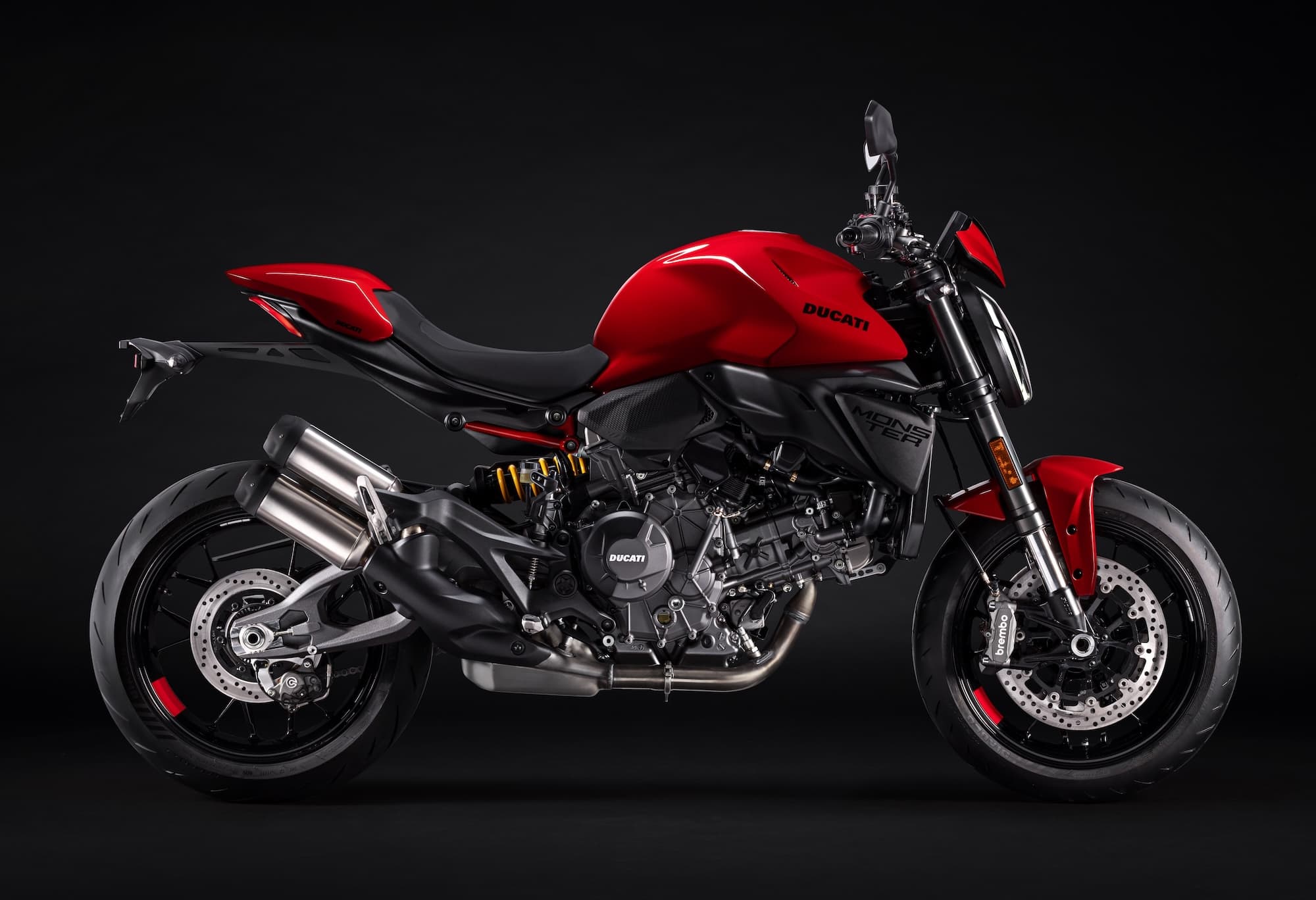
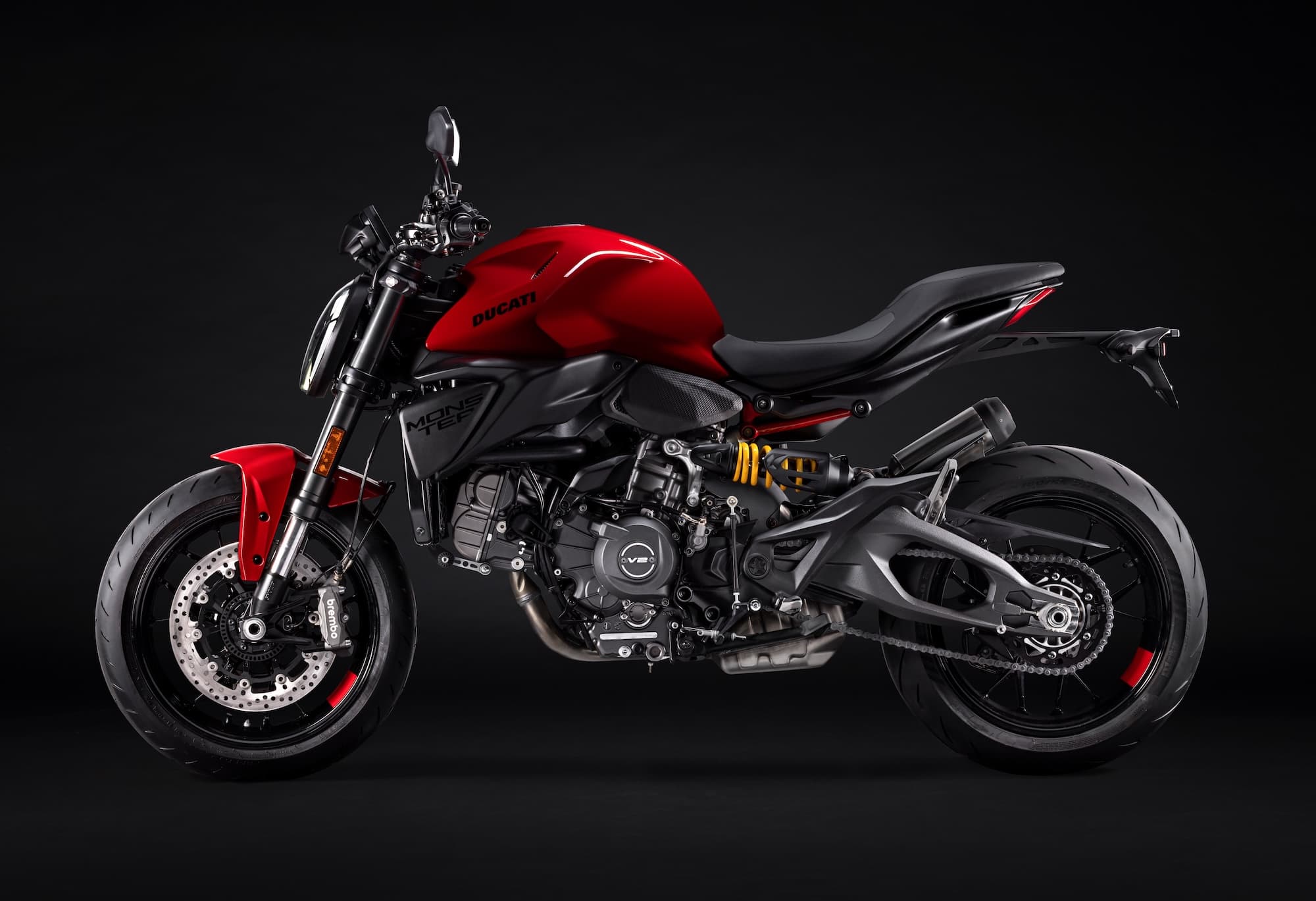
This is the maintenance schedule and service intervals for the Ducati Monster, updated for 2026 with the 890 cc “V2” engine, first released in the 2025 Ducati Panigale V2. While officially it’s the Ducati Monster, even Ducati has referred to it in some press materials as the Ducati Monster V2.
The Ducati Monster needs no introduction, but here goes: The Monster is one of Ducati’s long-standing models, released first in 1993 as a stripped-back, “just-the-basics” sport motorcycle with a chassis from here, an engine from there, and a design that caught the public’s imagination from day one.
The 2026 Ducati Monster, released in late 2025, is powered by Ducati’s middleweight V2 engine that brings Ducati’s street lineup squarely into the modern era. It has conventional (non-desmodromic) spring-actuated valves and uber-long maintenance intervals that even would have Yamaha and Honda perking up in interest. The 890cc V-twin engine makes 111 hp (82 kW) at 9,000 rpm, which is plenty for a fun day out.
The V2 model replaces the Testastretta-powered Ducati Monster model, known informally as the Monster 937. Its maintenance schedule is here.
At release, the Monster came in two variants, the straight Monster and the Monster +, with identical mechanical components — just some aesthetic add-ons.


This site has links for things like oil and spark plugs from which we earn a commission (which unfortunately nobody can save, not even us). If you appreciate this work, then please use those links. Thanks!
Ducati Monster V2 Service Intervals
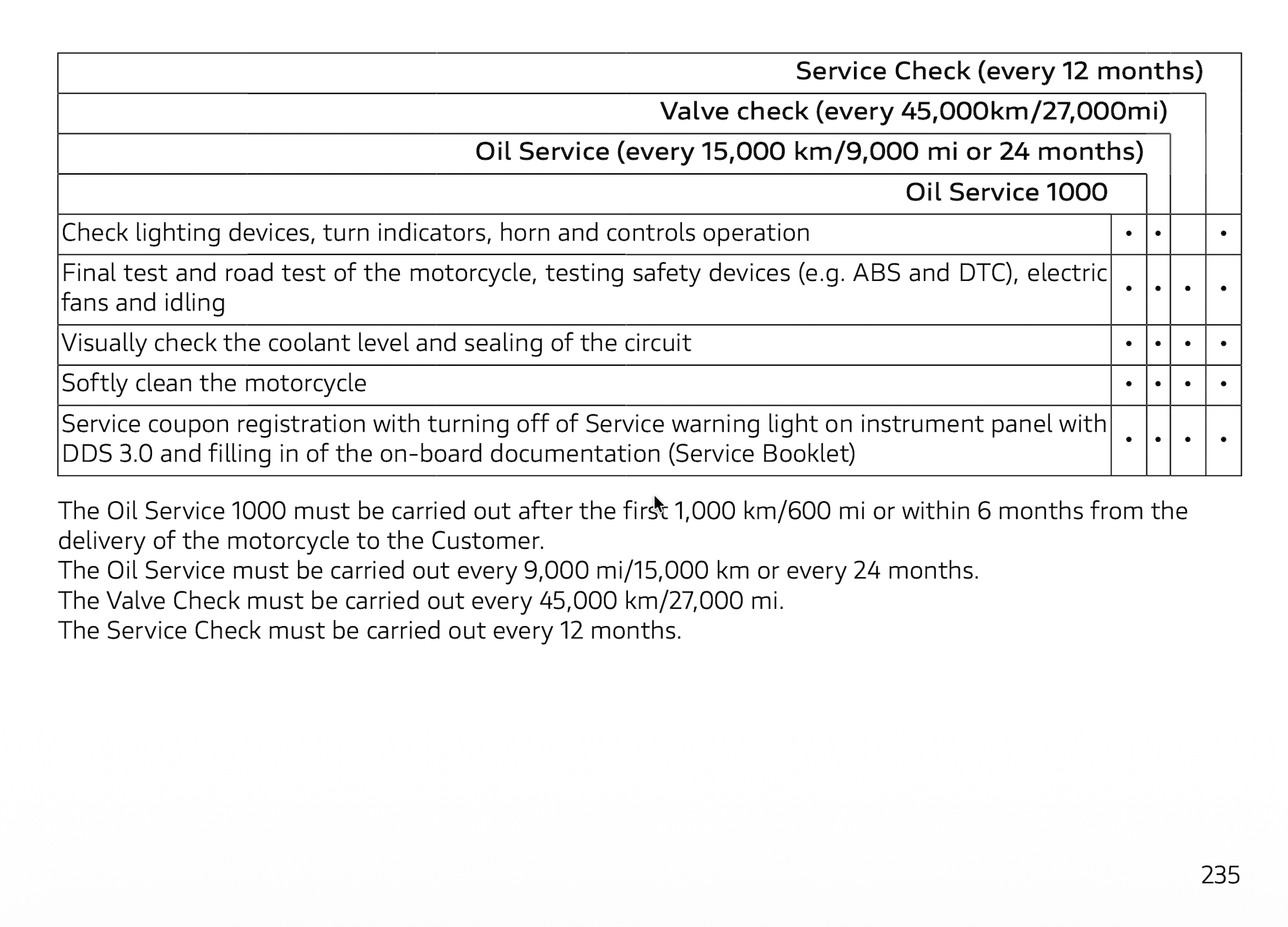
The basic service interval for the Ducati Monster V2 is every 9,000 miles / 15,000 km or every 24 months, whichever comes first. At each service, you should change the engine oil and filter, and inspect or adjust components according to the checklist (see below).
In addition, Ducati specifies an annual service every 12 months, even if the mileage interval hasn’t been met. This check includes a safety inspection, fluid checks, a road test, and diagnostic scan.
The major service — a valve clearance inspection, plus a few other items with the tank off — is required every 28,000 miles / 45,000 km. This is the most involved and expensive maintenance item and would normally be performed by a Ducati-certified technician. But the good news is that with no desmodromic timing, there are fewer clearances to inspect and adjust, so it’s possibly further within the reach of the home mechanic!
Owner checks for the Ducati Monster V2
This is maintenance that you can do yourself.
Assuming you ride in everyday conditions (on sealed roads, under “normal” engine stress, every 1000 km / 500 miles OR 6 months (whichever comes first), perform the following maintenance:
| Monster V2 — Regular maintenance |
|---|
| Check engine oil level (Motul 300V 15W-50) |
| Check brake fluid level (Castrol DOT 4) and clutch fluid level |
| Check tire pressure and wear (see below for recommended pressures) |
| Check the drive chain tension and lubrication (Motul chain paste) |
| Check brake pads and replace if necessary |
Checking and Adjusting Chain Tension
While Ducati recommends you get chain tension adjusted at a dealer, it’s definitely something many home motorcycle owners do.
When checking drive chain tension, follow this procedure for the Ducati Monster V2.
- Roll the motorcycle until you find the tightest point of the chain (bottom part deflects the least).
- Put the motorcycle on its side stand.
- Use a finger to push the chain down at the measurement point (indicated in the image), roughly halfway between the sprockets
- Use a ruler or tape measure to measure the distance between the centre of the chain pins and the bottom surface of the sing arm
- Make this measurement at a number of points on the chain, moving the bike around.
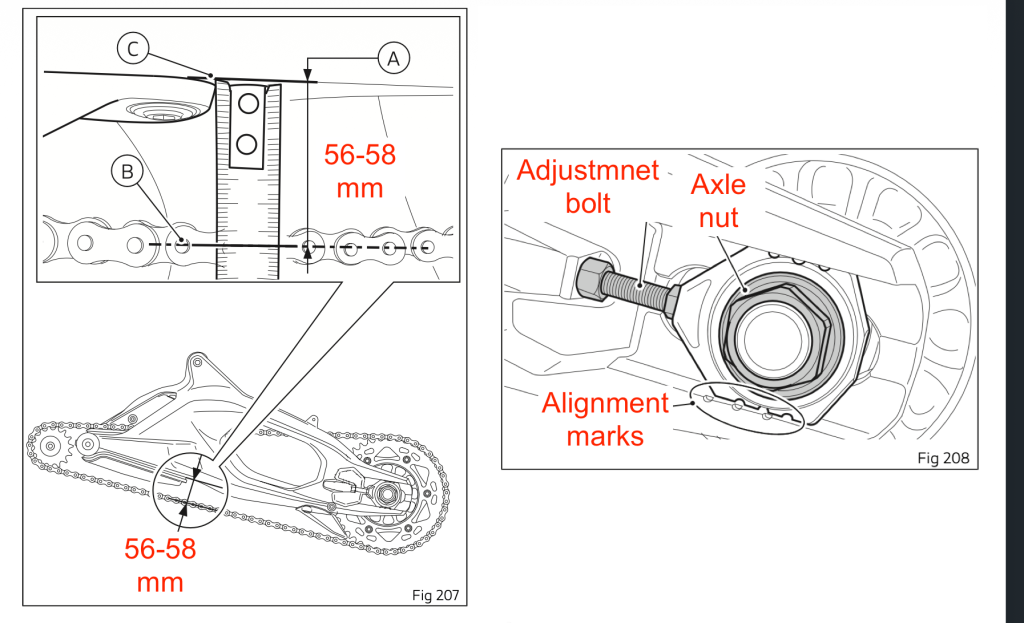
Target chain slack for the Ducati Monster V2: 56-58 mm (2.2-2.28 in)
To adjust the chain slack, you have to loosen the axle, loosen the lock nut on the axle slider, and adjust it by the same amount on both sides. Use the alignment marks to make sure the axis is aligned.
Ducati Monster V2 Maintenance Schedule Table
Below is the full maintenance schedule for the Ducati Monster V2, adapted from the official Ducati owner’s manual and service documentation.
The schedule has been streamlined for clarity. Some dealer-specific notes have been omitted, and certain recommendations have been updated for practical use.
| km x 1000 | 15 | 30 | 45 | 60 | Time |
|---|---|---|---|---|---|
| mi x 1000 | 9 | 18 | 28 | 36 | (Months) |
| Annual maintenance checklist (see below) — Perform | ✓ | ✓ | ✓ | ✓ | 12 |
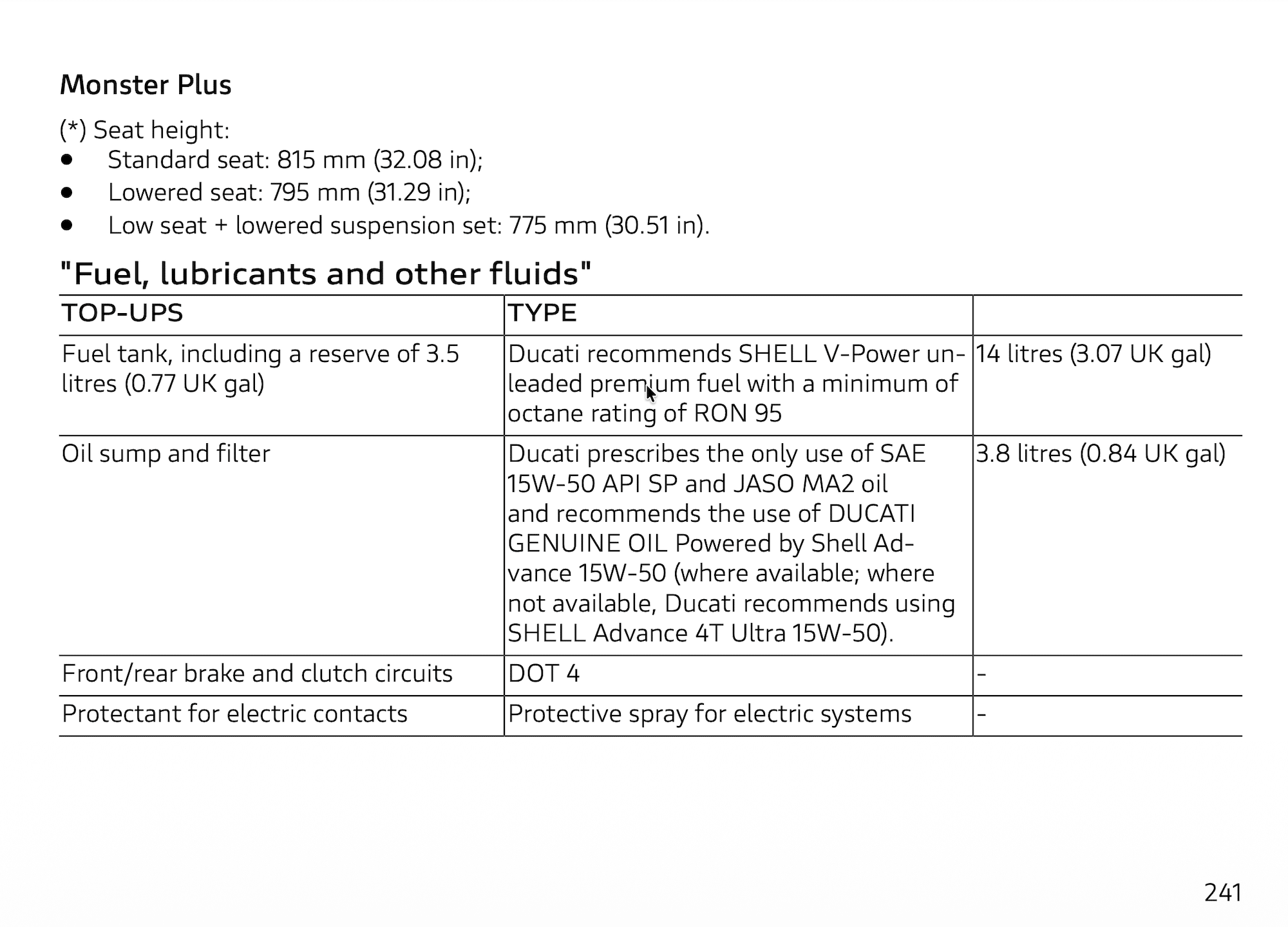
| Change engine oil (Motul 300V 15W-50) | ✓ | ✓ | ✓ | ✓ | 24 |
| Change oil filter (HF159) | ✓ | ✓ | ✓ | ✓ | 24 |
| Check the cush drive damper on rear sprocket | ✓ | ✓ | ✓ | ✓ | 24 |
| Check and clean the air filter | ✓ | ✓ | ✓ | 24 | |
| Change the air filter | ✓ | ||||
| Check and/or adjust valve clearances | ✓ | ||||
| Check secondary air reeds | ✓ | ||||
| Change spark plugs (LMDR10A-JS) | ✓ | ||||
| Replace the water pump seal and bushing | ✓ | ||||
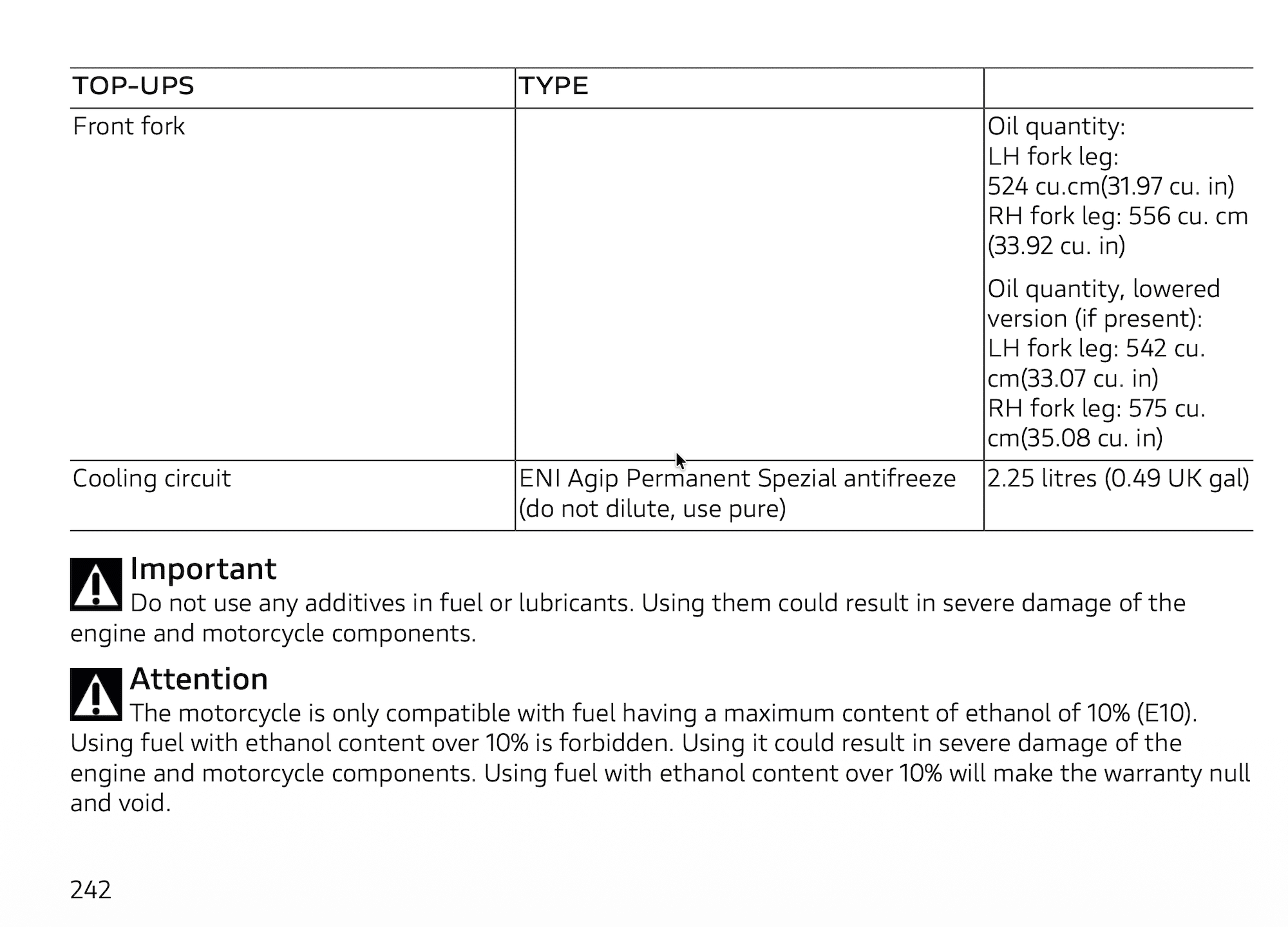
| Change coolant (ENI Agip Spezial) | ✓ | 48 | |||
| Change front fork fluid (Shell Donax TA) | ✓ | ||||
| Check the tightening of frame fasteners to engine, swingarm, and rear shock | ✓ | ||||
| Change brake and clutch fluid Fluid level drops with wear of the brake and clutch. Top up with Castrol DOT 4 or similar | 24 |
Annual Maintenance Checklist
Below is the annual maintenance checklist for the Ducati Monster V2. Perform it according to the schedule above.
Items marked [D] require dealer tools.
| Ducati Monster V2 Annual Maintenance Checklist |
|---|
| [D] Read the error memory with DDS 3.0 |
| [D] Check the presence of any technical updates and recall campaigns |
| [D] Register service by turning off service warning light on instrument panel with DDS 3.0 and filling in the on-board service booklet |
| Visual check front fork and rear shock absorber seals |
| Check brake and clutch fluid level Fluid level drops with wear of the brake and clutch. Top up with Castrol DOT 4 or similar |
| Check front and rear brake disk and pad wear |
| Check tightening of front/rear brake caliper bolts and front brake disc bolts |
| Visually check rear brake disk bolts (check tightening by removing rear wheel shaft) |
| Check front/rear wheel nuts and rear sprocket nut tightening |
| Check tightening of swinging arm and rear shock absorber fasteners |
| Check front and rear wheel hub bearings |
| Check tightening of rear subframe to engine and frame bracket fasteners |
| Check final drive chain elongation, tension, and lubrication (Motul chain care kit) |
| Check wear of chain and sprockets. Note: Replace chain kit within 20,000km/12,000mi |
| Check clearance of steering tube bearings Note: Not required at initial test |
| Check freedom of movement and tightening of side stand |
| Check all gaiters and flexible hoses (fuel, brake, clutch, cooling system, bleeding, drainage, etc.) are not cracked, are properly sealing and positioned |
| Check free play of rear brake lever and lubricate handlebar/pedal controls |
| Check tyre pressure and wear (See below for standard tire pressures) |
| Check operation of all electric safety devices (clutch/side stand sensor, brake switches, engine kill switch, gear/neutral sensor) |
| Check lighting devices, turn indicators, horn and controls operation |
| Final test and road test (testing ABS, DTC, electric fans, idling) |
| Visually check coolant level and sealing of the circuit |
| Clean motorcycle |
Tyre sizes and pressures for the Ducati Monster V2
According to the Ducati Owner’s Manual, the Monster V2 arrives shod with Pirelli Diablo Rosso IV tubeless radial tires.
Here are the tire sizes and recommended pressures.
| Wheel | Rim size | Tyre size | Tyre pressure (cold, single rider) |
|---|---|---|---|
| Front | 3.50 x 17″ | 120/70 R17 | 2.5 bar / 36 psi With passenger/bags: 2.6bar / 38 psi |
| Rear | 5.50 x 17″ | 180/55 R17 | 2.5 bar / 36 psi With passenger/bags: 2.9 bar / 42 psi |
About the Ducati Monster V2 (2026+)
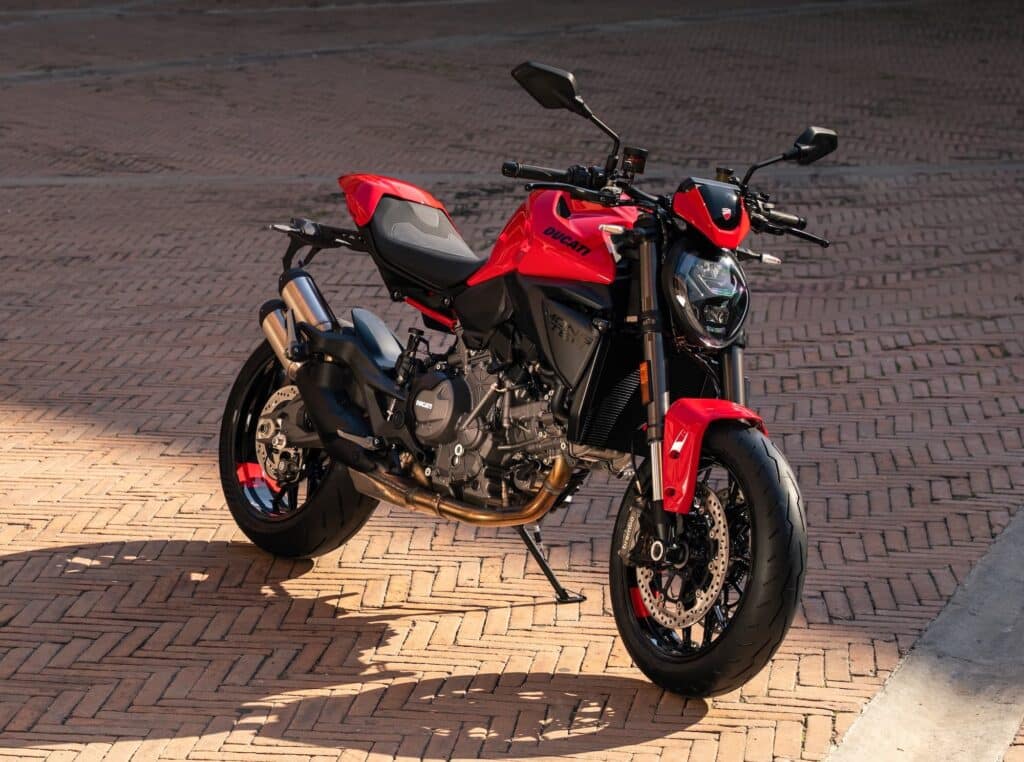
The 2026 Ducati Monster V2 is the fifth generation (depending on how you count) of the platform and the most dramatic reset since the air-cooled era.
Fundamentally, things haven’t changed since launch. The 2026 Ducati Monster still has handlebars and one of the mid-range (not superbike-derived) engines. But gone is the trellis frame, the cantankerous 2-valve desmodromic timing system, air/oil cooling, and the dry clutch. All in the name of progress and reliability, but at some cost to character. Still, you can’t ride character when it’s not running!
Where the outgoing Monster used the 937 cc Testastretta 11° engine, the new bike moves to Ducati’s 890 cc V2 with IVT (Intake Variable Timing), first introduced in the Panigale V2 in slightly higher trim.
The new engine produces 82 kW / 111 hp at 9,000 rpm and 91 Nm / 67 ft-lb at 7,250 rpm, maintaining more than 80% of its torque from 4,000-10,000 rpm — focusing on everyday usability, which is what the Monster is all about.
Although the V2 has slightly less peak power than the outgoing 937, the engine is 6 kg / 13 lb lighter, mechanically cleaner, and delivers broader midrange response. It also brings a major practical gain: valve checks at 45,000 km / 28,000 miles, far longer than the Testastretta’s intervals, and a far cry from the Desmodue of old (10,000 km / 6,000 miles).
The new engine feels less like a detuned superbike motor and more like a purpose-built, flexible street unit that runs cooler, responds more smoothly at low revs, and suits everyday riding. So think of this as Ducati taking a cue from the success of other purpose-built middleweight engines, like that in the Yamaha MT-07, for example.
Ducati moved the styling of the 2026 Monster closer to the 1993 original, with compact proportions, a redesigned “bison-back” tank, new integrated air intakes, a one-piece seat, and a shorter, lighter tail. The full LED headlight adopts a modern double-C signature, a departure from previous generations.
Compared to the outgoing model, the 2026 version is slimmer at the waist, cleaner around the engine, and lower and narrower at the seat to improve reach to the ground. The riding position is slightly more upright and natural, with higher, forward-set handlebars.
Still, this is a far cry from the original Monster. It’s light, powerful, and high-tech. Ducati’s new Monster has not just a 6-axis IMU (for cornering ABS), but even optional cruise control — something Ducati has seemed reticent about adding to its sportier bikes.
The chassis is all new, replacing the steel frame with an aluminium monocoque item using the engine as a stressed member, backed by a steel/GFRP trellis subframe. Overall weight drops to 175 kg / 386 lb (wet, no fuel, which is how Ducati measures it these days), roughly 4 kg / 9 lb lighter than the previous generation.
The Monster V2 (even in + trim) uses a 43 mm Showa USD fork and a Showa rear shock, with revised calibration aimed at everyday compliance without losing the bike’s sporty feel. Brembo M4.32 calipers still handle braking, but updated pads and a revised master cylinder give a softer initial bite and more predictable modulation.
So far, everything is relatively entry-level, but the tech suite is one inspired by Ducati’s superbikes. This includes QuickShift 2.0, which uses a sensor on the gearshift drum, power modes, a 5-inch TFT display and a petal joystick.
But it’s maintenance that steals the show. When Ducati initially released the V2 engine in 2025, they announced shorter (though still long) service intervals. Now, for 2026, Ducati has revised the maintenance schedule extensively, both simplifying it and extending valve service intervals to a whopping 28,000 miles or 45,000 km. This is as long as it needs to be — frankly, longer than most people own motorcycles!
It’s likely Ducati will release special edition or SP models of the Ducati Monster V2 in coming years with uprated suspension and special paint. Stay tuned!
References — Screenshots from the Ducati Monster V2 Owner’s Manual
The above info was sourced from the owner’s manual for the 2026 Ducati Monster V2.
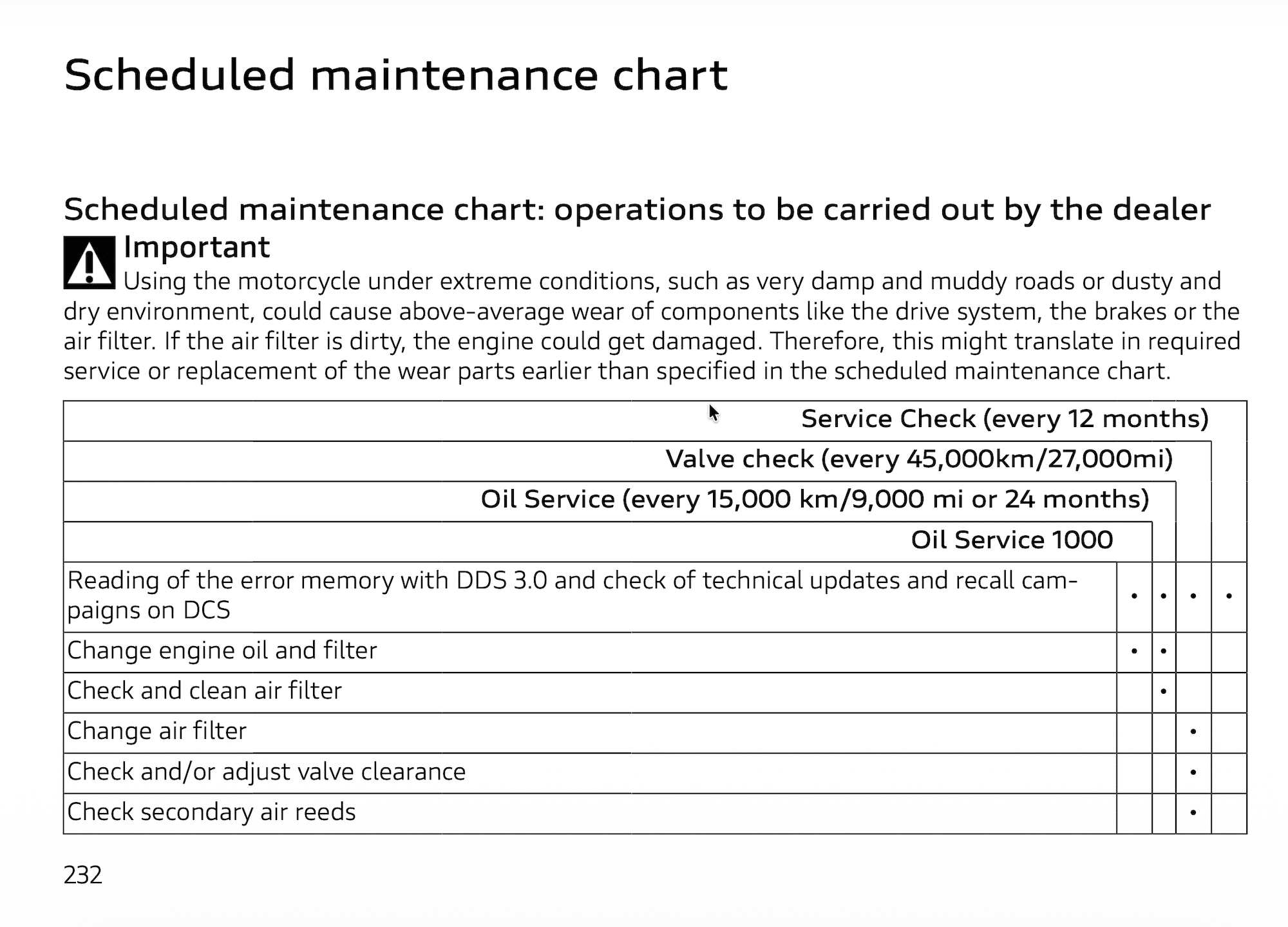
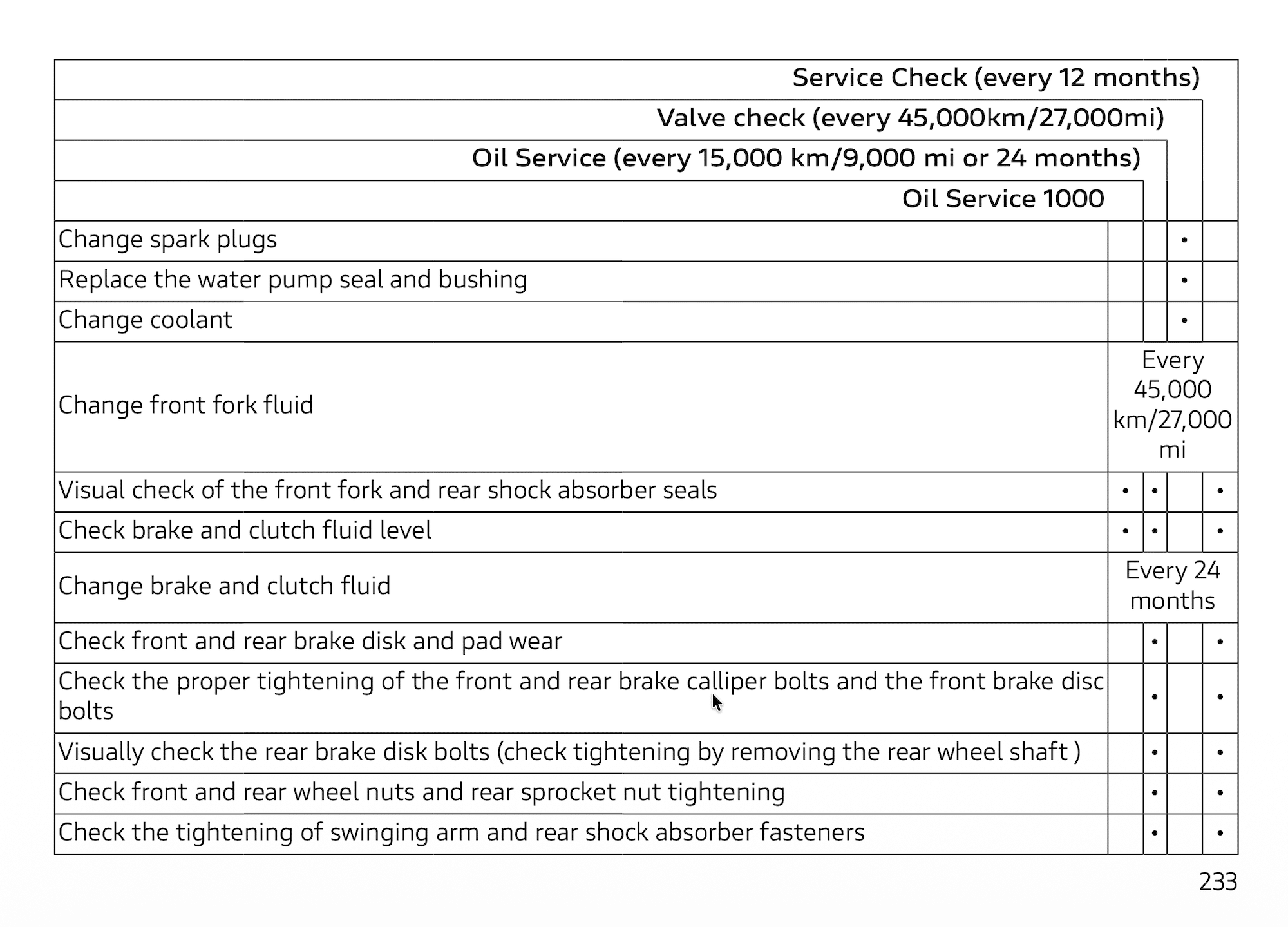
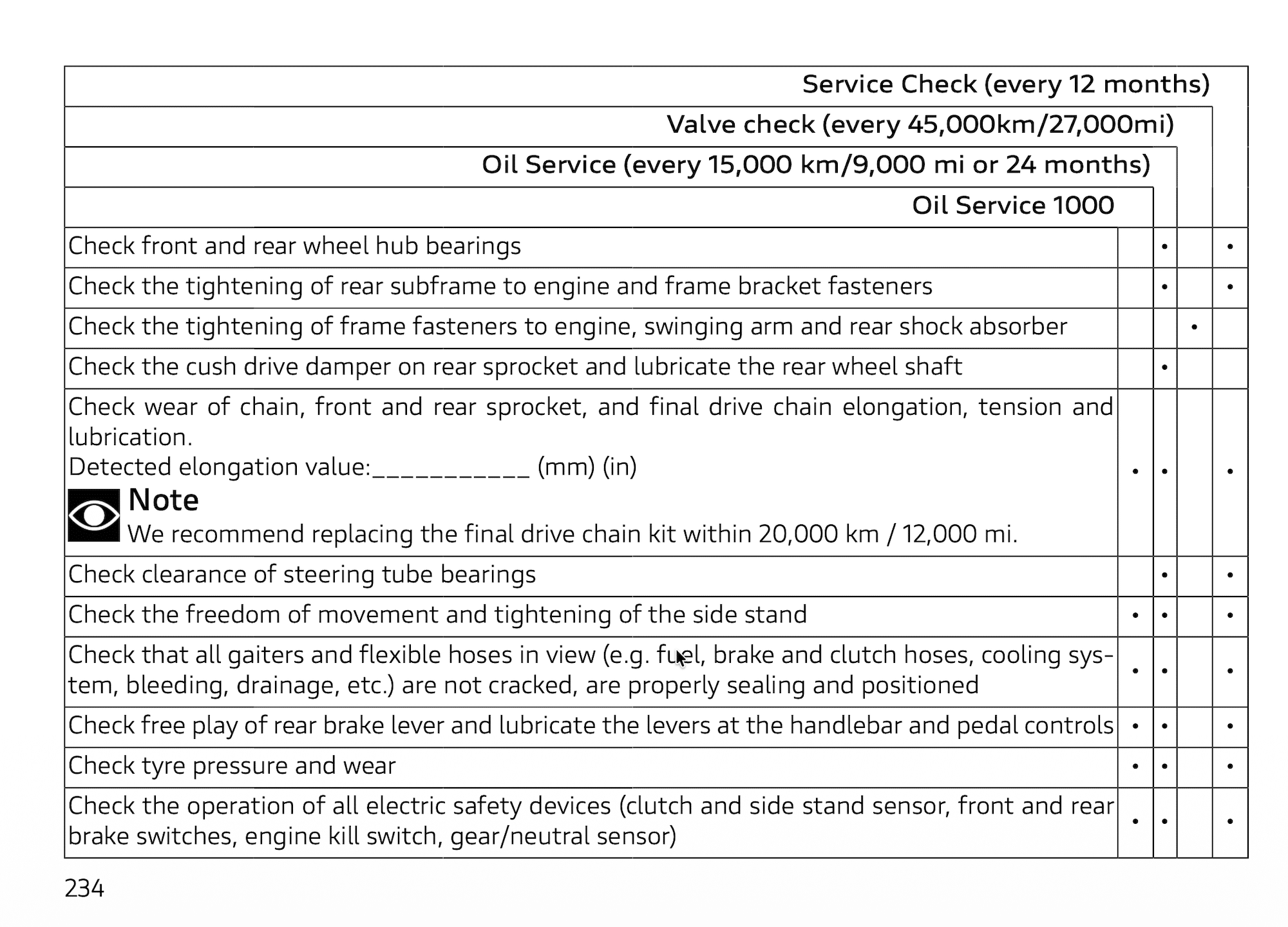


Here’s a copy of the 2026 Ducati Monster V2’s manual for reference.
You can download it from the Ducati website here.