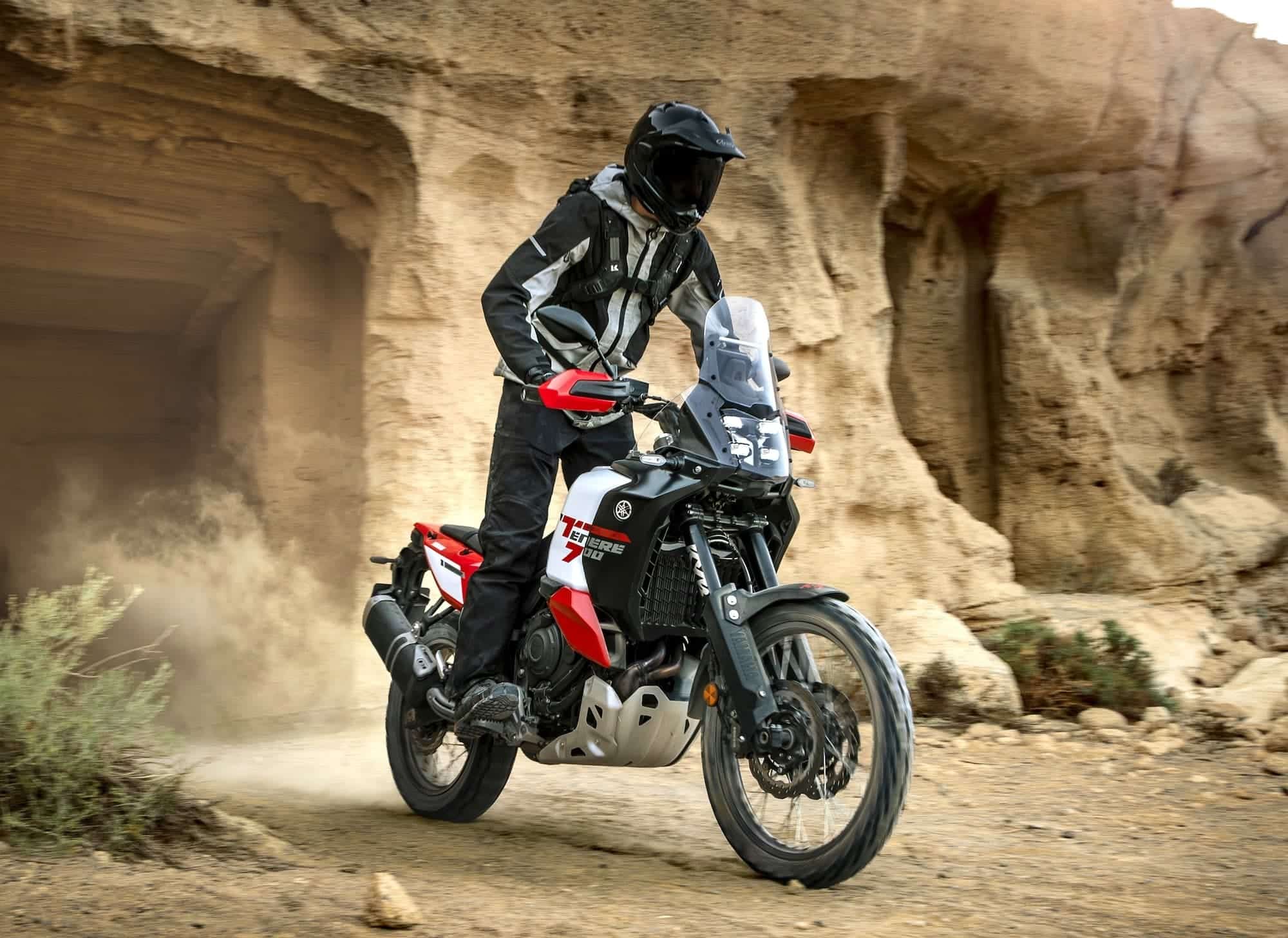
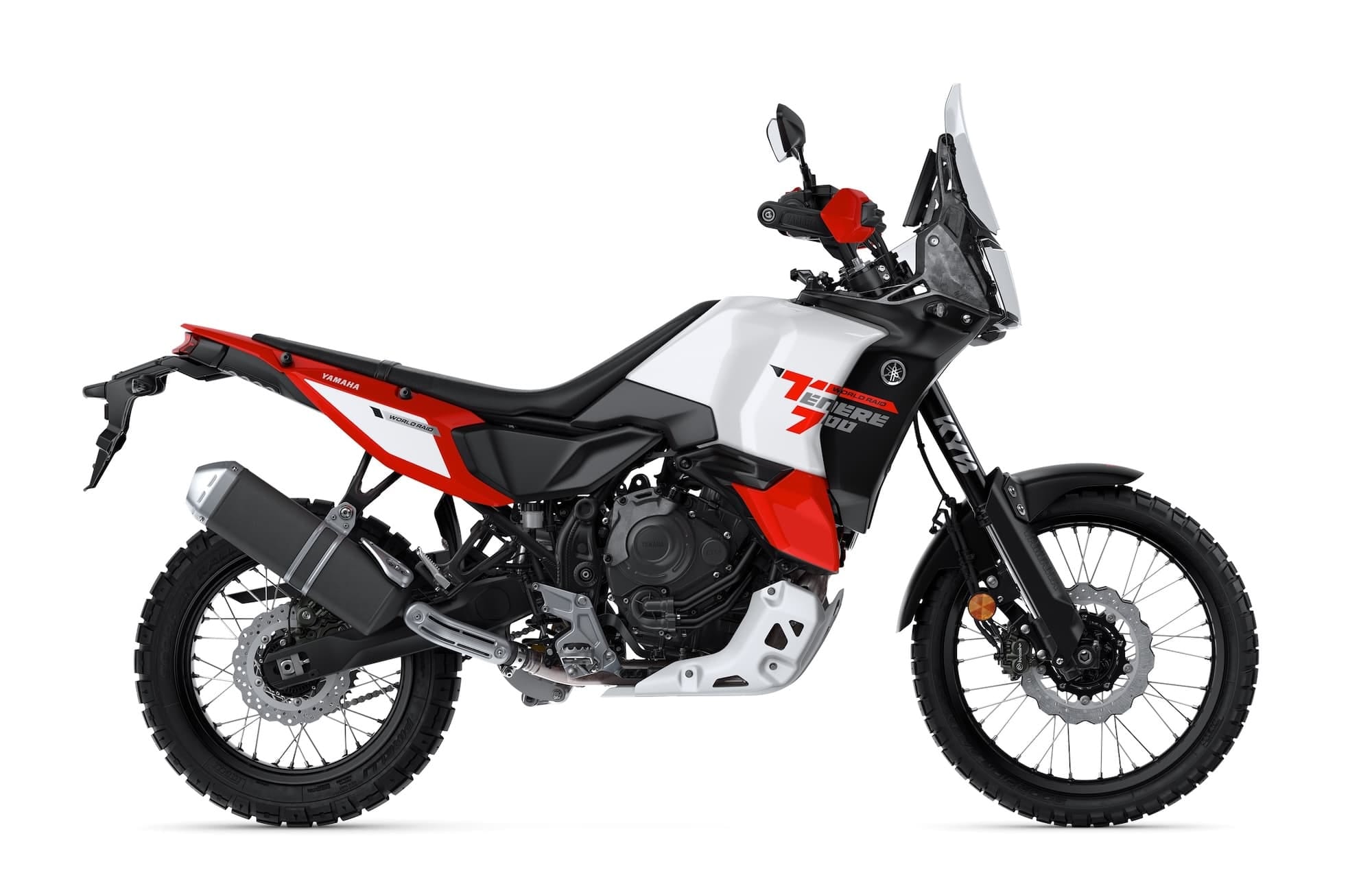
Yamaha Ténéré 700 World Raid (2026+) Maintenance Schedule and Service Intervals

This is the maintenance schedule and service intervals for the second-generation Yamaha Ténéré 700 World Raid, introduced for the 2026 model year. It covers the new ride-by-wire World Raid sold in Europe, Australia and the United States.
The 2026 World Raid still uses Yamaha’s 689 cc liquid-cooled CP2 parallel twin, six-speed gearbox and chain final drive. Yamaha kept the core service pattern but replaced the mechanical throttle cable with YCC-T electronic throttle control. That changes the throttle-related maintenance wording: the manual now calls for a throttle-grip operation check and lubrication of the grip housing guides, rather than throttle-cable free-play adjustment.
This page is specific to the 2026+ World Raid and its manual, including the scheduled steering-damper inspection. For the earlier family, use the 2019–2024 Yamaha Ténéré 700 maintenance schedule. The standard 2025 global / 2026 US Ténéré 700 is a separate model and is not covered here.
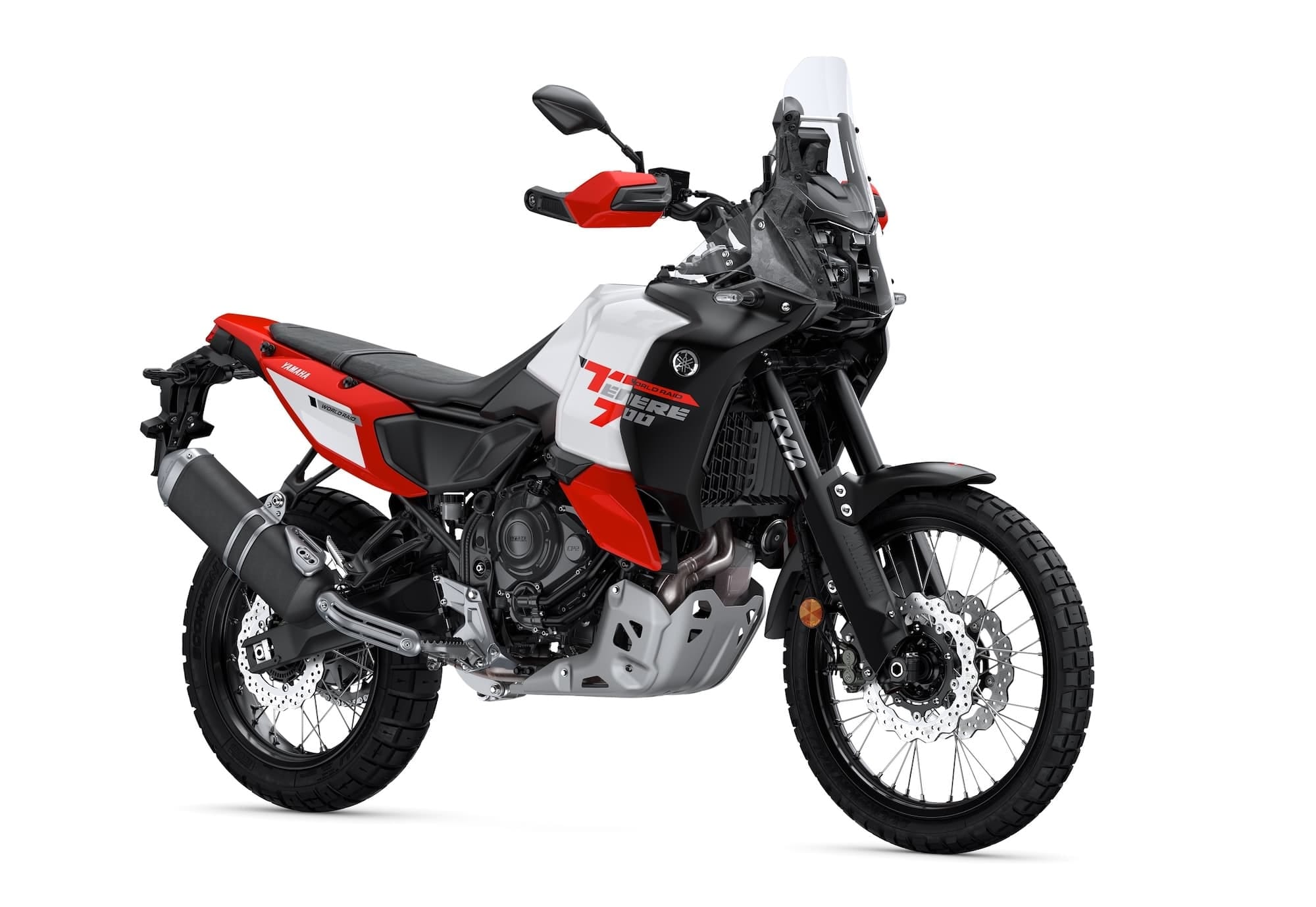
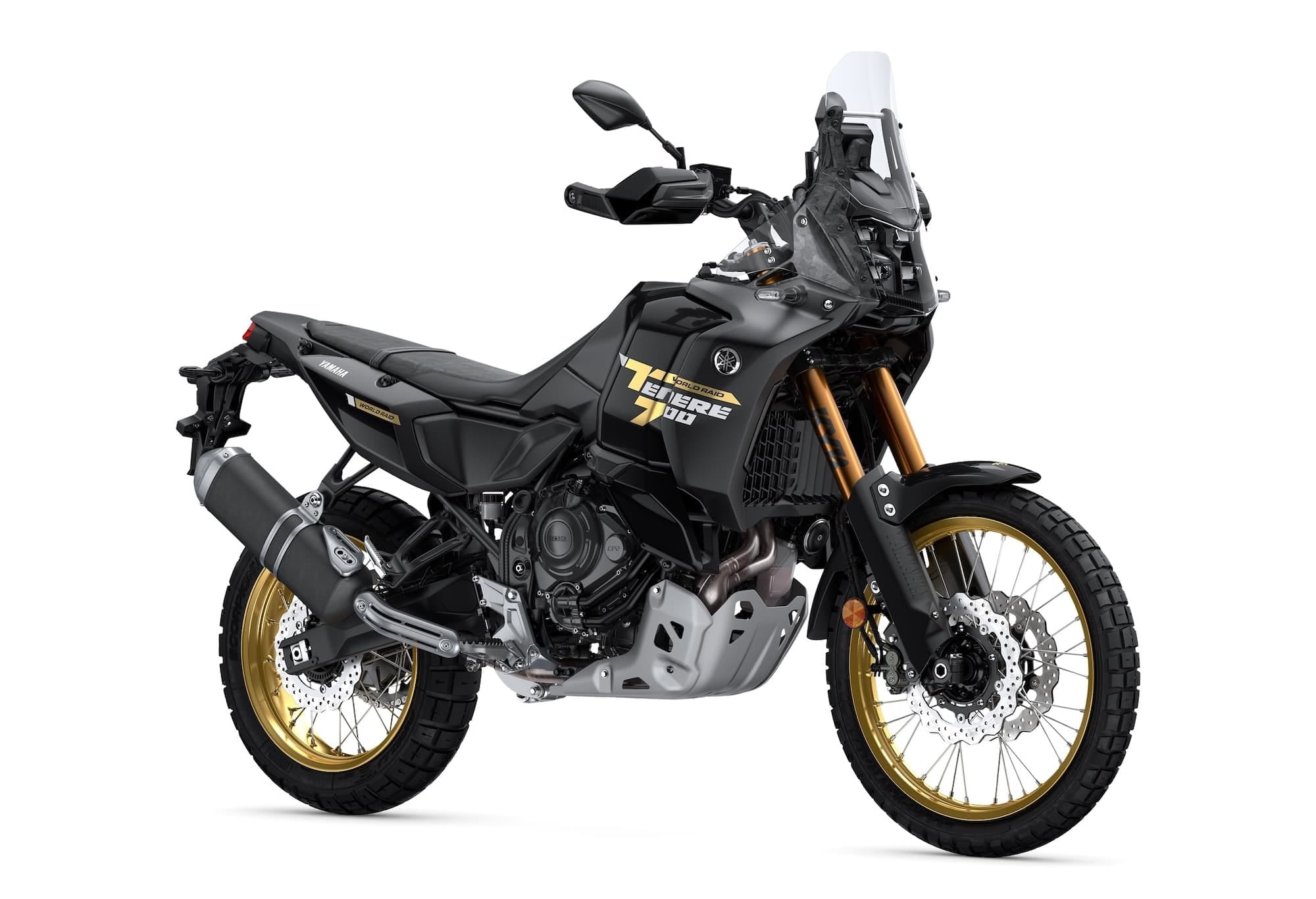
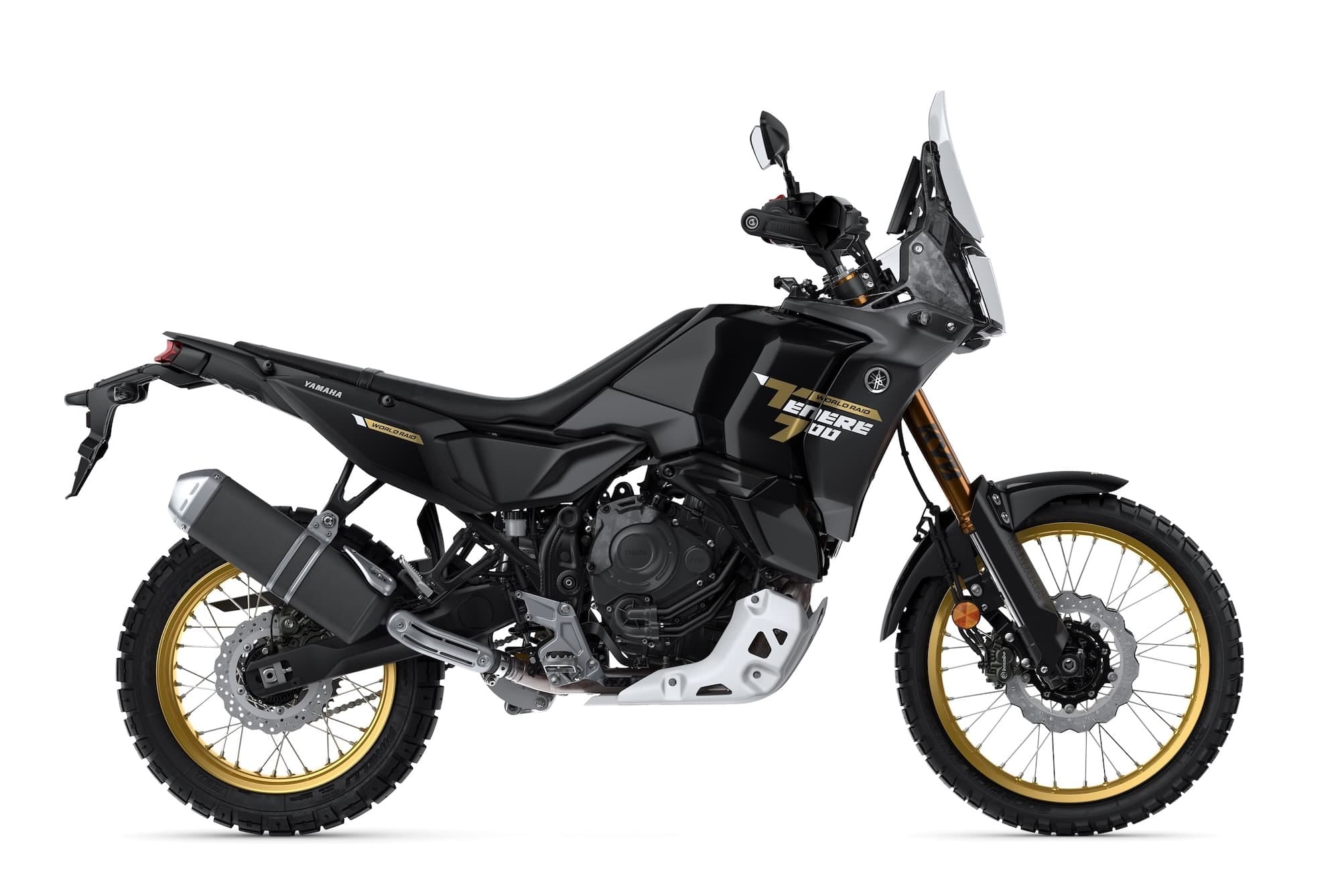
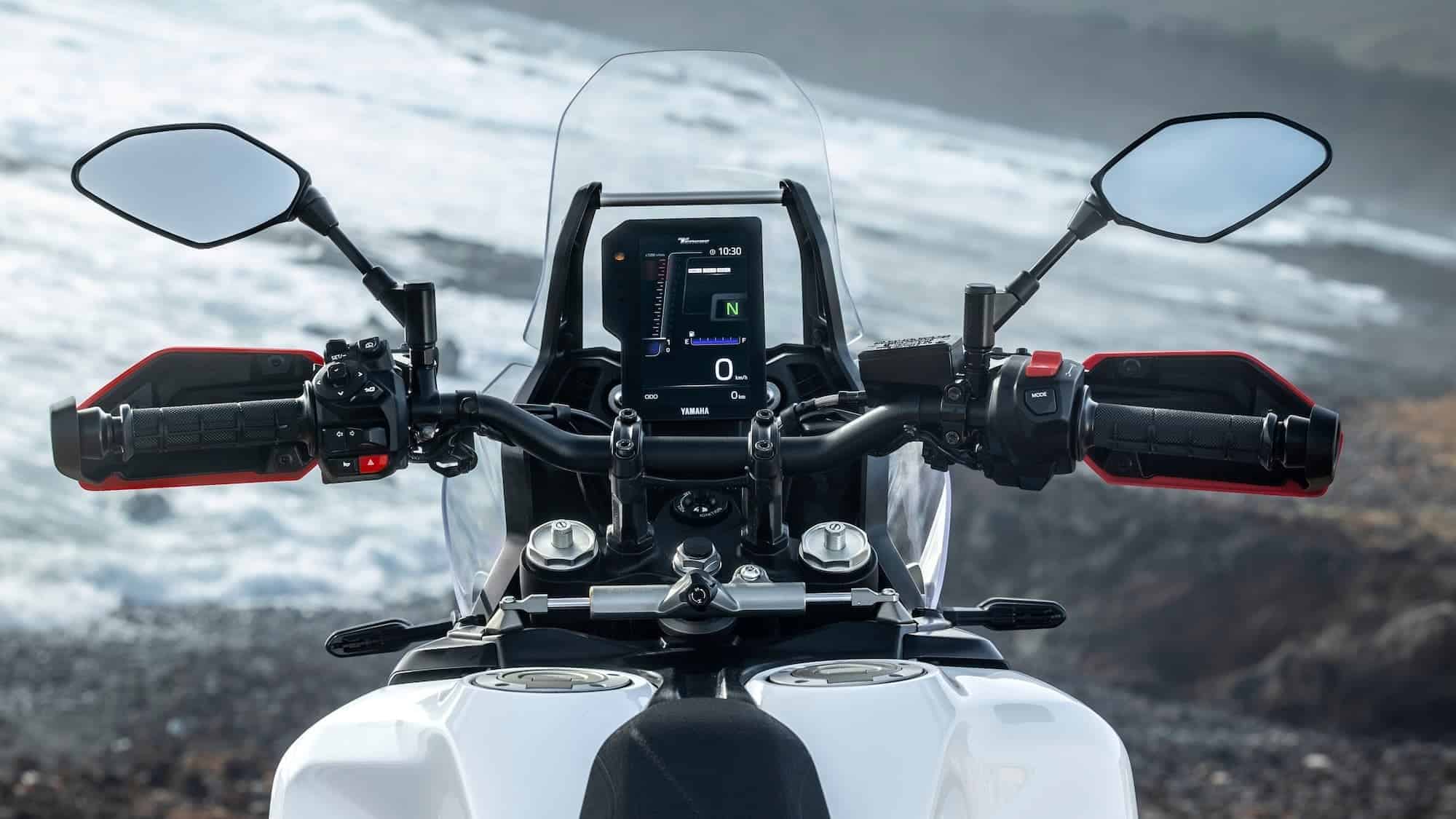


Yamaha Ténéré 700 World Raid Service Intervals
The first service is at 1,000 km (600 mi). After that, the supplied World Raid manual uses a 10,000 km (6,000 mi) or annual service interval, whichever comes first. From 50,000 km (30,000 mi), repeat the pattern from the 10,000 km service.
Change the engine oil at the first service and every 10,000 km (6,000 mi) or year. Replace the oil filter at the first service and every 20,000 km (12,000 mi). Inspect and adjust the valve clearances every 40,000 km (24,000 mi).
Replace the brake fluid every two years, brake hoses every four years and coolant every three years. Check and lubricate the drive chain every 1,000 km (600 mi), and after washing the motorcycle or riding in rain or wet conditions. Check chain slack before every ride.
Market note: The tables below follow the supplied international 10,000 km / annual World Raid manual. If the manual supplied with your motorcycle gives a different regional interval, follow that manual.
Maintenance Fluids and Lubricants
The supplied schedule names the service lubricants below. Use the oil, coolant and brake-fluid specifications printed in the owner’s manual supplied with your motorcycle; the schedule screenshots do not give their grades.
| Service point | Specified lubricant |
|---|---|
| Drive chain | Special O-ring chain lubricant |
| Swingarm pivot and suspension-link pivots | Lithium-soap-based grease |
| Brake lever pivot | Silicone grease |
| Brake pedal and clutch lever pivots | Lithium-soap-based grease |
| Sidestand | Molybdenum-disulfide grease |
Yamaha Ténéré 700 World Raid Maintenance Schedule
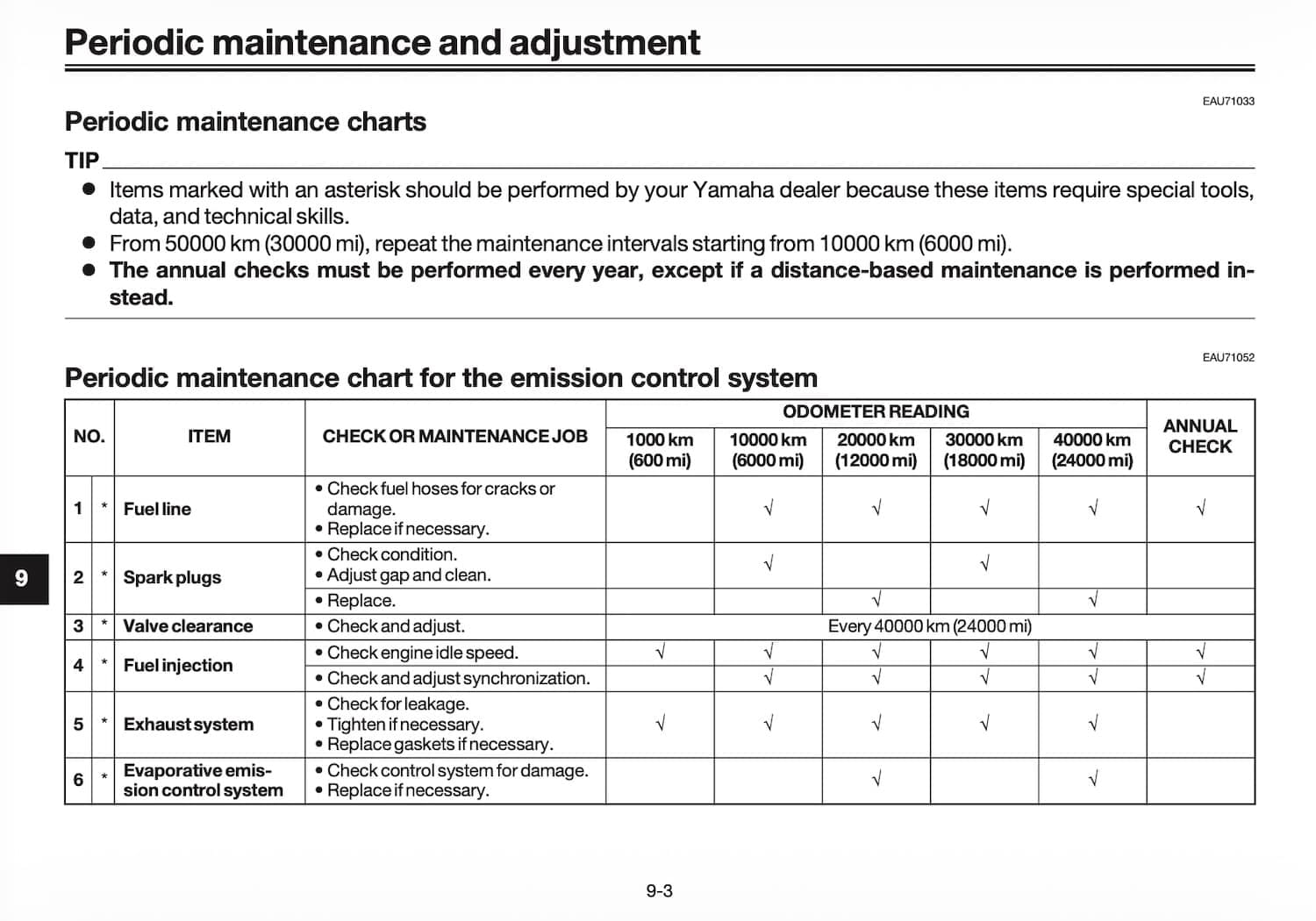
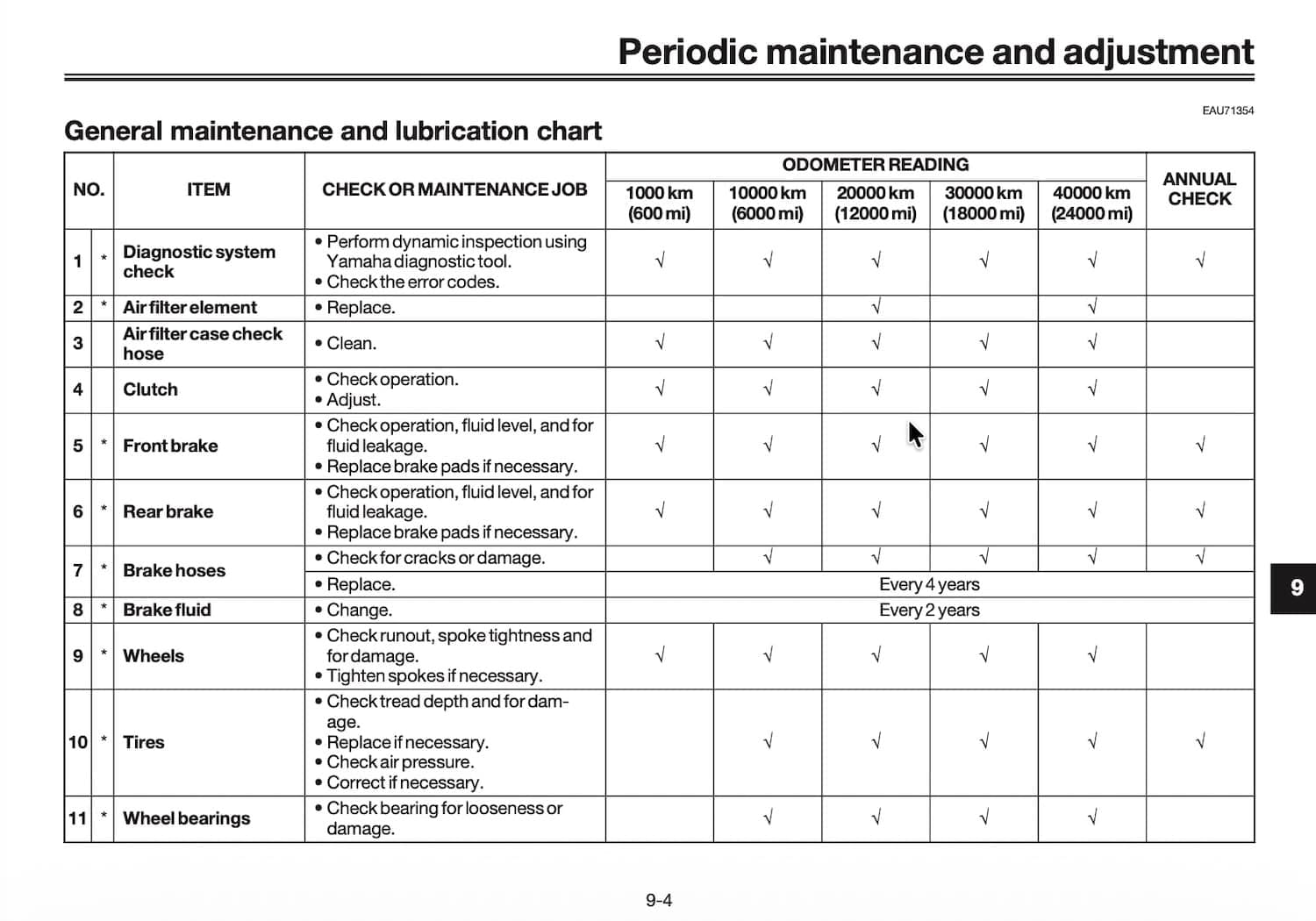
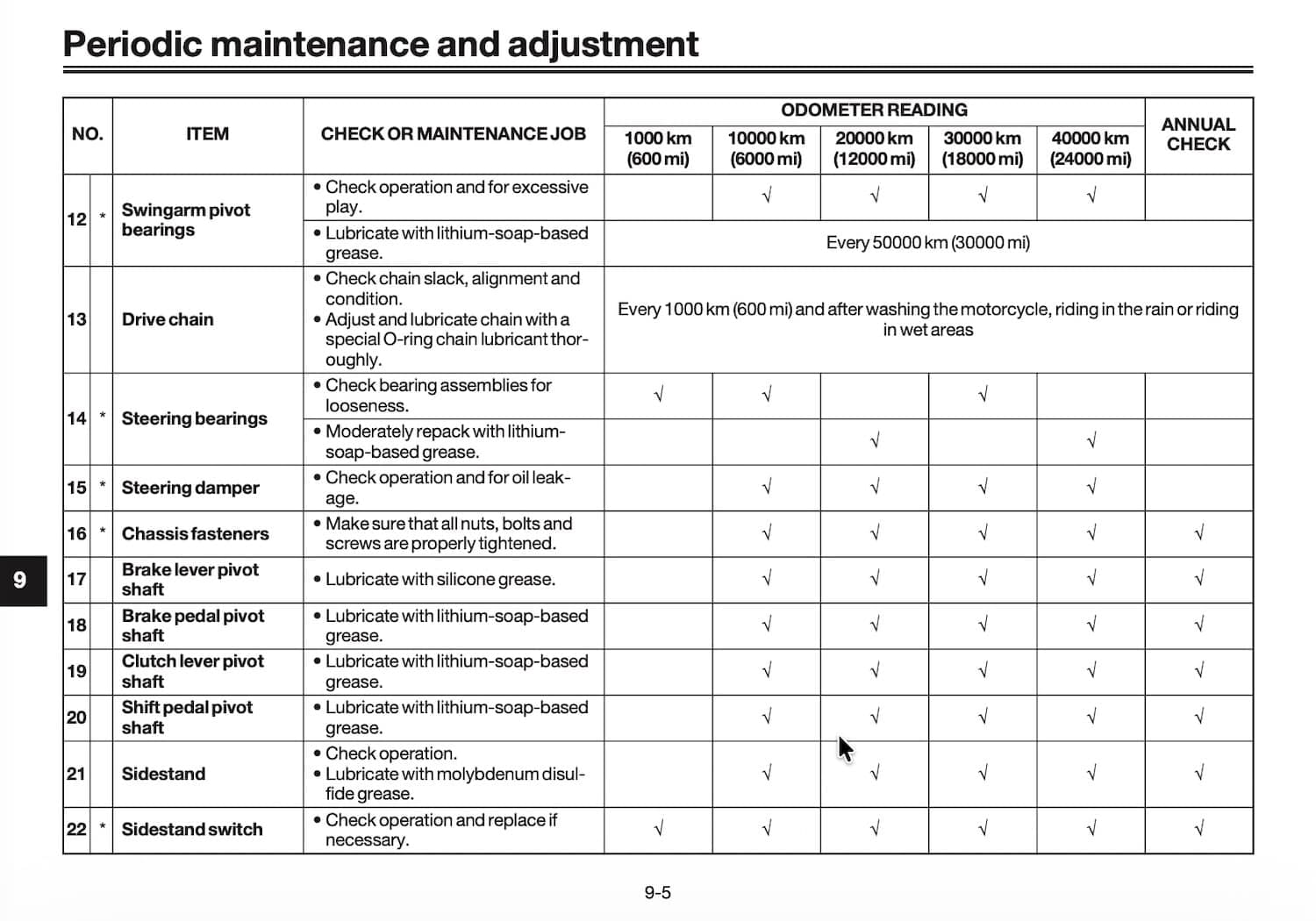
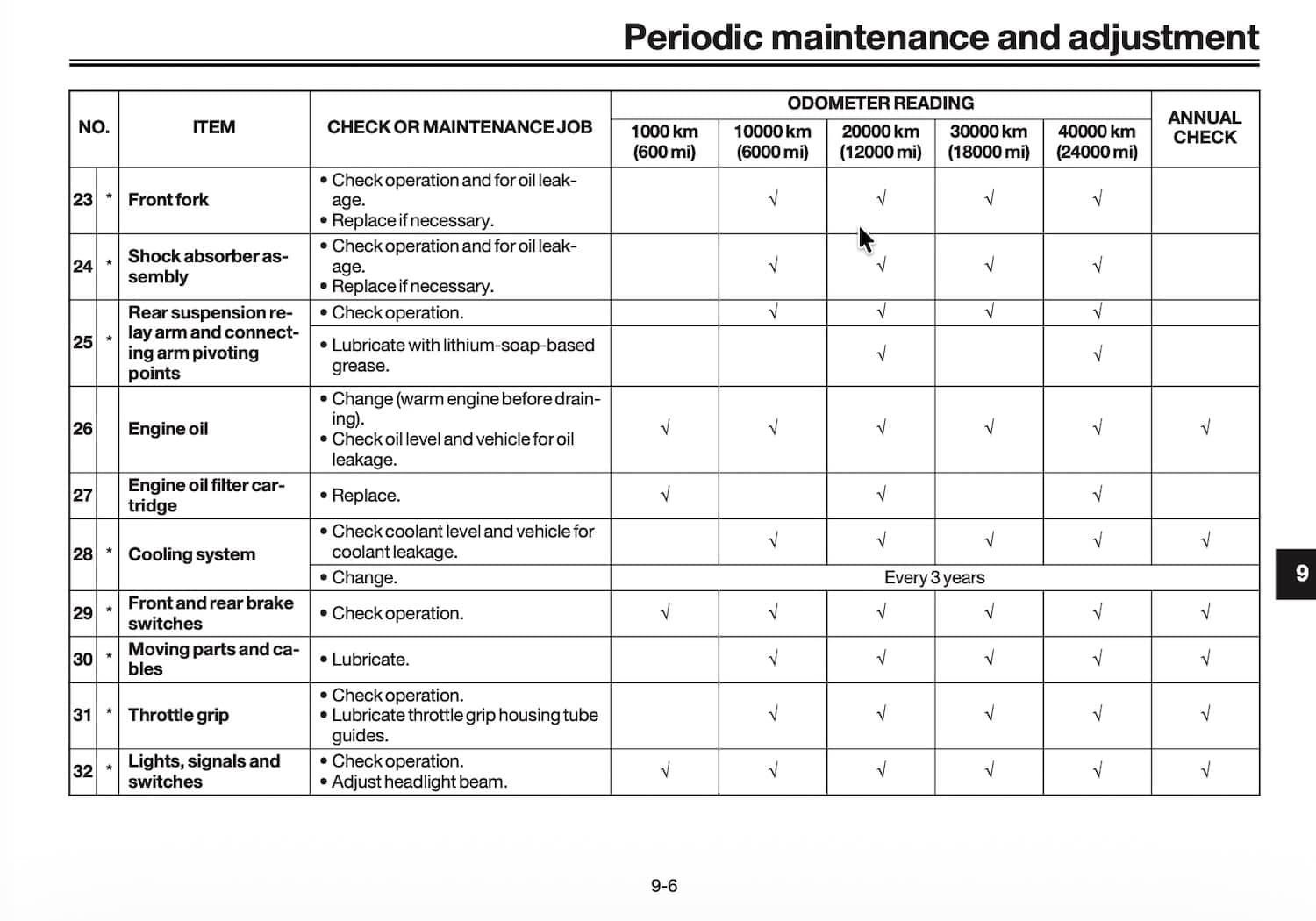
The tables below are adapted from the periodic-maintenance charts in the 2026 Yamaha Ténéré 700 World Raid owner’s manual. Items marked with an asterisk require dealer tools, data or technical skills according to Yamaha.
Replacement and Major-Service Intervals
| Maintenance item | Interval |
|---|---|
| Engine oil — change warm; check level and leaks | 1,000 km (600 mi), then every 10,000 km (6,000 mi) or annually |
| Engine-oil filter cartridge — replace | 1,000 km (600 mi), then every 20,000 km (12,000 mi) |
| Spark plugs — inspect, clean and adjust gap | 10,000 and 30,000 km (6,000 and 18,000 mi) |
| Spark plugs — replace | Every 20,000 km (12,000 mi) |
| Valve clearance* — check and adjust | Every 40,000 km (24,000 mi) |
| Air-filter element* — replace | Every 20,000 km (12,000 mi); inspect more often in dust or wet use |
| Brake fluid* — change | Every 2 years |
| Brake hoses* — replace | Every 4 years |
| Coolant* — change | Every 3 years |
| Swingarm pivot bearings* — lubricate | Every 50,000 km (30,000 mi) |
| Drive chain — inspect, adjust and lubricate | Every 1,000 km (600 mi), and after washing, rain or wet riding |
Periodic Inspection Checklist
| Inspection or maintenance job | When |
|---|---|
| Diagnostic system* — dynamic inspection with Yamaha diagnostic tool; check error codes | 1,000 km, every 10,000 km and annually |
| Fuel line* — inspect hoses; replace if needed | Every 10,000 km and annually |
| Fuel injection* — check idle speed | 1,000 km, every 10,000 km and annually |
| Fuel injection* — check and adjust synchronization | Every 10,000 km and annually |
| Exhaust system* — inspect for leaks; tighten and replace gaskets if needed | 1,000 km and every 10,000 km |
| Evaporative-emission control system* — inspect for damage | Every 20,000 km |
| Air-filter case check hose — clean | 1,000 km and every 10,000 km |
| Clutch — check operation and adjust | 1,000 km and every 10,000 km |
| Front and rear brakes* — check operation, fluid level and leaks; replace pads if needed | 1,000 km, every 10,000 km and annually |
| Brake hoses* — check for cracks or damage | Every 10,000 km and annually |
| Wheels* — check runout, spoke tightness and damage | 1,000 km and every 10,000 km |
| Tyres* — inspect tread and damage; check pressure | Every 10,000 km and annually |
| Wheel bearings* — check for looseness or damage | Every 10,000 km |
| Swingarm pivot bearings* — check operation and play | Every 10,000 km |
| Steering bearings* — check for looseness | 1,000, 10,000 and 30,000 km |
| Steering bearings* — moderately repack with lithium-soap grease | 20,000 and 40,000 km |
| Steering damper* — check operation and oil leakage | Every 10,000 km |
| Chassis fasteners* — check nuts, bolts and screws | Every 10,000 km and annually |
| Brake lever pivot — lubricate | Every 10,000 km and annually |
| Brake pedal, clutch lever and shift-pedal pivots — lubricate | Every 10,000 km and annually |
| Sidestand — check and lubricate | Every 10,000 km and annually |
| Sidestand switch* — check and replace if needed | 1,000 km, every 10,000 km and annually |
| Front fork* — check operation and oil leaks | Every 10,000 km |
| Shock absorber* — check operation and oil leaks | Every 10,000 km |
| Rear-suspension relay arm and connecting-arm pivots* — check operation | Every 10,000 km |
| Rear-suspension pivots* — lubricate | 20,000 and 40,000 km |
| Cooling system* — check coolant level and leaks | Every 10,000 km and annually |
| Front and rear brake switches* — check operation | 1,000 km, every 10,000 km and annually |
| Moving parts and cables* — lubricate | Every 10,000 km and annually |
| Throttle grip* — check operation; lubricate housing-tube guides | 1,000 km, every 10,000 km and annually |
| Lights, signals and switches* — check operation; adjust headlight aim | 1,000 km, every 10,000 km and annually |
Ride-by-Wire Maintenance Difference
The 2026 World Raid uses Yamaha Chip Controlled Throttle (YCC-T). The rider’s grip sends an electronic request rather than pulling mechanical throttle cables to the throttle bodies.
For maintenance, remove the old-generation throttle-cable free-play adjustment and cable-lubrication task. The current manual instead says to check throttle-grip operation and lubricate the throttle-grip housing-tube guides at the first service, every scheduled 10,000 km service and annually. The separate “moving parts and cables” task still applies because the bike retains other cables, including the clutch cable.
Drive-Chain Maintenance and Adjustment
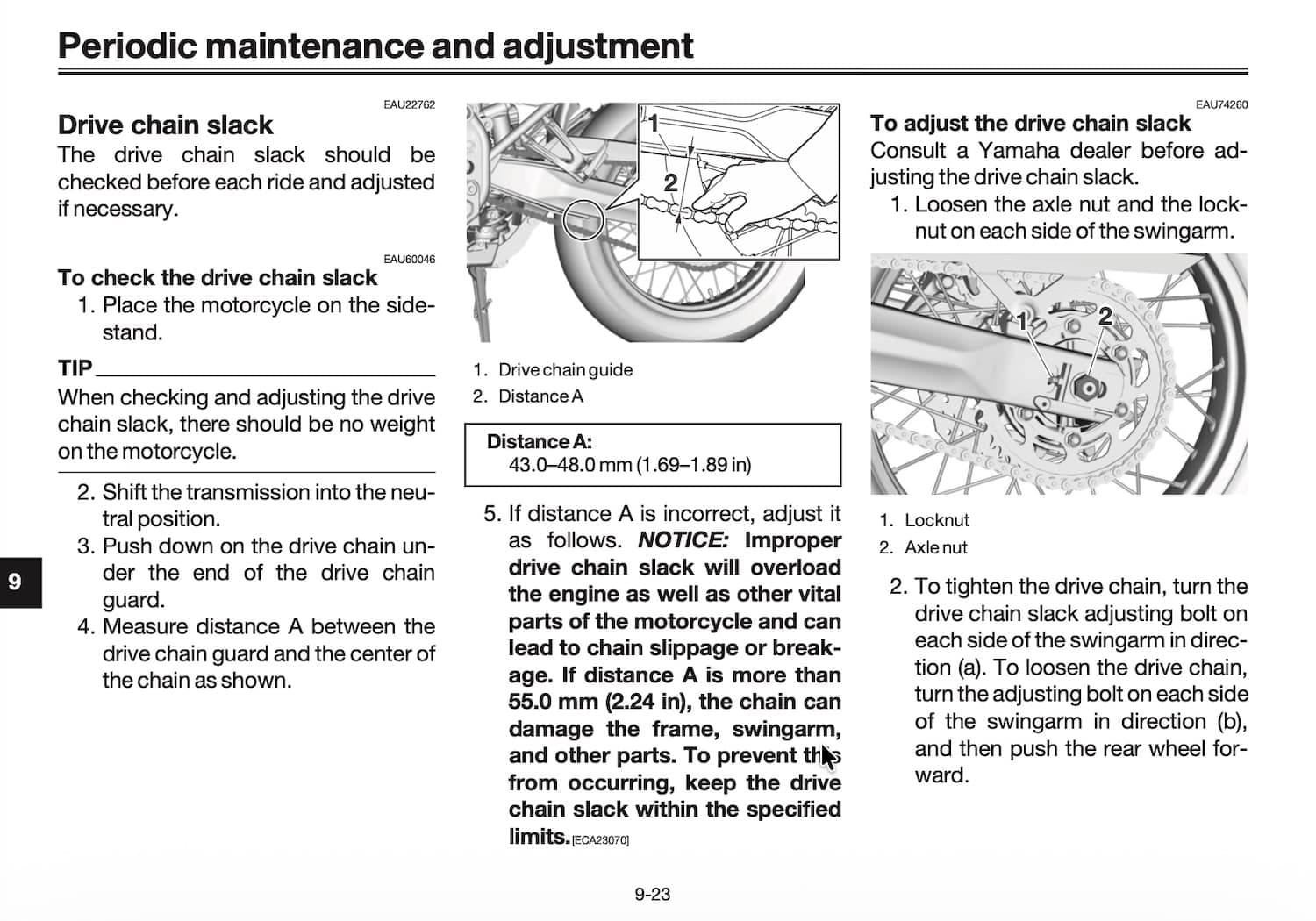
Check the drive-chain slack before every ride. The manual measures a vertical distance from the bottom of the chain guard to the centre of the lower chain run, not the chain’s total up-and-down movement.
| Chain specification | Value |
|---|---|
| Target distance A | 43.0–48.0 mm (1.69–1.89 in) |
| Maximum distance before damage risk | 55.0 mm (2.24 in) |
| Inspection / lubrication interval | Every 1,000 km (600 mi), and after washing, rain or wet riding |
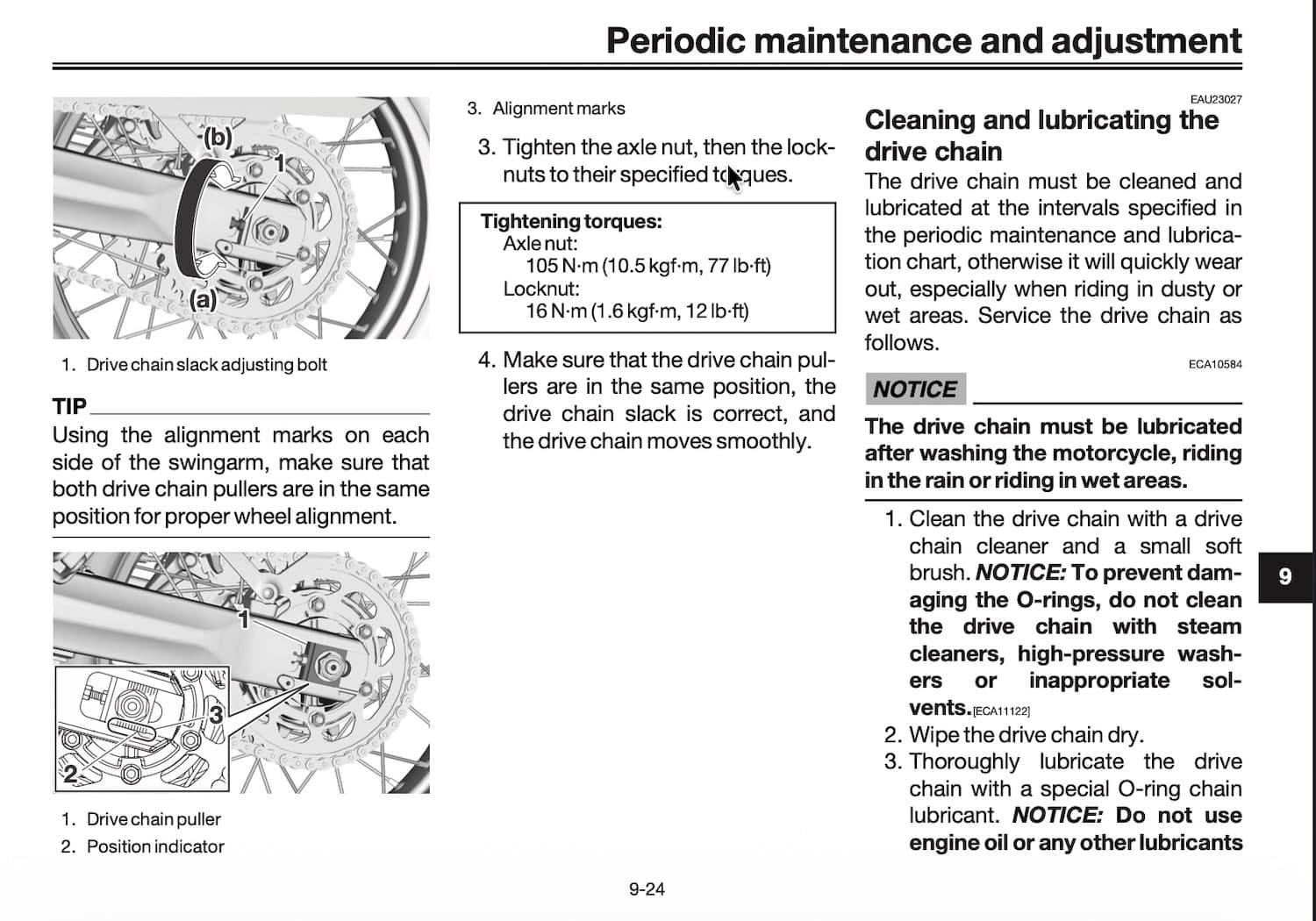
| Rear axle nut | 105 Nm (77 lb-ft) |
| Chain-adjuster locknuts | 16 Nm (12 lb-ft) |
How to Check Chain Slack
- Put the motorcycle on its sidestand with no added weight, and shift the transmission into neutral.
- Push the chain down under the rear end of the chain guard.
- Measure from the bottom edge of the chain guard to the centre of the chain. The target is 43.0–48.0 mm (1.69–1.89 in).
- If the measurement is outside the target, adjust the chain. Yamaha says to consult a dealer before making the adjustment.
How to Adjust the Chain
- Loosen the rear axle nut and the adjuster locknut on each side of the swingarm.
- Turn both drive-chain adjusting bolts evenly. Move the axle rearward to tighten the chain or forward to loosen it.
- Use the swingarm alignment marks to put both chain pullers in the same position.
- Tighten the axle nut to 105 Nm (77 lb-ft), then tighten both locknuts to 16 Nm (12 lb-ft).
- Check alignment, remeasure the slack and turn the wheel to confirm that the chain moves smoothly.
Clean the chain with chain cleaner and a small soft brush, wipe it dry, then apply a special O-ring chain lubricant. Do not use a steam cleaner, high-pressure washer, unsuitable solvent, engine oil or a general-purpose lubricant on the chain.
Tyre Sizes
The 2026 World Raid keeps the off-road-oriented 21-inch front and 18-inch rear combination. Check cold pressures against the tyre-information label and the manual supplied with your motorcycle, because the supplied schedule pages do not include pressure figures.
| Wheel | Tyre size |
|---|---|
| Front | 90/90-21 |
| Rear | 150/70 R18 |
About the 2026+ Yamaha Ténéré 700 World Raid
The 2026 World Raid is the second major version of Yamaha’s long-range Ténéré 700. Yamaha kept the 689 cc CP2 parallel twin, also used in the MT-07 and Tracer 7, along with the six-speed gearbox, chain drive and 21/18-inch wheels. Yamaha changed the intake and certified the engine to Euro 5+. It still makes its case through tractable low- and mid-range torque rather than peak power.
The biggest mechanical-control change is YCC-T ride-by-wire. It gives the World Raid two throttle maps, Sport and Explorer, and makes cruise control and a speed limiter possible. Yamaha also revised the clutch actuation and gearbox dogs and prewired the bike for an optional up-and-down quickshifter.
A six-axis IMU supports lean-sensitive traction control, slide control and brake control. You can choose three traction/slide settings, and the ABS menu has road, rear-off and fully-off modes. These electronics add diagnostic coverage, but the owner’s schedule does not add separate recurring service items for the ride modes or IMU.
The connected twin aluminium fuel tanks still hold 23 L (6.1 US gal), but Yamaha reduced their weight and moved the fuel pump lower. The narrow tank junction and flatter one-piece rally seat make it easier to move forward when standing, while the two fillers preserve the World Raid’s distinctive long-range layout.
Suspension is also different from both the previous World Raid and the current standard Ténéré 700. The World Raid has a 46 mm Kashima-coated KYB fork, 230 mm (9.1 in) of front travel, 220 mm (8.7 in) at the rear and a 16-position steering damper. That damper is why it appears as its own inspection item in the supplied maintenance schedule.
The 6.3-inch colour TFT has Street, Explorer and Raid layouts, smartphone connectivity and turn-by-turn navigation. Yamaha also added new switchgear, USB-C power, auto-cancelling indicators, a revised screen and wind deflectors, and steel-braided front brake lines.
Compared with the previous World Raid, the 2026 bike keeps the 23 L capacity, 220 kg (485 lb) published wet weight and 230/220 mm suspension travel. The larger 46 mm fork, revised rear linkage, 16-step damper, lighter tank assembly, one-piece seat, YCC-T and IMU-supported electronics are the meaningful changes rather than a new engine or a larger motorcycle.
World Raid vs Standard Ténéré 700
| Specification | 2026 World Raid | 2026 standard Ténéré 700 |
|---|---|---|
| Fuel capacity | 23 L (6.1 US gal), twin aluminium tanks | 16 L (4.2 US gal), single tank |
| Wet weight | 220 kg (485 lb) | 208 kg (459 lb) |
| Front suspension | 46 mm KYB; 230 mm (9.1 in) travel | 43 mm KYB; 210 mm (8.3 in) travel |
| Rear travel | 220 mm (8.7 in) | 200 mm (7.9 in) |
| Seat height | 890 mm (35.0 in) | 875 mm (34.4 in) |
| Electronics | Six-axis IMU, cornering rider aids, cruise control and speed limiter | YCC-T, two throttle maps, traction control and three-mode ABS |
| Steering damper | 16-position adjustable | Not fitted |
The World Raid therefore needs its own page even though much of the CP2 service cadence resembles the first-generation Ténéré 700 family. It has different chassis hardware, a steering damper and a specific manual. The standard second-generation Ténéré 700 should be checked against its own handbook rather than this World Raid table.
References — Screenshots from the 2026 Yamaha Ténéré 700 World Raid Owner’s Manual
The schedule, ride-by-wire maintenance wording, chain slack, adjustment procedure and tightening torques above were transcribed from the 2026 Yamaha Ténéré 700 World Raid owner’s manual. The untouched source pages are shown below.


For the complete handbook, use Yamaha’s official owner’s manual library. Yamaha’s 2026 World Raid launch information supplies the model-change details above.